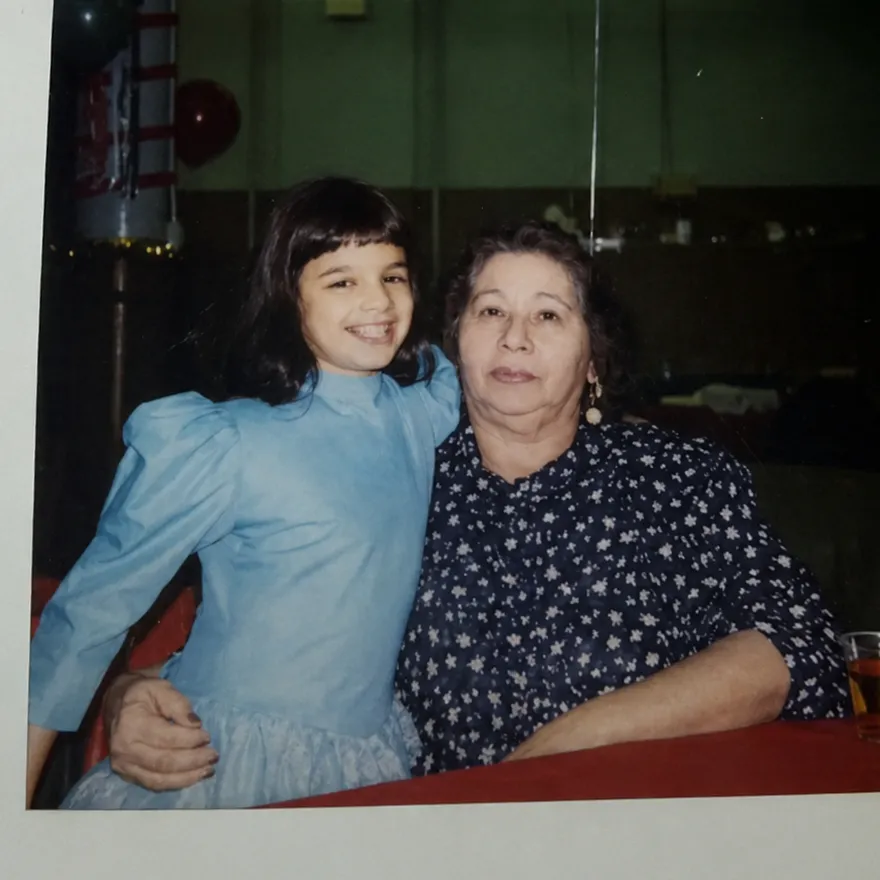
Jennifer Peña raced home from middle school on a Friday afternoon two weeks before Christmas 1999, trying to beat her 3:30 p.m. curfew at her family’s Soundview apartment in The Bronx.
She still remembers glancing at the clock.
3:14 p.m.
Inside, her adoptive mother, Antonia Peña, lay on the floor, facing the living room couch. Her father, Carlos Peña, was a few feet away.
Blood was everywhere.
The family’s new dog bounded into Jennifer’s arms.
Then she turned to the friend who had walked home with her and told her not to come inside. The two girls sprinted down the hallway and into a stairwell.
Jennifer, who was 13 at the time, called her brother-in-law, Serge Ruggio, sobbing so hard he struggled to understand what she was saying.
Jennifer was taken downstairs to the superintendent’s apartment. Hours later a local news broadcast confirmed what no one had yet told her: Her parents were dead.
“You always watch the news stories, and you’re like, ‘Wow, that sucks,’ but then you never really think that it’s going to be your story,” she told The City Reporter.
More than 26 years later, Jennifer Peña is being forced to relive that afternoon.

Jose Colon, the man who murdered her parents, is asking Gov. Kathy Hochul for clemency that would free him from prison after nearly three decades. Colon was 17 — just four years older than Jennifer — when he pulled the trigger.
Colon has an unlikely supporter in his bid: The now-retired judge who sentenced him to 30 years to life in prison now believes the punishment he imposed was too harsh.
Colon’s clemency petition sits at the intersection of several volatile and contentious debates: how society should punish teenagers who commit violent crimes, what role rehabilitation and remorse should play after decades in prison, and when mercy is appropriate for someone convicted of murder.
“Generally, we incarcerate for three reasons: to incapacitate someone, to deter crime and for retribution,” said Cara Drinan, a professor at Catholic University of America’s Columbus School of Law who specializes in juvenile sentencing. “When it comes to youth crimes, none of these rationales support lengthy sentences.”
The Colon case is one of hundreds in New York where people serving long sentences for crimes committed in their youth are seeking clemency. Supporters contend decades behind bars justify a second chance. They also cite research showing the risk of a released inmate committing a new crime drops sharply with age.
“It’s rough, because as a Christian, I am told that he should be forgiven, you know, to let it go for my own personal sake, so I do adhere to that,” Jennifer said. “But as far as second chances go, it’s hard because he took a lot. He took more than just two lives. He ruined the lives of a whole family.”
‘I Was Terrified’
Jennifer had been adopted by the Peñas as a toddler after first arriving in their home as an emergency foster placement. The couple regularly opened their apartment to children removed from abusive homes, her brother-in-law Ruggio said, and eventually adopted Jennifer as their own.
The killings upended everything.
Jennifer stopped going to school for a time and eventually was adopted by her sister Emmy and her husband Ruggio. She struggled with depression, distrust and recurring nightmares. She never received any meaningful counseling.
The nightmares were the worst.

“I was terrified that he would come find me, because I’m the one that called the police,” she said. “That’s still something that bothers me.”
Another worry: Colon was a member of the Latin Kings street gang, which had members in New York and Florida.
“How do I know he’s not going to come after me and my family?” she asked. “That could be farfetched, but that’s what my brain thinks about.”
The family eventually moved to Florida. Jennifer joined the Air Force, where she said she “felt safe,” before leaving for medical reasons.
“So since then I’ve just kind of been living,” she said, “always looking over my shoulder, in a sense, looking over my kids’ shoulders too.”
‘I Don’t Have the Answer’
Jennifer has spent more than two decades trying to understand how one afternoon changed her life.
Jose Colon has spent nearly three decades trying to understand why he shot her parents.
Recently, he sat in a sparsely furnished conference room with no air conditioning inside Sing Sing prison in Westchester County.
His eyes welled up as a reporter told him about Jennifer’s ordeal.
“I have a daughter now and would never want her to see something like that,” he told The City Reporter during an extensive interview inside the 200-year-old prison.
Bald and soft-spoken, Colon sounds more like a middle-aged father than the teenager prosecutors described nearly three decades ago.

Colon said he and his accomplice, David Rodriguez, didn’t even have bus fare that rainy Friday. They slipped onto a Bx39 through the back door.
Colon knew the Peñas’ apartment building well. His aunt lived there and he knew the basement entrance was often left unlocked.
A week earlier, he had tagged along with a friend who had bought jewelry from Carlos and Antonia Peña, who used a folding cart to sell inexpensive baubles to local shops and buyers. Antonia, who was battling cancer, also babysat the couple’s grandchildren.
Rodriguez rang the Peñas’ doorbell and asked for a random, fake person, Ashley.
For a moment, Colon “froze,” as he and Rodriguez talked it over by the staircase after the Peñas at first failed to open the door, he recalled.
Rodriguez tried to persuade him to leave — twice.
Colon, armed with a sawed-off .22 caliber rifle, ignored his pleas and kicked through the door as Antonia opened it, shooting her in the stomach. Carlos, startled, came out of the bedroom in the back with his coat on.
Colon shot him in the neck.
Colon and Rodriguez then went to the kitchen where the family’s money and jewelry cart were stored.
“We put everything that was on the table into a bag,” Colon recalled, adding that he shot Antonia a second time on their way out.
Right after, he got “lightheaded,” his vision turned yellow and he became nauseous.
“I knew immediately that I had fucked up,” he said. “I don’t know how to explain the feeling.”
That night, they went to a Sweet 16 birthday party, where Rodriguez gave his girlfriend one of the stolen rings and talked about the murder with friends.
Police arrested Rodriguez and Colon the next day.
“A lot of people called the precinct because of us,” Colon said. “Sometimes I sit here and think about that. Did I just think it was business as usual? That nobody cares?”
“I went to the extreme for no reason at all,” he added. “I just don’t have the answer. I don’t want to make something up either.”
‘It Was Fights Every Day’
Colon never went to trial and admitted to police he was the sole shooter responsible for the immigrant couple’s death.
His grandfather, who was his stand-in father figure, didn’t talk to him for the next five years.
The murder was the culmination of a childhood marked by instability, untreated mental health struggles and repeated separation from the adults in his life.
Colon was born in The Bronx to a 15-year-old mother. His biological father left when he was two years old. For much of his early childhood, Colon was raised by his grandparents while his mother worked long hours. He said he later had a tumultuous and often violent relationship with his stepfather.
Around age six, Colon began experiencing involuntary facial and hand tics and explosive outbursts. Doctors diagnosed him with Tourette syndrome and prescribed him medication, but the side effects were difficult to manage, according to medical records included with his clemency petition. Over the next several years, he was evaluated by multiple neurologists and psychiatrists, suspended from school repeatedly and eventually placed in special education.
Colon said the tics made him the target of relentless bullying, leaving him depressed, ashamed and increasingly angry. He clashed with classmates, teachers and family members.
“Every year, I was in a different borough,” he recalled. As a rare Latino student during a stint at a Brooklyn elementary school, “It was fights every day, fights every day, fights every day.”
His mother would take the train with him to school when he was enrolled in Manhattan. But as soon as she left, he’d just take the opposite train back to The Bronx, he recalled.
“I’d take the train from Parkchester to the Brooklyn Bridge,” he remembered. “I’d be on the train all the time.”
When Colon was 13, his mother filed a Person in Need of Supervision petition, and a family court judge sent him to a residential treatment school in Westchester County, where he remained for more than three years.
“I’ve never made it back home,” Colon said from Sing Sing as his eyes became watery.
He viewed the placement as abandonment by his mother. Colon returned home at 15, but stayed only a few months before his stepfather forced him out. Following a juvenile assault conviction, he spent nine months at Spofford Juvenile Center, a notorious facility that closed in 2011. Mike Tyson, the famous boxer, did time there as a young person.
A ‘Chilling’ Confession
When Colon was released at 16, he relied on friends’ families for a place to sleep.
One of those friends was David Rodriguez. Colon had moved in with Rodriguez’s family just a week before the robbery that ended with Carlos and Antonia Peña dead.
Colon’s clemency application argues that his troubled childhood wasn’t the only factor overlooked during his prosecution and sentencing. After Colon pleaded guilty to two counts of second-degree murder in exchange for a sentence of 30 years to life, a new attorney unsuccessfully sought to withdraw the plea, arguing critical mitigating evidence of Colon’s psychiatric history and treatment had not been presented to the court.
The application also argues that State Supreme Court Justice William Mogulescu misinterpreted Colon’s demeanor after the killings. Mogulescu described Colon’s videotaped confession as “chilling” because he appeared emotionless, viewing it as evidence of a lack of remorse. Colon’s attorneys now contend his flat affect reflected psychological detachment and the still-developing brain of a 17-year-old rather than an absence of remorse.
Supporters say Colon’s prison record tells the story of a man who bears little resemblance to the teenager who burst into the Peña family’s apartment.
His clemency application points to a cognitive behavioral program he created to help prisoners confront the harm they caused and mentor teenagers in hopes they avoid making the same choices he did.

While locked up, Colon earned his GED and enrolled in college, earning an associate’s degree in behavioral science earlier this summer.
His disciplinary record, however, reflects a more fraught path.
State Department of Corrections records show Colon accumulated numerous infractions during his first two decades in prison, including several violent incidents that resulted in solitary confinement. His last serious infraction came in 2021, after what he described as a fight in self-defense. According to his clemency application, he has remained infraction-free for the past five years.
Today, Colon works as a clerk in Sing Sing’s education department, where he mentors other incarcerated students, oversees the prison library and helps manage academic records.
His clemency application also points to repeated commendations from prison staff, including for helping extinguish a fire set by another inmate, volunteering in the prison’s hospital and helping clean cells during the COVID-19 pandemic, when 45 state inmates died from the coronavirus.
Colon’s supporters say perhaps the clearest evidence of who he has become isn’t found in certificates or commendations but in the family he built from inside prison walls.
He married Janette “Jeannie” Colon in 2011, after the two rekindled a friendship that dated back years. More than a decade later, they reconnected after Colon began writing to her with questions about the Yoruba religion. The letters turned into phone calls, then prison visits, and eventually a relationship.
Colon, who has no biological children, became a father figure to Jeannies’ young daughter Bryanna from behind prison walls. He sent her drawings and birthday cards, carved out time for every phone call and helped make parenting decisions, according to his wife.
“He won Bryanna’s heart over, just like mine,” she wrote in his clemency application. “We were simply meant to be a family.”
His clemency application faces steep odds.
Since first taking office in August 2021, Gov. Hochul has granted clemency — in the form of a sentence commutation — to 19 people. She’s currently running for re-election.
An ‘Excessive’ Sentence?
Justice Mogulescu, now retired, remembers little about the plea negotiations that unfolded in his courtroom more than 25 years ago.
What he does know is this: He would not impose the same sentence today.
“I believe that the sentence of 30 years to life imposed on a 17-year-old was excessive,” Mogulescu wrote in a letter supporting Colon’s clemency application.
Mogulescu said Colon’s extensive mental health history was not fully presented to him before sentencing because prosecutors and defense attorneys had already negotiated a plea agreement.
“It was not my place to kind of say, ‘What are you, some kind of asshole?’” he told The City Reporter, describing his reluctance to second-guess the defense counsel’s strategy.
Since Colon’s sentencing, the U.S. Supreme Court has repeatedly recognized children should be treated differently from adults in criminal punishment, citing research showing adolescents are more prone to impulsivity, risk-taking and poor judgment.

Asked whether he regrets the sentence today, Mogulescu didn’t hesitate.
“It hasn’t been a highlight of my life,” he said. “I think it’s appropriate for that sentence to be adjusted.”
Under current New York law, however, judges have no power to revisit a sentence once it’s imposed. Only Hochul can shorten it through executive clemency.
That’s one reason supporters of a proposed law called the Second Look Act want judges to have the authority to reconsider lengthy prison sentences after people have served years behind bars.
“This is exactly the kind of case second look legislation was designed for,” said Marta Nelson, director of the Sentencing Reform Initiative at the Vera Institute of Justice. Colon committed the crime at 17, an age when research shows people are more impulsive and susceptible to peer pressure, she said. The question decades later is whether continued incarceration remains “in the interest of justice.”
Nelson, who reviewed clemency cases during the Cuomo administration, said the question is whether “the sentence is still appropriate for who this person is now.”
The case also underscores how little support many victims receive once the criminal case ends.
For example, Colon wrote a letter years ago accepting responsibility for the killings and expressing remorse through the state’s Apology Letter Bank, which allows incarcerated people to submit notes that victims or their families can choose to receive if they wish.
But Jennifer said she never knew Colon’s letter existed.
Under DOCCS policy, victims are notified only if they are registered with the agency’s Office of Victim Assistance.
She also said no one ever told her about New York’s restorative justice programs, which allow victims and offenders to voluntarily meet in a carefully facilitated setting if both sides agree — though she isn’t sure she would ever want such a meeting.
Not everyone believes Colon deserves another chance.
Serge Ruggio, Jennifer’s brother-in-law, who became her guardian after the killings, says Colon should spend the rest of his life behind bars. To him, no amount of rehabilitation can erase what happened that afternoon in The Bronx.
“To the day I die, I will fight this,” Ruggio, a former NYPD homicide detective, told The City Reporter.
Ruggio said the robbery showed planning, not youthful impulsiveness. What happened next has stayed with him for more than a quarter-century.
According to Ruggio, after shooting Carlos and Antonia Peña, Colon and his accomplice stepped over their bleeding bodies, rifled through the apartment and stole the folding jewelry cart Antonia used to sell inexpensive trinkets in neighborhood beauty salons and flea markets in the weeks before Christmas.
Jennifer discovered the bodies about 90 minutes later.
“She was hysterical,” Ruggio recalled. “I could barely understand what she was saying.”
Ruggio rushed from Manhattan, arriving before detectives assigned to the case. He said years of investigating violent crime did little to prepare him for seeing members of his own family lying dead.
“What I saw was horrendous,” he said. “I was a homicide detective. But seeing your own family there was different.”
Ruggio said he has no objection to clemency in appropriate cases. He pointed to people serving lengthy drug sentences and others whose punishments no longer fit today’s standards.

But, he said, this case is different.
“This wasn’t a burglary that went bad,” he said. “This was a brutal, premeditated double murder.”
For Ruggio, the question isn’t whether Colon has changed — it’s whether that change can ever outweigh the devastation he left behind.
Ruggio recalled spending the weeks before Christmas planning two funerals instead of celebrating the holidays. He remembered having to tell his young children that the beloved grandparents who watched them while he worked would never be coming home. He watched his wife, Emmy, struggle with grief for years, consumed by questions of what she might have done differently that day.
Emmy never fully recovered from losing her parents, Ruggio said. She died years later after battling cancer, leaving Jennifer and the rest of the family carrying scars he says will never disappear.
Ruggio said he hopes Colon has found remorse and faith during his decades in prison. But he drew a sharp distinction between redemption and clemency.
“That’s between him and God,” Ruggio said. “I hope he does find remorse. I hope he does find God. But as for clemency, this is not a clemency case.”
Even if Hochul rejects the petition, Colon is expected to become eligible for parole in 2029, when Jennifer Peña and Serge Ruggio will again have an opportunity to register opposition if he applies to the state Parole Board for supervised release.
Michael Jacobson, a former New York City corrections commissioner and a leading criminal justice scholar, said he understands why victims’ families often oppose clemency and believes their voices should carry significant weight.
But, he said, the government represents “a variety of interests” and ultimately has to decide not only what a person deserves, but what purpose continued punishment serves.
“At some point, the state has to ask itself the question: What’s the point after 25 years?” Jacobson said. “He’s already had an unbelievable amount of punishment.”
Our nonprofit newsroom relies on donations from readers to sustain our local reporting and keep it free for all New Yorkers. Donate to THE CITY today.
The post Judge Who Sentenced ‘90s Teen Killer Now Wants Him Freed appeared first on The City Reporter.