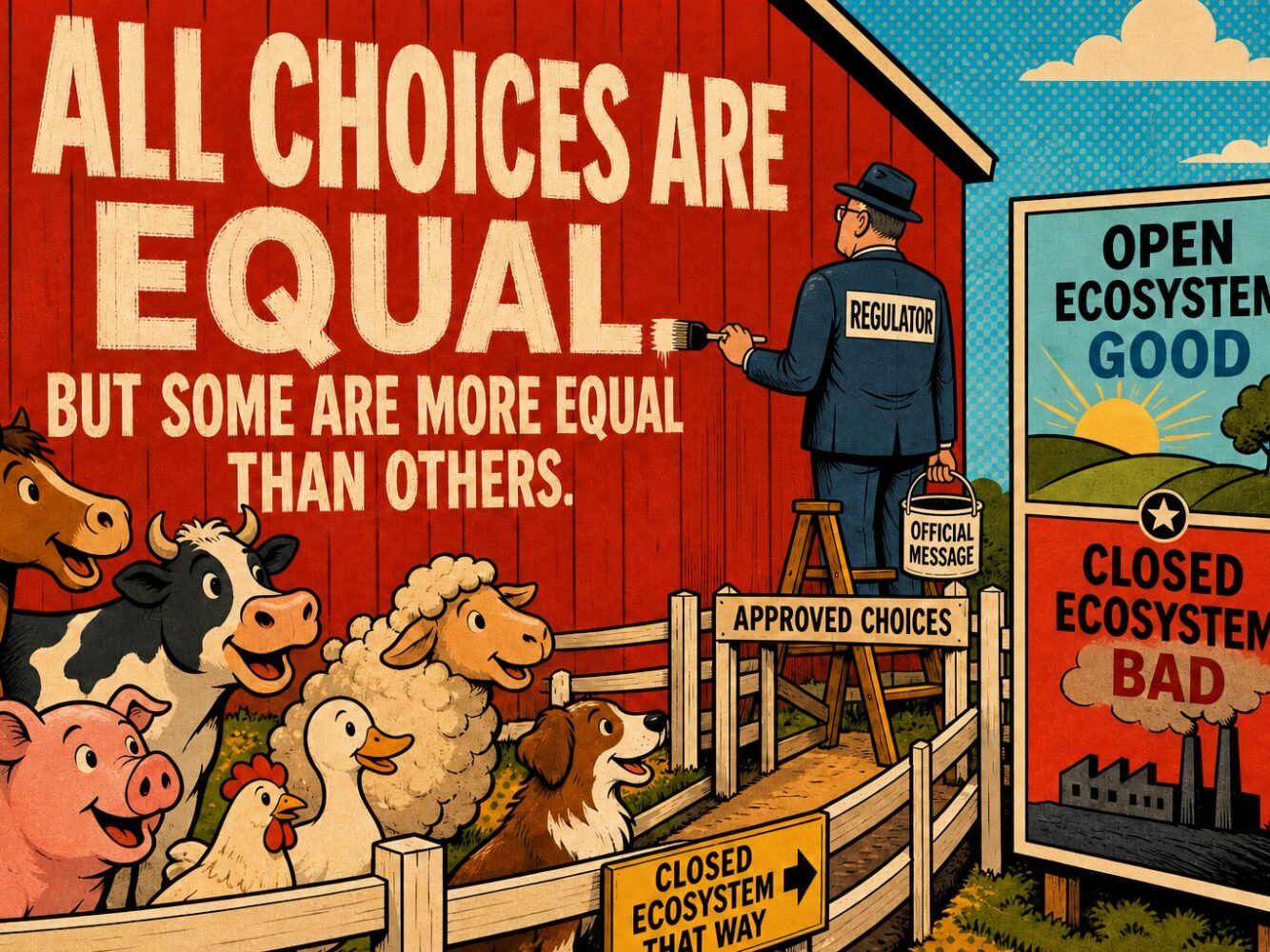
Under the Digital Markets Act (DMA), consumers are apparently sovereign—right up until they choose the wrong thing.
When Mozilla reports that Firefox is now selected through a DMA browser-choice screen once every 10 seconds—more than 6 million selections in total, with daily active iOS users 113% higher in the European Union than they would have been absent the regulation—the result is treated as proof that the DMA is working. Consumer choice has spoken.
When fewer than 1% of Meta users chose its new paid, ad-free subscription option—introduced largely to comply with DMA edicts—over the existing free, ad-supported alternative, that result was treated as proof that the DMA needs to go even further. Critics pointed to the low uptake as evidence that Meta had priced the subscription to deny users a “genuine” choice. Consumer choice, it seems, needed a chaperone.
Notice the asymmetry. In the first case, consumer choice is a verdict to be respected. In the second, it is a symptom to be cured. The common thread is not consumer welfare, but direction of travel. Choice matters when it moves users away from a designated gatekeeper. When it does not, regulators and commentators look for reasons to discount it.
I develop this argument at greater length in a new International Center for Law & Economics (ICLE) white paper. It nonetheless merits separate treatment because it captures something about the DMA that more familiar critiques—focused on per se rules, limited judicial review, or the absence of an effects-based analysis—do not fully reach.
The DMA does not ignore consumer choice. It instrumentalizes it. Choice enters the analysis on one condition: it must support more intervention.
Choice for Me, but Not for Thee
Competition law, for all its faults, treats consumer behavior as informative. The entire consumer-welfare framework rests on the premise that what consumers actually do—what they buy, switch to, or stick with—tells us something about whether conduct is helping or harming them.
If consumers continue choosing an integrated product after being shown alternatives, that is evidence. It may suggest the product is better, cheaper, or more convenient. It may suggest switching costs are real, but that the benefits of switching are modest. Effects analysis exists precisely to sort among those possibilities, rather than assume the answer in advance.
The DMA dispenses with that inquiry. Its objectives of “fairness” and “contestability” are defined, by the Act’s own terms, independently of “the actual, potential or presumed effects of the conduct of a given gatekeeper … on competition on a given market.” In other words, the DMA’s core concepts do not depend on showing that conduct harms competition or consumers.
Recital 33 defines fairness only in negative terms, with “unfairness” deemed to be “an imbalance between the rights and obligations of business users where the gatekeeper obtains a disproportionate advantage.” There is no benchmark, no counterfactual, and—crucially—no role for revealed preference. What consumers actually choose places no meaningful constraint on intervention.
What emerges is a regime with a built-in direction, but no clear destination. The premise of structural unfairness is that designated markets produce unfair outcomes because they are structurally unfair. Whenever an asymmetry remains—whenever users have not migrated, whenever a gatekeeper’s product remains popular—the diagnosis is the same: not enough has been done yet.
The logic is self-reinforcing. Persistent gatekeeper success is not considered evidence that might falsify the premise. It is taken as evidence that the premise has not yet been fully implemented.
That helps explain why the DMA struggles to process the most mundane explanation for why people keep using gatekeepers’ products: fully informed consumers may simply prefer them. A framework that took that possibility seriously would have to treat sustained uptake of an integrated product as a reason to stop intervening—or at least to reconsider whether the intervention is working as intended. The DMA is structurally inclined to reach the opposite conclusion. Heads, the regulator wins; tails, the consumer switches.
Fairness Isn’t Free
None of this would matter much if intervention were costless. It is not. Reshaping how consumers interact with core platform services is not a side effect of the DMA. It is the mechanism. And that reshaping carries costs that fall, at least initially, on the very consumers in whose name the regime ostensibly operates.
Some of those costs are already visible. Mozilla’s browser-choice data came with an acknowledgment that users now face more friction when navigating online. Apple has delayed or withheld a series of features in the European Union—including iPhone Mirroring, Live Translation for AirPods, and, most recently, its revamped Siri AI—each time citing the difficulty of complying with interoperability mandates without exposing user data.
One can debate, as the European Commission and Apple do, how much of this reflects genuine engineering constraints and how much amounts to strategic foot-dragging. The debate itself nonetheless concedes the point. The regime is changing the consumer product and, at least in some cases, making it less convenient or less capable.
There is a respectable case for accepting those costs. A DMA defender can argue openly that some consumer convenience, quality, and integration are worth sacrificing to achieve less concentrated markets and greater competition over time. Some proponents say exactly that: short-term inconvenience is the price of long-term contestability. That is a coherent position.
It is also an inherently political one. It reflects a choice to benefit one set of interests—organized business users, rivals, and complementors—at some expense to another: consumers who prefer the status quo.
The trouble is that the DMA rarely presents the tradeoff in those terms. Instead, it is packaged in the universal language of “fairness,” a word that suggests nobody loses.
Yet the Organisation for Economic Co-operation and Development (OECD) has acknowledged that fairness in this context is “strongly tied to redistribution.” The Commission’s own expert panel similarly described the fairness objective as achieving “a higher standard of fairness in the distribution of the social value generated by large platforms.”
Redistribution may be a defensible objective. But redistribution from consumers to business users, carried out in the name of consumers, is something else entirely.
My colleagues and I have made a version of this argument before. The Google and Apple designation decisions illustrate how little users actually matter under the DMA, even as policymakers invoke their interests at every turn.
The Difference Between Policing and Steering
That sleight of hand is easier to see once we are precise about the kind of regime the DMA creates. The problem is not merely that the DMA sometimes discounts consumer preferences or understates consumer costs. It is that the DMA treats consumer behavior differently from competition law because it is doing a different job.
The DMA is not simply an “oversight” regime. It is an “ordering” regime. And that distinction is the whole ballgame.
An oversight regime—such as competition law in its Article 102 Treaty on the Functioning of the European Union (TFEU) form—polices markets from the outside. It treats consumer behavior as a partly exogenous input: something to be measured, explained, and respected, even when the explanation is inconvenient. .
If consumers keep buying the integrated product, the enforcer must grapple with that fact. The burden is to show harm to consumers, and persistent consumer uptake is evidence that demands an explanation. A diffuse and numerous consumer class cannot easily be conscripted into any particular firm’s commercial agenda.
An ordering regime works in the opposite direction. It begins with a vision of what the market should look like—more rivals, more switching, more disaggregation—and treats consumer behavior as an outcome to be steered toward that vision.
Choice architecture ceases to be something regulators should approach neutrally and becomes a policy tool. The question is no longer, “What do consumers reveal that they prefer?” It becomes, “Are consumers moving in the right direction, and if not, what additional steering is required?”
Consumer choice is not ignored. It is repurposed—from a constraint on the regulator to an instrument of the regulator.
That repurposing helps explain why the regime is resistant to its own failure. Every outcome can be interpreted as validation. Significant migration to rivals vindicates the intervention. Persistent loyalty to gatekeepers justifies intensifying it.
The European Commission’s first review of the DMA reflects precisely this disposition. It treats designations, proceedings, and enforcement outputs as evidence of success, while treating reports of consumer harm as consultation inputs rather than findings that might call the underlying premise into question.
A bus headed for a cliff is not “working” simply because it is moving.
What If They Already Chose?
There is an older intellectual lineage here, though not the one usually invoked in the DMA’s defense.
Ordoliberalism, the tradition that shaped postwar European competition governance, is generally remembered for its commitment to an “economic constitution“: a rules-based order insulated from day-to-day political pressure and policed by a neutral guardian, rather than steered toward preferred outcomes. On that telling, ordoliberalism is the opposite of market ordering.
But the tradition always carried a more directive strand. Franz Böhm, one of ordoliberalism’s founders, described the “true core of an economic constitution” as “a steering norm, which guides economic happenings in a politically desirable direction.” He also accepted that the state should suspend “indirect economic steering by legally-governed competition” whenever “direct market steering by methodical means of command” seemed more appropriate.
The competitive order was to be tended by a nobilitas naturalis—an “aristocracy of the public spirit” trusted to read political needs and pull the right lever.
The DMA is that directive strand, shorn of the constitutional constraints that were supposed to discipline it. The European Commission is cast as the aristocracy of the public spirit, charged not with refereeing the competitive process, but with deciding what “fair” digital markets should look like and steering consumers toward them.
Once the regulator’s role is to define desirable outcomes rather than police a competitive process, consumer choice loses its standing as an independent fact. It becomes one more input for the steering norm to interpret—respected when it cooperates, corrected when it does not.
That is the deepest sense in which the DMA instrumentalizes choice. The problem is not merely that the Commission reads the data tendentiously. Under an ordering logic, there is no other way to read it. A regime built to redesign markets around a preferred template cannot also treat consumers’ revealed preferences as a verdict on whether that template was worth pursuing. It can only treat them as a progress report.
That leaves the question the DMA is structurally unequipped to ask: What if consumers do not need steering? What if they already chose?
