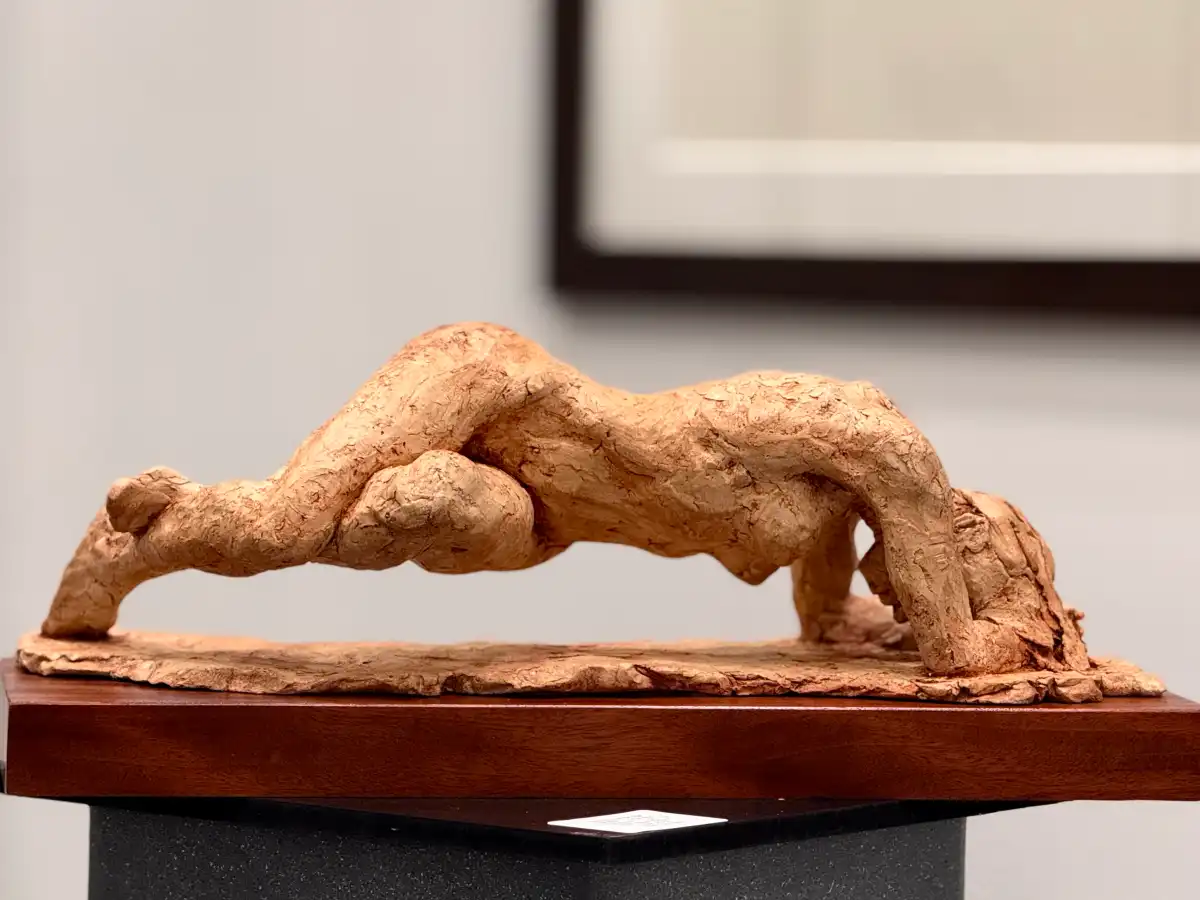
Basil Barrington Watson’s works are at the Harlem Fine Arts Show
Photo courtesy of Basil Watson Studio
Marble remembers what flesh forgets. Bronze, when shaped by the right hand, holds time in suspension—an argument against decay, against disappearance, against the quiet erasure of the human story. From the idealized bodies of ancient Greece to the divine tension of David, classical sculpture has long served as both mirror and myth, elevating the human form into something enduring, almost sacred. It is a lineage defined by rigor, by discipline, by an almost obsessive devotion to anatomy, proportion, and the elusive translation of spirit into matter.
It is also, quite plainly, a lineage from which Black bodies have too often been excluded—not in reality, but in representation. One does not frequently encounter Black classical sculpture rendered with this level of technical precision and historical fluency, where the canon is not rejected, but claimed, expanded, and made more truthful. There is, perhaps, a quiet astonishment in that recognition, a moment where absence gives way to presence with undeniable force.
Which is precisely why encountering Basil Barrington Watson at the Harlem Fine Arts Show felt less like discovery and more like recognition—inevitable, almost, as though the work had been waiting to be seen in the fullness of its authority.

Watson’s practice does not whisper. It does not hedge. It arrives with a commanding elegance, grounded in a profound understanding of the tradition he is operating within, yet entirely unburdened by it. There is a muscular intelligence in his figures, a command of anatomy that recalls the discipline of the Renaissance while carrying a distinctly contemporary vitality. Bronze, under his direction, does not harden into stillness. It breathes. It extends. It gathers energy and releases it with a fluency that feels both studied and instinctive, as though the material itself has conceded to his vision.
This is not merely skill. This is mastery, rendered with conviction.
Born in Kingston, Jamaica, and the son of Barrington Watson, one of the Caribbean’s most revered painters, Watson was immersed early in the language of form, composition, and discipline. His training at the Jamaica School of Art laid a formidable foundation, though it is his decades of refinement—his unwavering commitment to craft—that have elevated him to the position he now holds as Jamaica’s leading figurative sculptor. His work reflects not only technical excellence, but a clarity of vision that feels, in many ways, resolute—a belief in the human figure as a site of strength, beauty, and unassailable presence.
That belief is carried, with remarkable force and sensitivity, into his public works.
Watson’s monumental sculptures of John Lewis, Martin Luther King Jr., and Rosa Parks resist the static solemnity that so often defines civic memorials. His figures do not simply stand; they advance. They lean into history with a sense of forward motion, as though time itself were embedded within their posture. His rendering of Usain Bolt captures not only the body in motion, but velocity as an idea—an abstraction made tangible, and executed with striking clarity.

Recognition, unsurprisingly, has followed. In 2016, the Government of Jamaica awarded Watson the Order of Distinction (Commander), a distinction that speaks not only to his artistic achievements, but to his cultural and national significance. His works now occupy spaces across continents—from the United Kingdom’s National Windrush Monument to major installations throughout the United States, China, and beyond—each placement reinforcing his presence within a global sculptural discourse.
Yet what lingers, perhaps most profoundly, is the intimacy within the grandeur. There is no excess here, no ornamental distraction. Each figure feels resolved, distilled to its essential truth, as though the artist has pared away everything extraneous until only clarity remains. There is a luminosity to that restraint—not austerity, but precision—that allows the work to resonate with unusual depth.
This is where Watson’s brilliance sharpens into something almost philosophical.
His sculptures do not simply represent the body; they restore it. They assert its dignity, its complexity, its rightful place within the highest traditions of art history. They invite a reconsideration—gentle yet insistent—of what has been centered, what has been overlooked, and what it means to witness oneself reflected within a canon that has not always made room.
The encounter lingers with a kind of quiet insistence.
One leaves with the distinct awareness that something has shifted—not only in the understanding of the work itself, but within the broader landscape it inhabits. Basil Barrington Watson is not merely participating in the tradition of classical sculpture. He is expanding it, enriching it, and, perhaps most importantly, rendering it more complete.
Basilsculpture.com