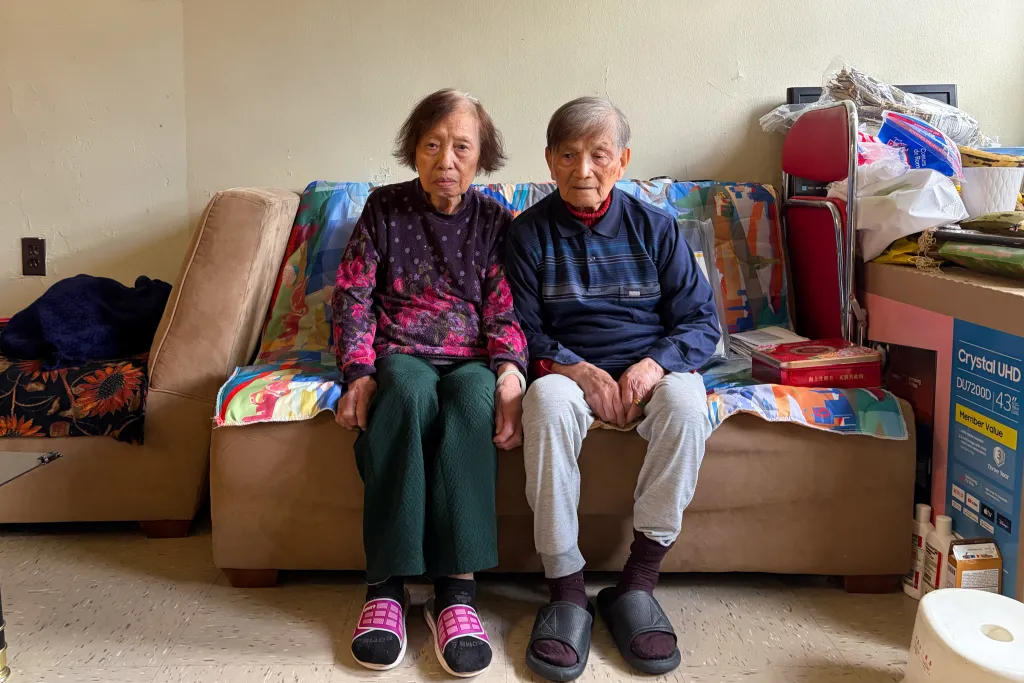
Jin Tao Wu has survived Japan’s invasion of China, the rise of the Communist Party and the massacres of the Cultural Revolution.
Now, thousands of miles and many decades later, the 93-year-old sits in a beige-walled public housing apartment in Manhattan’s Chelsea neighborhood, confronting what he sees as the biggest crisis of his life.
The New York City Housing Authority has told Wu that he and his 90-year-old wife, Qiong Zhong, who has dementia, must vacate their apartment in a seniors-only development as soon as possible, relocate another development for up to four years, and then move yet again into a new non-seniors-only building.
“I’m not going to move,” he said recently, speaking in Cantonese through an interpreter. “I’m 93. If you’re going to move to a general [public] housing, it’s not going to be good. It’s not going to be healthy. It’s not going to be safe. I feel I don’t have that many years left.”
Wu and his wife are among 24 households in NYCHA’s Chelsea Addition refusing the authority’s demand to relocate twice while their building is demolished and replaced. The authority insists the dual moves are necessary first steps in its grand plan to demolish 18 NYCHA buildings in Chelsea and replace them with 15 new towers.
If all goes as planned, the new buildings will house the displaced residents of Chelsea Addition and the Fulton, Elliott and Chelsea Houses, and add another 2,500 market-rate apartments and 1,000 permanently affordable ones.
Under this $1.2 billion project, the mega-developer of the nearby Hudson Yards, The Related Companies, and their partners, Essence LLC, would handle demolition and construction. NYCHA would maintain ownership of the properties but turn over management of the buildings to their private sector partners.

The first phase of the plan, which requires the demolition of Chelsea Addition and one nearby building, was slated to start this spring. But the entire plan is on hold as one lawsuit contests the legality of all of it and another fights the eviction of the seniors who are resisting moving, including Wu and his wife.
‘There Was War’
For Wu and his wife, NYCHA’s proposed move is a traumatic prospect, after a long and momentous journey from the cities of China’s Guangdong province to the streets of Manhattan.
Wu was born in 1934. When he was still a child, the Japanese army invaded China, in a brutal occupation until their surrender to the Allied Forces in September 1945. During the conflict, Wu received just three years of intermittent elementary school education.
“No middle school. No high school,” he said. “There was a war. We were fighting Japan.”
Four years after the war’s end, Mao Zedong and the Chinese Communist Party came to power. When he was in his 30s, Mao unveiled the Cultural Revolution, a campaign to purge what he declared were capitalist influences compromising his vision. Across China, fighting between factions erupted, and in 1968, a series of massacres took place in Guangdong Province where Wu lived.
Wu declined to further discuss his years in China except to say, “I’m 93 years old. I’ve seen quite a few kings.” Asked if there were any he admired, he replied, “Not one of them.”

He married Qiong Zhong and the couple had one daughter, Li Ching Wu. All three emigrated to New York City, with Jin Tao Wu and his wife arriving when he was 60 in 1994. Soon he found a job cutting string in a Garment District factory.
Wu retired a few years later and the couple’s sole income became Social Security. They lived in Chinatown off Canal Street, which is where they resided on Sept. 11, 2001, when Islamist terrorists flew planes into the World Trade Center and the resultant fallout blanketed the surrounding neighborhoods, including Chinatown, with toxic dust.
Later the couple signed up for NYCHA’s waiting list and snagged an apartment in the Taft Rehab Houses on W. 117th St. near Columbia University. This was Wu’s first experience with the Housing Authority’s general population developments — and it did not go well.
In the summer of 2021, Wu heard knocking at his door.
“I opened the door and they pushed their way in and robbed the place,” he recalled. “I called 911. The police couldn’t catch him. They asked if we were scared. Of course we were scared.”
He says his neighbor knew the robbers and wouldn’t cooperate with police. Because of that, he says, NYCHA granted their request to transfer to an all-seniors development. In August that year, they moved into a cozy one-bedroom in Chelsea Addition.
The building sits across from athletic fields where children from a nearby public school fill the air with their voices during recess on school days. The street is otherwise quiet, as their fellow tenants are all over 60 and there’s a security guard assigned to patrol the building and the surrounding area seven days a week. Many of Wu’s neighbors are, like him, immigrants from China who speak little English.
“It is better here. It is peaceful. No harassment,” he said.
It is also where he and his wife expected to spend their final days. They live off of a combined Social Security income just short of $1,500 a month while paying NYCHA around $450 in rent — the required 30% of income all public housing tenants pay.
Their circumstances do not allow them to venture far from their apartment.
Wu’s wife, suffering from dementia, has on occasion become lost in the neighborhood. Wu presents a five-page document listing 44 medications that he must take for a daunting conflagration of medical conditions that includes heart disease, kidney disease, asthma (related to his exposure to 9/11 toxic dust) and diabetes. He relies on a walker.
The couple’s daily regimen is overseen by home-health aides who monitor them 24 hours a day, seven days a week in shifts. They occasionally go out to nearby restaurants but must rely on the publicly subsidized and often unreliable Access A Ride.
“If we don’t have transportation, we don’t go,” he said.
NYCHA v. Wu
Last summer Housing Opportunities Unlimited, a non-profit hired by the developers overseeing the NYCHA project, began knocking on doors of Chelsea Addition residents, slipping notices under doors and calling them, advising that they needed to immediately sign an agreement to relocate to a nearby general population NYCHA development.
“I got lots of notices,” Wu said. “They came and knocked on the door. They called. They were always calling.”
The non-profit showed Wu an apartment in the nearby non-senior-exclusive Chelsea Houses, but he said the bathroom was only accessible through the sole bedroom, an arrangement the home health aides would not accept, he said. He declined to sign NYCHA’s relocation documents, mentioning the robbery that took place in the general population NYCHA development on W. 117th ST.
In October, NYCHA filed suit against Wu, claiming that he had violated the terms of the lease by refusing to consent to relocation.
Their daughter, Li Ching Wu, who is raising a family in Queens and works long hours at a Chinese restaurant, says she is upset about the twilight-of-life disruption her father and mother have been forced to endure.
“Of course this isn’t good. They’re already so old, how are they supposed to pack themselves up?” she told THE CITY. “The government already says it wants to help the elders. Why does it have to use senior housing for development?”
Li Chin is worried about her parents’ safety now that NYCHA wants them to move back to a regular development, noting, “Even young people get robbed in the streets. Of course I’m at least a little worried about my parents.”
And she says two moves would likely confuse her mother.
“My mom has to readjust to an entirely new environment and learn to recognize it,” she said. “She already doesn’t remember many places nearby. But you can’t stop her from going outside — or sometimes you don’t even catch her going outside. It’s guaranteed trouble when she can’t recognize her way back.”
“Everyone’s already of such old age,” she added. “If the government needs to take back the building, they should just let them live out the rest of their lives there and take the units back gradually, one at a time, when they pass over to the other side. That way the elders aren’t thrown into such chaos.”
In December NYCHA withdrew its violation-of-lease suit against Wu and more than a dozen other Chelsea Addition holdouts, shortly after Manhattan Supreme Court Justice David Cohen denied the authority’s motion for a preliminary injunction forcing tenants to sign their relocation agreement.
That lawsuit is now pending before an appeals court that last month suspended the project while it considers the case. After that happened NYCHA began offering to relocate residents of Chelsea Addition in other seniors-only buildings.
Thomas Hillgardner, a lawyer for Wu and the 23 other holdouts, contested the notices in a separate suit filed in civil court in March. That litigation is also pending.
Recently THE CITY visited the couple in their apartment. Wu’s wife sat in silence, gazing at the floor. Dried lettuce and scallion hung on the back of the apartment’s entry door as an old country tradition commemorating the New Year. Against one wall of the living room, boxes filled with food were stacked next to a bag of yams spilling across the floor. Wu’s walker rested nearby.
When THE CITY suggested taking a photo of the couple, Wu asked to put on a nicer shirt first. He and his wife then sat on the couch and posed in silence.
Outside their window the blue-glass towers of Hudson Yards — a huge project of the Related Companies, the developer preparing to demolish and rebuild the Wu’s building —- glimmered in the distance.
Our nonprofit newsroom relies on donations from readers to sustain our local reporting and keep it free for all New Yorkers. Donate to THE CITY today.
The post He Survived Japanese Occupation and Mao’s Cultural Revolution. At 93, He’s Fighting NYCHA. appeared first on THE CITY – NYC News.
