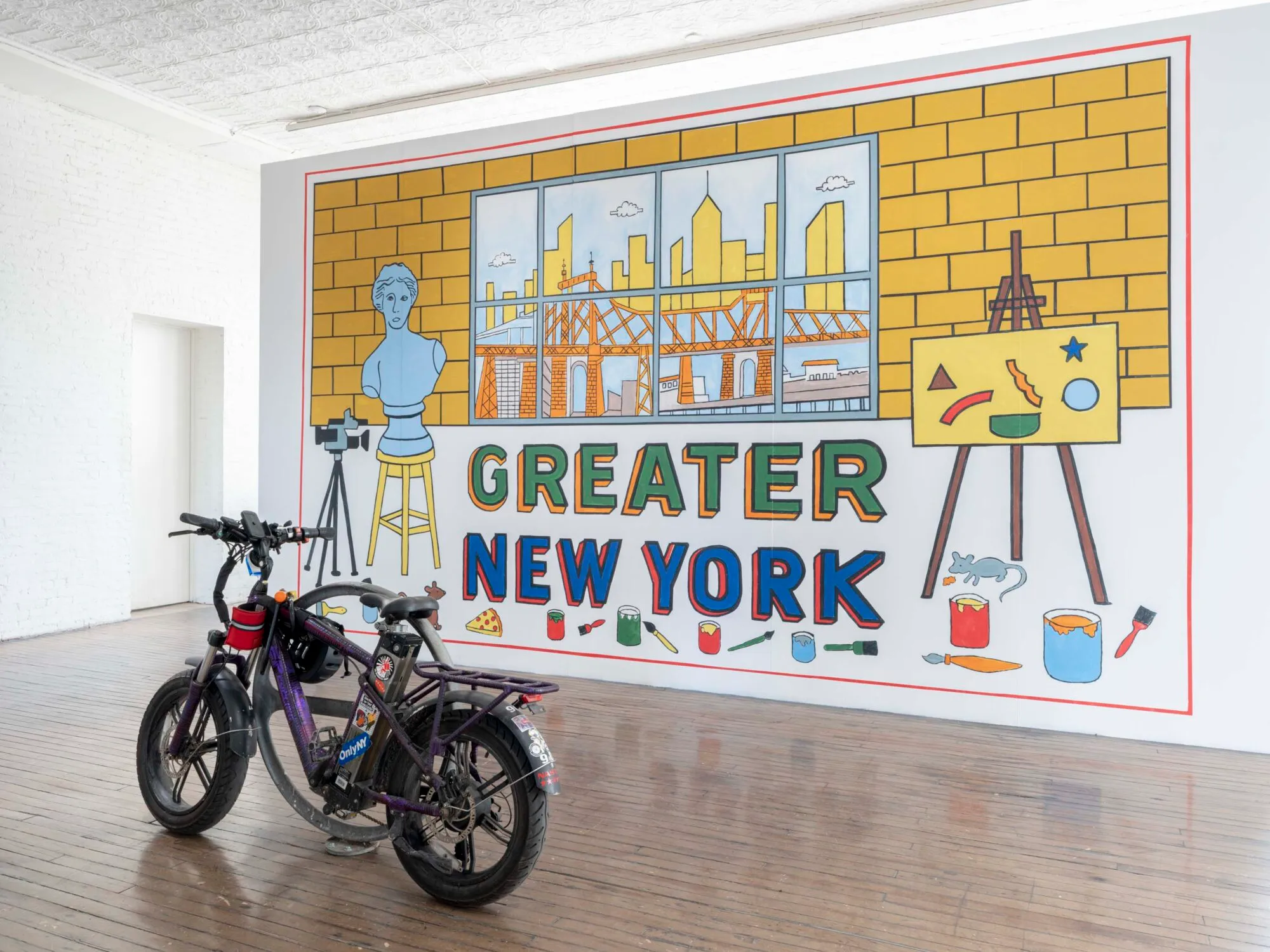
A poetics of impermanence is also a poetics of transition, of remnants and remainders, carrying fragments of knowledge into whatever comes next. That’s what prevails at the latest edition of MoMA PS1’s “Greater New York” survey on view through August 17. The central feeling? That the world as we know it—and the New York we know—has by now crossed a threshold. Since its launch in 1999, the quinquennial has embraced the mantra “New Art in New York Now,” aiming to serve as a gauge of the state of art in the city. This edition registers that liminal, suspended condition between a world that is gone and one still to come with unusual clarity. Worth noting, the 2026 edition is the first to be curated in-house by a young cohort of MoMA PS1 curators, many of them from the same generation as the artists on view and operating within a similar milieu in the city.
Compared to the Whitney Biennial, which often strains toward narrative or some fixed position—in other words, presenting the fracture rather than the fracturing—”Greater New York” reads our present condition with sharper lucidity. It acknowledges systemic failure without overstating its own agency, displaying instead gestures of resistance, practices of endurance and forms of emotional and material resilience. As one of the curators, Kari Rittenbach, puts it in the catalog, the survey’s artists are not putting a dot at the end of the sentence, but are instead working in relation to “the brokenness and meanness of reality and asking, ‘Is this how we want to continue?’”
Still, as at the Whitney, the prevalence of poor, provisional, often makeshift materials across the show is impossible to ignore, and reads less as a shared formal tendency than as evidence of constraint. This is not Arte Povera revived as an aesthetic choice and philosophical gesture; much as in the Postwar period, it is a choice made out of necessity. The poverty of materials and techniques on view reflects a New York that has become increasingly unaffordable for artists, where production is shaped more by economic limitation than by conceptual intent or technical ambition.
Perhaps also for this reason, most of the works on view adapt, endure and persist, preferring to revisit the past and address the present rather than to break into the speculative terrain of alternative worlds and possibilities of improvement. The imaginative leap is deferred or impossible to envision under current conditions, as promises of technological and societal progress have already proven to be failures. Ideas seem irremediably conditioned by the constraints the present moment imposes on creativity and imagination.
Overall, “Greater New York” gives off Bushwick survival vibes that can certainly signal a creatively regenerating yet exhausted system, but are likely symptomatic of something deeper: a structural fracture driven by the real estate industry and other factors, as a much-discussed essay by Josh Klein recently addressed.
Through the work of 53 artists and collectives who call the New York City area home, the exhibition is deeply informed by the present moment, as defined by technological acceleration, systemic breakdown and political violence, further amplified in a city like New York, positioned as a key nexus of flows of labor, capital and goods within both the American and global system. Many works engage the tensions between visibility, surveillance and performance in a digital world, while others retreat toward tactility, intimate worlds and the personal and familial—opposite but often complementary strategies for processing external crises that frequently project inward.

Eulogies of urban survival
Most often, the result is a general disconnection from the broader societal and historical fabric, as well as from everyday reality itself—a common survival strategy among younger generations that has, at this point, inevitably made its way into art. This widespread digitally induced dissociation is exemplified by Poyen Wang’s digital animation in the basement installation, staging a series of absurd animated vignettes centered on a hapless, nameless marionette figure as it moves through cramped, deteriorating environments (a Taiwanese interior, a construction site, a memory space) delivering fragmented monologues that combine personal recollection, pop lyrics and bureaucratic language. The effect is one of psychological exhaustion and emotional escapism rather than boredom: a portrait of postglobal displacement rendered through a subject trapped between systems, speaking into the void—or into a screen that mirrors the passive experiential drift many of the artists, and probably many visitors, recognize in their own everyday lives.
The digital space has become the primary confidant of contemporary alienation. In Julia Wachtel’s work, image culture operates as a loop of desire and self-confirmation that underlies the growing use of A.I. as a tool of psychological support. Combining appropriated celebrity and digital media imagery with fragments of online search language, her compositions on the first-floor stage a flattened emotional register in which nostalgia, aspiration and anxiety coexist in a disquieting mix that reflects much of the identity and relational confusion of younger generations.
What emerges throughout the floors is a kind of eulogy of urban survival. Clubs and dancehalls—long places of temporary escape for free bodies and spontaneous erotic expression—are evoked in several works, but always with the awareness that they can only ever be a fleeting site of connection, a “one night only” miracle, temporary and dissolving by morning. The confetti and the beer bottles are still on the floor, but once again as remnants of a party already over: a moment of happiness and celebration that slipped past before it could be savored, a feeling shared by an entire generation that came of age on the final stretch of early-1990s prosperity before the historical ruptures of the new millennium.
In a dedicated intermediary room on the first floor—a liminal, separate space before entering the main exhibition—Mekko Harjo’s installation transforms the remains of a nightlife space into a charged political metaphor. Drawing from Indigenous urban experience, the work reframes the dancefloor as a site of collective formation shaped by histories of forced relocation. The installation accumulates traces of a performance that repeats under compulsion, suggesting both community and consumption, a cultural ritual always on the verge of disappearance and erasure.
The ritual of prosaic resilience is further evoked upstairs by Kenneth Tam’s I’m Staying Hopeful and Strong, an unfiltered take on the precarious lives of New York taxi drivers affected by the medallion crisis. Once seen by immigrant communities as a path to stability, the system collapsed under the predatory rise of ride-sharing platforms like Uber and Lyft, which transformed the customs and rhythms of urban movement worldwide. The video follows two brothers as they perform choreographed gestures—a box dance, duets with folding chairs—while reciting complaints intercut with affirmations to keep going. “Life goes on,” says one.

A similarly subdued lyricism that celebrates community resilience against the odds of sociopolitical dynamics emerges in Cinthya Santos Briones’s photographs of migrant communities across New York, the U.S. Southwest and the U.S.-Mexico border. Intimate domestic scenes and emptied interiors trace the erosion of sanctuary spaces once shielded from immigration enforcement, foregrounding the precarious persistence of lives shaped by displacement and survival.
More poetry of the vernacular and the power of improvised communities appears in Piero Penizzotto’s In the Council of las Tías (2026), staging what the artist calls “fragile moments of togetherness,” where informal sidewalk gatherings collapse public and private space.
With a double appearance across New York’s key biennial exhibitions, Taina Cruz Tenerger’s figures evoke a Hopper-like solitude—a narrative of urban coming of age filtered through internet culture, as they are immersed in their own psychological worlds, marked by introspection and estrangement inside suburban interiors, their emotional lives shaped as much by digital narratives and idols as by lived experience.
With her wall photo constellation, Farah Al Qasimi similarly turns inward, framing domestic spaces as sites where identity is both constructed and loosened. Her photographs capture, pair and dialectically connect geographically and culturally distant communities through subtle visual continuities, revealing the underlying networks of migration, labor and cultural exchange that bind them.
The systematic failure of the civil infrastructure
In the incapacity to find larger systems of meaning and belief to carry us toward the future, several artists in the show return repeatedly to the collapse of the civil infrastructures that once articulated shared ideologies and values. In a room on the top floor, Louis Osmosis’s sculptures assembled from discarded materials and surrounded by confetti become a parody of the authority of public monuments, embracing chaos over a coherence that feels impossible after the fall of all grand narratives, reflecting instead a fractured public sphere populated not by collective stories but by niche obsessions and improvised identities.
Kristin Walsh’s Indicator no. 9 (2026) literalizes this breakdown through exposed mechanisms—gears, cables and circulating pennies—revealing the absurd disjunction between material reality and economic abstraction. The work underscores how value persists as structure even when it no longer makes sense, pointing to the hidden economies embedded in everyday objects and sustained by invisible labor, resources and energy.

Many artists are similarly attuned to the contradictions between material production and the systems that assign value to different commodities, spaces and even people. The struggle of postindustrial and post-capitalist boom life is also in the work of Hay Carrier, but with a vibrantly kaleidoscopic large painting completed before her passing last year—an imaginative, subconscious piece that evokes the untamed, primordial beauty of a flourishing landscape.
By contrast, the ruins and failures of urban infrastructure are directly confronted in Janiva Ellis’s Lens Error, exposing the implied violence of the systems that determine circulation and control. The main cable of the Brooklyn Bridge extends from the top left quadrant of the canvas, dominating the composition. Drawing on a nostalgic history of imagery celebrating the city’s engineering wonders across art and popular culture, the painting turns that promise of forward progress into smoky obfuscation and collective hallucination. As the title suggests, the fogginess—along with the faint figures—may be a mistake, the result of glare or delusion, as much as the collective hallucination underpinning a notion of progress based on technological predominance and possession.
The same tension between yesterday’s technological utopia and today’s infrastructural dystopia is evoked by Sophie Friedman Pappas’s instructional drawings, which address gentrification and urban violence through the imaginative repurposing of vacant Financial District offices into industrial kilns. Rendered in 18th-century vedute and capricci styles, the works hover between utopian proposal and latent destruction.
The invisible labor behind these urban cathedrals of capital and real estate value is meanwhile revealed by Marie Angeletti’s chance encounters with workers in the city. Screened in a dedicated room, Men at Work (2026) compiles dozens of photographs of men working construction on the streets of New York and various European cities, taken over a ten-year period, initially without a specific purpose in mind. Invited to pause, they smile, flirt, joke and pose for the camera, as Angeletti takes pictures that both register and acknowledge their human presence.


