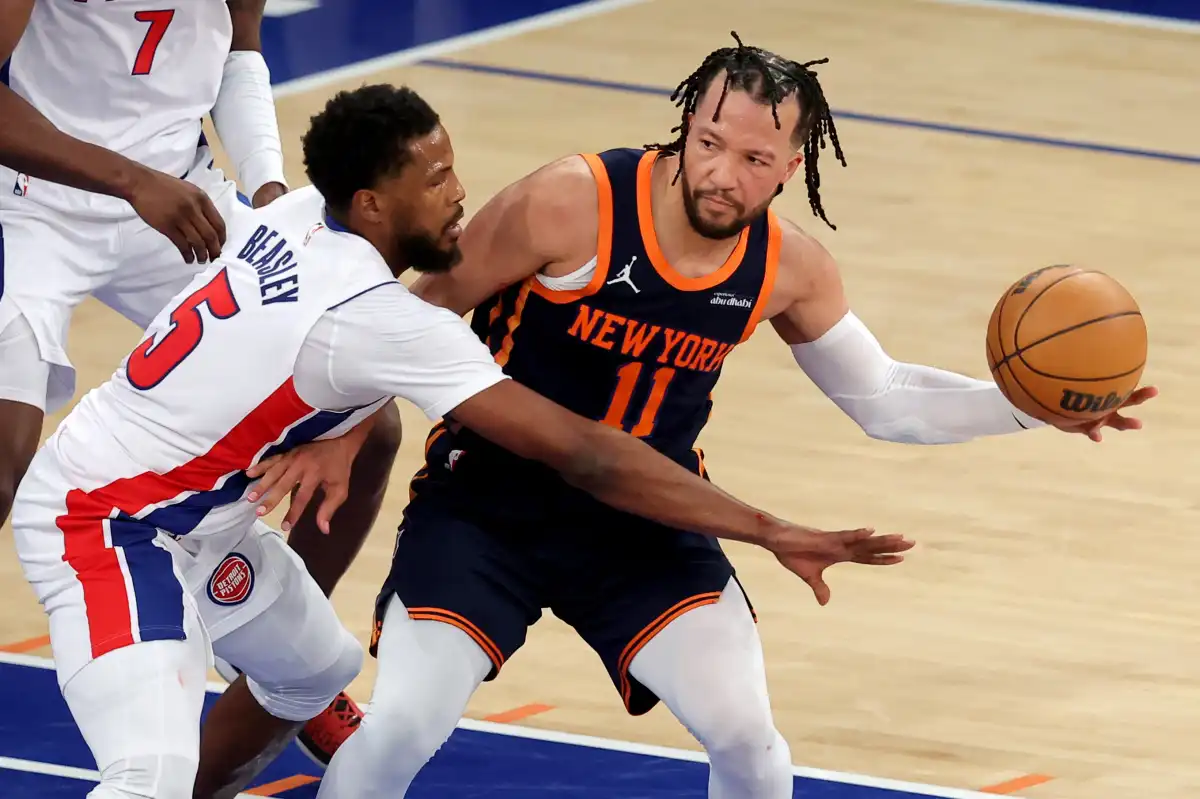
Former NBA player Malik Beasley was indicted Monday morning in Brooklyn federal court over allegedly accepting bribes from a group of men, including his former teammate and a current NBA player agent, to manipulate his game performance so they could cash in on big bets with sports gambling sites.
Beasley, a nine-year veteran of the league, is the latest NBA player to be charged with sports bribery, wire fraud, money laundering, and illegal betting in an increasingly sweeping government investigation into illegal sports gambling in the professional basketball world. He was charged alongside the men who allegedly bribed him: Current NBA player agent Paolo Zamorano, his former teammate and 12-year NBA veteran, Edward Davis and three sports bettors from across the country, William Brown, Robert Gorodetsky and Ernesto Plascencia.
In the indictment, federal prosecutors allege Beasley, then a player for the Milwaukee Bucks, agreed with his former Minnesota Timberwolves teammate Davis to accept bribes to underperform or overperform relative to one or more of the game statistics a person could bet on. Other co-conspirators would subsequently use this information to place fraudulent wagers conditioned on Beasley’s performance in four games across 2024.
For example, the government alleges, Beasley agreed to accept bribes to underperform on rebounds in a January 2024 game where the Bucks played against the Cleveland Cavaliers. In addition, he allegedly accepted bribes in order to score fewer points than he’d be expected, but overperform on rebounds, in a February 2024 game against the Charlotte Hornets; and overperform on rebounds in a March 2024 game against the Los Angeles Clippers.
Davis, Zamorano, Brown, Gorodetsky and Plascencia allegedly turned a profit of hundreds of thousands of dollars based on Beasley’s fixed performance in games they bet on.
“These defendants allegedly operated an illegal betting ring in an attempt to unlawfully earn hundreds of thousands of dollars,” said FBI Assistant Director James Barnacle. “As alleged, Malik Beasley allowed himself to be bought and altered his gametime performance to line the pockets of Ed Davis and his other co-conspirators.”
All defendants in Monday’s indictment have been taken into custody except Beasley and Zamorano. All are expected to be arraigned in the Eastern District of New York in the coming days.
Beasley allegedly got roped into the scheme because he owed millions in gambling debt, and Davis had loaned him some of the money he had used to gamble. Davis convinced Beasley to accept bribes to alter his game performance so he could make money to pay him back and get out of debt, prosecutors allege.
“Only way you can beat Vegas is sports betting,” Davis allegedly texted Beasley a month before the first rigged game. “Everything else they got the edge.”
The two then agreed to talk over Snapchat, with Davis telling Beasley he “could make some good money.”
Beasley has been under investigation for over a year regarding allegations of a sports betting conspiracy. His attorney, Steve Haney, emphasized Monday’s indictment was one-sided, and asked people to “reserve judgment” until all the facts were known.
“An indictment is nothing but a probable cause one-sided charging document,” Haney said in a statement. “It is not evidence, and Malik maintains his presumption of innocence throughout this two-year investigation. We ask that people reserve judgment until all the facts are known.”
The scheme allegedly collapsed when, in a game against the Brooklyn Nets, Beasley alleged failed to play as he had been bribed to, which caused the co-conspirators to lose money.
When Plascencia demanded that Davis convince Beasley to agree to future bets so they could make more money, Davis initially agreed, then backed out after hearing that then-NBA player Jontay Porter was under investigation for a similar sports betting bribery scheme.
Beasley and Davis are not the first NBA players to get caught up in federal indictments. Former Miami Heat player Terry Rozier and coach Chauncey Billups are charged with similar conduct and expected to face trial in the Eastern District of New York next year.
In April, former NBA coach and player Damon Jones pleaded guilty to two counts of wire fraud conspiracy in a scheme to use inside information derived from NBA teams, players and coaches to profit from illegal betting activity.
In the Eastern District of Pennsylvania, 26 men were charged in February over allegedly fixing the scores of Division 1 college basketball games.
