Consumer choice for filling a prescription used to be selecting which pharmacy to go to. Patients still have that option, of course. But choice now extends to new online offerings fulfilled by home delivery. Behind the scenes, the companies supporting these digital options are working to ensure a user’s experience is as seamless and straightforward as possible.
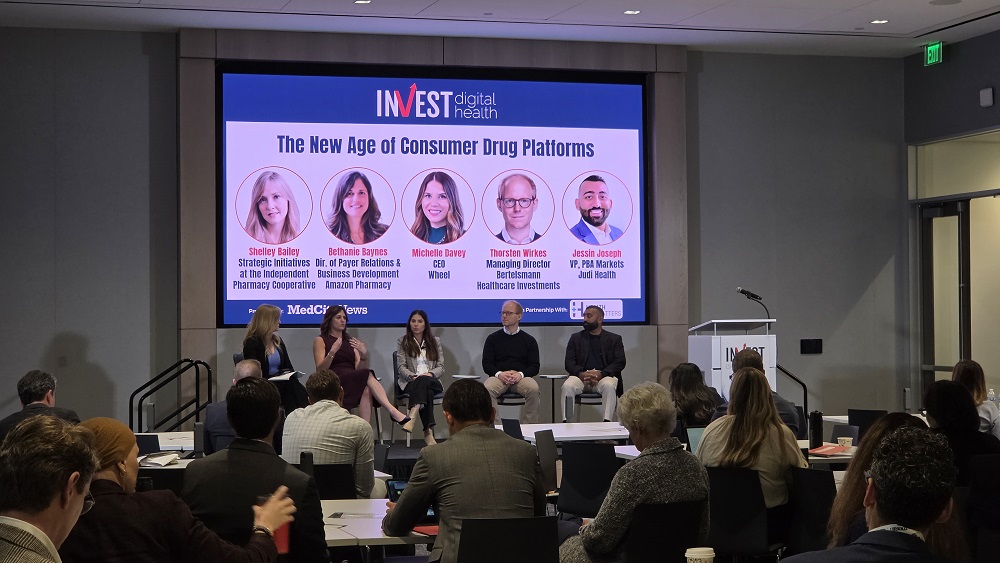
The growth of consumer platforms for medicines was the topic of a panel discussion during MedCity News’ recent INVEST Digital Health Conference in Dallas. The panel was moderated by Shelley Bailey of the Independent Pharmacy Cooperative.
Pharmacies are still the place where consumers most frequently interact with the healthcare system. But Bethanie Baynes, director of payer relations & business development, Amazon Pharmacy, said pharmacies have historically offered little transparency about what is covered, how much something will cost, and whether they have other options.
“We really see this as a clear need in this industry to put more agency at the patient and the members’ hands to see what their options are and make the best decision for them,” Baynes said.
Michelle Davey, CEO of care orchestration company Wheel, said that when her company started in 2018, most of the discussion around consumer healthcare was about cash pay interactions. Today, it’s not just about payment methods, it’s about pricing transparency and helping consumers understand their benefit information, including the cost of paying cash versus using insurance. Patients need support through the entire healthcare journey, not just one particular point of that journey, Davey said. This more holistic view helps patients come back and continue to use the digital tools.
Point of care does not end with a single interaction, Davey said. Beyond follow-up visits, there is a need to ensure adherence to medication. The goal is to ensure patients get the care they need in the moment as well as over time. Achieving that goal requires integration and connection of the disparate pieces of the healthcare system.
Right now, there are many channels where a prescription can be filled, dispensed, and received by the consumer, patient, or insurance plan member, said Jessin Joseph, vice president, PBA markets, at Judi Health, a pharmacy benefit administrator and medical claim adjudication platform. Historically, the different pieces of the system, such as pharmaceutical companies and the pharmacy benefit managers, have been siloed. Judi is trying to reduce the heavy lifting for patients, enabling them to see where a drug can be dispensed and how much those options will cost. The key is integrating this information with a patient’s pharmacy benefit.
“At the end of the day, there’s no reason why people have to go to every different pharmacy to figure out what is the cost of the drug,” Joseph said.
Baynes said innovation in consumer offerings can also come by making the journey easier for patients to navigate so they don’t get to the pharmacy counter only to find a drug is unavailable or is not covered. With Amazon Pharmacy, this easier journey means drugs delivered to patients’ homes, shipped for free — even for those who are not Amazon Prime members. Baynes said this option is important for people whose work schedules do not allow them to go to pharmacies when they’re open. Convenience and choice also helps with medication adherence. Every friction point for the patient and a drug is a chance for a patient to stop taking a drug, Baynes said.
Thorsten Wirkes, managing director, Bertelsmann Healthcare Investments, said that from an investment standpoint, the trend of direct-to-consumer (D2C) and direct-to-employer (D2E) offerings will continue because consumers want more convenience. These trends are shifting more decision making to consumers.
Technology must make it easier for consumers to make these decisions. One example of reducing friction points for consumers comes from the direct-to-consumer platforms offered by some pharmaceutical companies for certain medicines, such as GLP-1 weight management drugs. Davey said many employers have responded to these offerings by covering the cost of the actual care, then directing employees to obtain the medicine through a cash payment pharmacy Like Eli Lilly’s LillyDirect or Novo’s NovoCare Pharmacy. For these cash pay options, some employers will also share in covering the employee’s expense for the drug.
Davey said she’s seeing the direct-to-consumer platform trends play out with cardiometabolic drugs, such as type 2 diabetes and hypertension medicines. Another place where digital models are being applied to drugs is for products that are moving off patent. Wirkes sees these platforms expanding to high list price, low net price products often found in primary care, such as cardiometabolic drugs, respiratory inhalers, and migraine medicines. The second category of drugs in this trend are drugs that aren’t on the formulary or are not preferred by the formulary.
“As consumers want more decision making and have the chance and need to be more involved in decision making, they need a different environment to operate it,” Wirkes said. “That’s why we think D2C platforms or D2E employer platforms are here to stay and are a big part of the future ecosystem.”
Photo: Nick Fanion