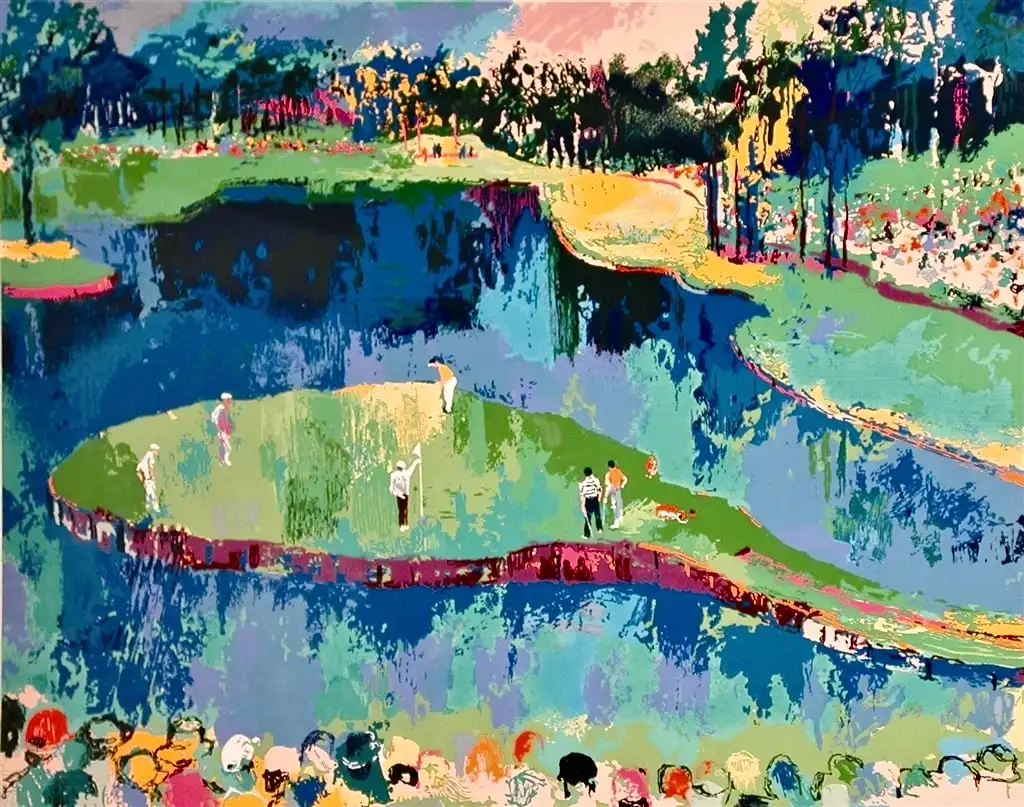
When I think of LeRoy Neiman, I do not think first of polite studio practice or the hushed sanctity of the white cube. I think of Ernest Hemingway with a paintbrush: bulls snarling in Pamplona, gin sweating in a glass, men leaning too close to danger because danger made them feel briefly immortal. I think of The Sun Also Rises, of dust and blood and heat, of cliff divers cutting through the air, of prizefighters under violent light, of racehorses breaking open the earth beneath them. Neiman’s work carries that same wild voltage: motion as appetite, freedom as thunder, color as a dare.
Yet Neiman’s significance extends far beyond literary romance or the mythology of masculine bravado. His achievement belongs to a more complex history of modern image-making, where ancient rituals of public performance collide with the visual velocity of twentieth-century America. He absorbed the theatrical force of the Baroque, the voluptuous power of Rubens, the charged spatial drama of Tintoretto, and the atmospheric pleasure of Fragonard, then hurled that inheritance into racetracks, prizefights, regattas, Olympic arenas, casinos, nightclubs, and after-hours rooms dense with smoke, ambition, perfume, money, and nerve.
Neiman’s paintings are often mistaken for pure celebration, when in truth they are studies of pressure. His subjects exist at the edge of control. The horse may break stride. The boxer may collapse. The bull may charge. The champion may lose. The great glamour of his art comes from that unstable instant, the suspended second when elegance and risk become inseparable. This is where Neiman becomes most serious as an artist. He understood that human beings reveal themselves most honestly in performance, whether beneath stadium lights, before a crowd, inside an arena, or alone in the brutal privacy of ambition.
Formally, his pictures carry the intelligence of abstraction while refusing to surrender the figure. Up close, a Neiman composition may dissolve into slashes, bursts, stains, and electric collisions of pigment. From a distance, the scene returns with startling authority. The body reassembles. The atmosphere clarifies. The sensation becomes legible. This push and pull places him in conversation with Abstract Expressionism, particularly its belief in gesture as evidence of life, while his saturated palette nods toward the Fauves, the Impressionists, and the Romantic Realists. He did not imitate these movements so much as absorb their heat, translating their lessons into an American language of speed, leisure, competition, and theatrical intensity.
His biography only deepens the mythology. Born in St. Paul in 1927 to parents of Turkish and Swedish descent, Neiman began not in salons or museums, but in local markets, painting calcimine images across fruit, vegetables, meat displays, and shop windows for neighborhood grocers. That origin feels essential. Before he was collected, exhibited, or institutionalized, he understood the democratic seduction of the image. Art could stop a passerby. Art could sell. Art could brighten the ordinary until commerce became theater and the everyday acquired a pulse. Later, in the Army, he painted murals in kitchens and dining halls and created stage sets for Red Cross shows. Again, art entered the room not as distant theory, but as atmosphere, morale, theater, and necessity.
That relationship to public life never left him. Neiman became one of the rare American artists who could move between the museum, the magazine, the stadium, and the collector’s wall without losing his identity. His long association with Playboy’s “Man at His Leisure” series placed him inside the architecture of postwar style, where travel, sport, appetite, fashion, and social performance became part of a broader cultural fantasy. Yet his work was never merely illustration. It became a visual record of an era obsessed with winning, acceleration, glamour, celebrity, and the ecstatic choreography of watching.

Arguably, it feels especially appropriate to revisit and honor Neiman as the United States approaches its 250th anniversary. Few artists captured the restless theater of American identity with such immediacy: the competitiveness, the pageantry, the appetite for reinvention, the love of heroes, the romance of public victory, and the belief that movement itself could become a kind of freedom. His paintings are American not because they offer simplistic patriotism, but because they understand the country as an arena: excessive, ambitious, performative, contradictory, and forever chasing the next defining moment.
Collectors continue to return to Neiman because his work carries both emotional charge and market intelligence. Available through galleries such as Park West, his paintings and editions remain part of a living collecting conversation around accessibility, connoisseurship, and the enduring magnetism of American visual culture. These works are not only visually immediate; they have become collectible objects with recognizable market durability, particularly as contemporary taste returns to figuration, narrative, personality, and the human form. In a cultural moment newly hungry for bodies, stories, icons, and images that declare themselves with confidence, Neiman feels less like a nostalgic figure than a painter whose relevance has come charging back into view.
Neiman gave twentieth-century life its own secular frescoes. Not saints ascending into heaven, but athletes, fighters, dancers, gamblers, sailors, and social animals suspended inside the charged rituals of modern desire. His canvases are not quiet because the world he interpreted was never quiet. It roared. It glittered. It wagered everything. It fell, rose, lunged, and began again. In Neiman’s hands, color became thunder, motion became myth, and public performance became a language worthy of serious art.

