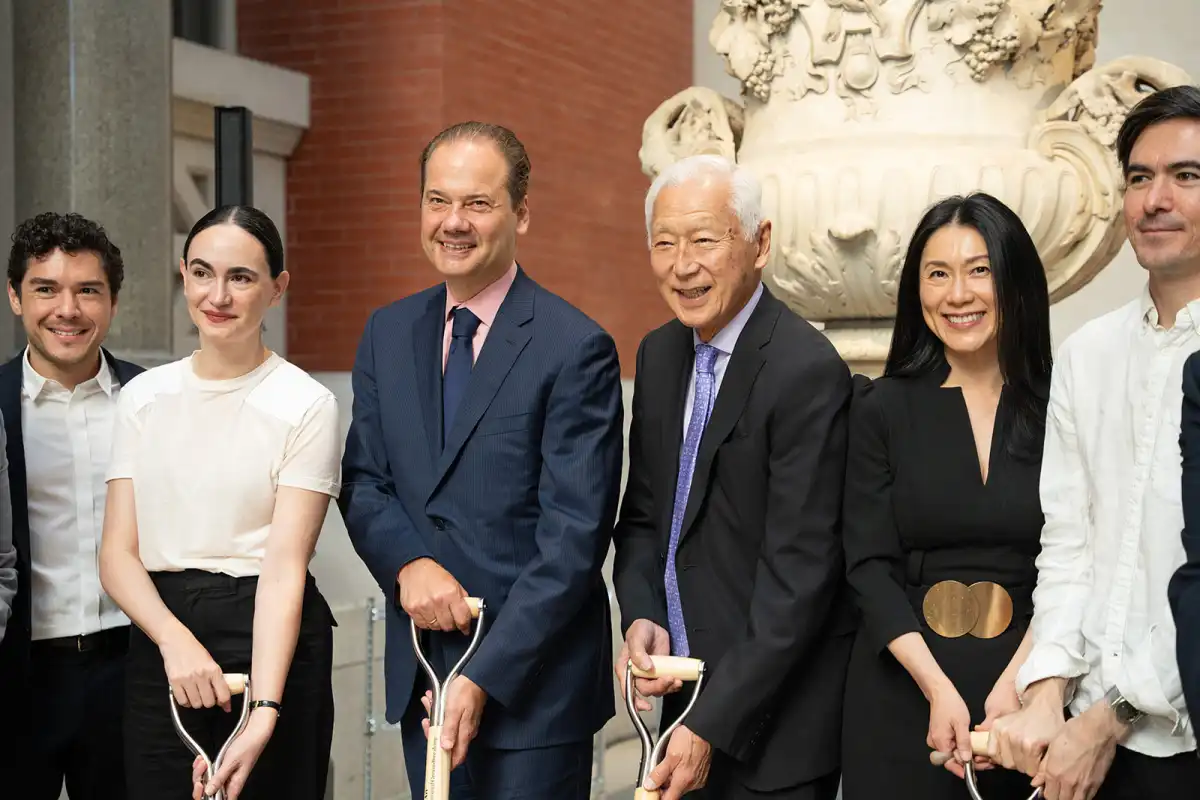
A museum may preserve the past so reverently that it forgets the future is waiting at the door. At The Metropolitan Museum of Art, Frida Escobedo is giving that promise architectural form. The first woman to design a wing in its 156-year history, she is shaping the Oscar L. Tang and H.M. Agnes Hsu-Tang Wing—and, with it, the spaces through which coming generations will discover their place in art.
There is, admittedly, a certain pleasure in watching a woman break an institutional glass ceiling while deciding how high the next ceilings ought to be. That distinction, however, carries an intellectual force equal to its symbolism. Escobedo’s 2018 Serpentine Pavilion, commissioned when she was the youngest architect yet selected, drew Mexican courtyard traditions into conversation with British materials and geography. Light and movement became instruments for enlarging perception.
When we spoke at the groundbreaking, I asked which part of her original vision had survived every negotiation. She returned to “the idea of creating connections”: linking the new wing to the existing museum, the city and Central Park.
“That was something that stayed,” she told me. Finishes and aspects of the layout had evolved, although those relationships—and the “moments of surprise” she hoped to create—remained essential.

That sensibility was already apparent in her 2024 design statement: “The wing is in New York, yet of the world; it reflects the global nature of this great collection.” Within that formulation lies a generous understanding of cultural belonging: a place can remain profoundly rooted in its surroundings while making room for perspectives that expand its horizons.
Although the Tang Wing is expected to open in 2030, this fall’s exhibitions already suggest the curatorial transformation we await: women’s achievements receiving fuller recognition, international voices gaining prominence, and contemporary artists finding fresh meaning in historical collections. Considered together, these presentations offer an early glimpse of the thinking that will animate the new galleries.
“The reimagining of these galleries will allow the Museum to approach 20th- and 21st-century art from a global, encyclopedic, bold, and surprising perspective,” Max Hollein said in the museum’s 2021 gift announcement. To my mind, his legacy will be measured by how fully that promise becomes daily practice: an enduring willingness to reconsider whose genius receives the institution’s attention.
Perhaps the most resonant example arrives with Krasner and Pollock: Past Continuous, opening Oct. 4. Across more than 120 works, Lee Krasner’s ceaseless reinvention of abstraction receives sustained consideration alongside Jackson Pollock’s achievements. Even the subtitle belongs to her, borrowed from a 1976 painting. There is an exquisite insistence in allowing an artist so frequently eclipsed by her husband to supply the language through which both are reconsidered. The canon, after all, acquires its authority through choices; revisiting them can restore entire dimensions of accomplishment.

Elsewhere, in David Hartt: Peripheries, opening Sept. 25, moving images and music enter the gallery housing John Vanderlyn’s panorama of Versailles. Hartt directs the gaze toward Paris and its margins, inviting us to contemplate the histories that splendor can obscure. Such exchanges anticipate the conversations Escobedo’s spaces are intended to encourage.
On Fifth Avenue, meanwhile, Liu Wei’s four monumental sculptures in Speculation unsettle the façade’s classical composure with assembled architectural fragments and bodily forms. Hollein has explicitly connected the commission to the Tang Wing’s ambitions. A more sobering reckoning unfolds in There Are No Words: Si Lewen’s Parade, opening Oct. 1, which follows military pageantry into devastation across 63 drawings. Stewardship includes safeguarding what a civilization might prefer to forget.
That duty feels especially urgent as the American Alliance of Museums warns that political pressure on the Smithsonian threatens institutional independence nationwide. The project predates these latest pressures, although its expansive outlook acquires renewed significance amid them. Scholarship requires the freedom to arrive at conclusions power may find inconvenient.
The Tangs’ philanthropy consequently assumes a particular civic gravity. Their $125 million commitment, announced in 2021, was the largest capital gift in Met history. Oscar Tang’s decades of support encompass curatorial positions, acquisitions and galleries; Agnes Wang, meanwhile, brings an archaeologist’s and art historian’s expertise in protecting cultural heritage. Together, they embody a profound obligation: what one generation has the means to preserve, another must have the liberty to reinterpret.

By the Sept. 15 groundbreaking, The Met had raised $670 million for construction and a substantial portion of an operating endowment. Such generosity sustains encounters its benefactors may never witness: a student’s revelation, a scholar’s discovery, an artist finding the courage to begin. Private wealth becomes a public inheritance.
In his statement marking that occasion, Hollein made the undertaking’s civic purpose explicit: “Importantly, the new wing will also serve as a welcoming new space for Museum goers and for all of New York City.” The public, rather beautifully, remains the ultimate beneficiary.
New York’s claim to remain the cultural capital of the world must be earned anew, through the audacity to commission and the humility to welcome those long excluded. Imagine a young visitor entering these galleries and discovering that a woman conceived the spaces around her. The question of belonging might then yield, almost imperceptibly, to a more exhilarating consideration: what she herself might create.
