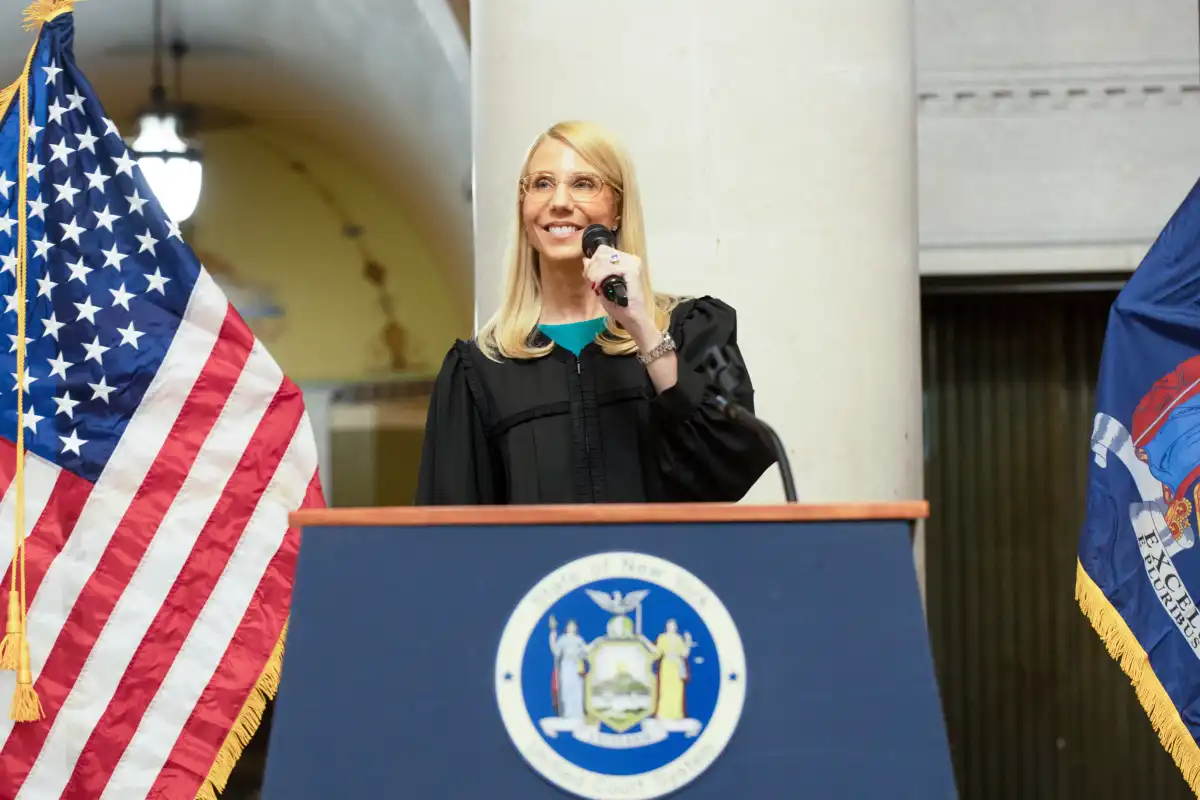
Helping people solve the problems they can’t on their own is Manhattan Civil Supreme Court Administrative Justice Suzanne Adams’ favorite part of her job. It’s a job she takes very seriously, she said, and doing it well requires “bringing a human element” to the bench.
Adams said she brings that critical humanity to the judiciary by doing what she can to increase its diversity, educating herself and Manhattan’s judges on the city’s wide swath of cultures and letting everyday conversations she has with strangers on the subways and the youth she mentors inform the way she leads the court.
“It’s always important for judges to be listening and learning because our responsibility is so great,” Adams said. “When people come to you and ask you to apply the law to their problem, that is an awesome responsibility. I take it as a serious, serious responsibility to be the person who’s going to make a decision.”
Before rising to her current position overseeing Manhattan Civil Supreme Court as its administrative judge — a role she likened to that of a school principal — Adams served on the Manhattan Criminal Court bench and as a Manhattan Family Court judge before moving to the Manhattan Civil Supreme Court bench.
At the Supreme Court, she primarily heard cases related to the city’s transit system and the Adult Survivor Act, which temporarily removed the statute of limitations for sexual assault, allowing people to sue over abuse they otherwise wouldn’t have been able to.
“I saw how a good judge could change people’s lives,” said Adams, who was an attorney for about 20 years before being elected to the bench in 2017. “That’s what propelled me to the judiciary.”
Justice Suzanne Adams follows in her father’s footsteps
The first time she saw what a good judge could do, she said, was when she was 14 years old and tagged along with her father, then Nassau County District Judge Thomas Adams, to watch him preside over his courtroom one night.
“I thought, ‘What a wonderful job, that he had the ability to help people solve problems they were unable to on their own,’” she said of watching her dad work.
As an attorney, Adams said it became incredibly clear to her the difference a good judge – one who listens, who’s kind, who shows up prepared – could make. She spent just under 15 years at insurance defense firm Morris Duffy Alonso & Faley, where she was a partner, before serving as a managing partner at McManus Ateshoglou Adams Aiello & Apostolakos, a firm she helped found in 2015.
After a few years practicing law, Adams, a Hofstra Law School graduate, realized she eventually wanted to devote her life to being “the kind of judge you wanted to appear before.”
Bringing the ‘human element’
How to become that type of judge? Adams said it has a lot to do with bringing the “human element” into court.
One way she does this is by working to increase diversity on the bench and ensuring she and the other judges serving Manhattan’s Supreme Civil Court are as educated as possible on the city’s wide range of cultures. Adams said she encourages cultural and historical programming, like cooking and serving food from across the globe in the courthouse, hosting Black history talks and holding other informational events, lessons from which she encourages her judiciary to bring back to their courtrooms.
“I very much feel that our bench and government need to reflect the people it represents,” said Adams, who calls the Upper East Side home. “When you have a judiciary that mirrors the population it represents, it creates confidence. If there’s no confidence in the judiciary, that’s a big problem.”
To materially increase the bench’s diversity, Adams mentors people from underrepresented backgrounds to help show them the path to the bench. She’s a judicial mentor for both the Richard Failla LGBTQ Commission and the Franklin H. Williams Judicial Commission, which works to address issues facing and offer guidance to attorneys who are queer and come from underrepresented communities looking to become judges.
In these roles and others, like as a mentor to law school, college and high school students and a member of roughly two dozen professional and bar associations, Adams also works to ensure fair and respectful treatment for all who enter or serve in the courts and to eliminate barriers to equity.
“People need to have confidence in us [and] people need to feel the court system is doing everything it can to be fair,” Adams said. “My dream would be to have a comment box [in the court] where people said, ‘Win or lose, I feel like I can come back here and trust this.’”

Another way she makes the courts feel more human is by allowing her worldview to be infused by her everyday conversations, which she says have taught her that 1) Most people are good, and 2) Most people want to help each other.
“If I’m on the subway, I’ll talk to you. I think it’s very important,” Adams said. “It’s important to be interacting with other people. Taking interest in other people’s enthusiasm is the best way to learn, [and] learning about other people is a great thing for me.”
It’s evident that her willingness to be impacted by those around her has allowed the court system to help more people.
When she served as a judge in Manhattan Criminal Court, Adams said she immediately saw the need for social workers in the court. She was struck by people appearing before her with extreme mental illness, schizophrenia, improper attire, no shoes and severe physical health problems, like untreated, leaking, septic-looking wounds and swollen legs.
“I realized, I’m not able to address some of these individuals’ needs,” Adams said. “The population we were serving needed significantly more wrap-around services than the court system could provide.”
“What I saw was the need for mental health and social workers,” she said, then added that, alongside her colleagues, she used her time on that bench to push for social workers to be placed in the court.
When she worked as a Family Court judge, she heard cases involving 16- and 17-year-olds accused of crimes under the state’s then-newly passed Raise the Age law, which mandated that teenagers be tried as minors in Family Court, not adults in Criminal Court.
“My goal in the Raise the Age part was to give young people the tools to turn their ship around,” Adams said, adding that her work on that bench centered around rehabilitation justice for young people. “[The court] gave me the resources, programs, and social workers necessary to turn their ship around.”
“We have to do that for the good of society because if we don’t, where are we headed?” Adams said. She said she was chosen to work on Raise the Age cases because of her “holistic approach” to bail and courtroom proceedings generally.
As an attorney, she spent six years working pro bono in the Eviction Intervention Services Clinic, offering free legal advice to people facing eviction and other housing-related issues, like those who needed to take their landlords to court over bug infestations or structural issues in their apartments, such as severe leaks or crumbling ceilings.
There, she said, she learned the importance of hearing people out, no matter how long it took.
“When people are dealing with [these issues], it’s all-consuming,” Adams said. “You need to let them get out their whole story.”
Now, when she hears a case, she said the most important thing to her is ensuring everyone feels that they’re heard and that the resolution that’s reached feels fair.
At the end of a proceeding, Adams said she always asks, “Is there anything else you’d like to say to me?” She said she’ll frequently tell people in her courtroom, “You might not win, you might not lose, but we’re going to resolve this today.”
Being a resource to the city’s civil judiciary, managing the courthouse’s operations and judges’ caseloads and schedules – while still hearing cases herself – as Manhattan’s administrative judge allows her to have the impact she’s always wanted.
“This is, by far, the greatest job I’ve ever had in my life,” Adams said. “It’s been the great honor of my life to work here.”
