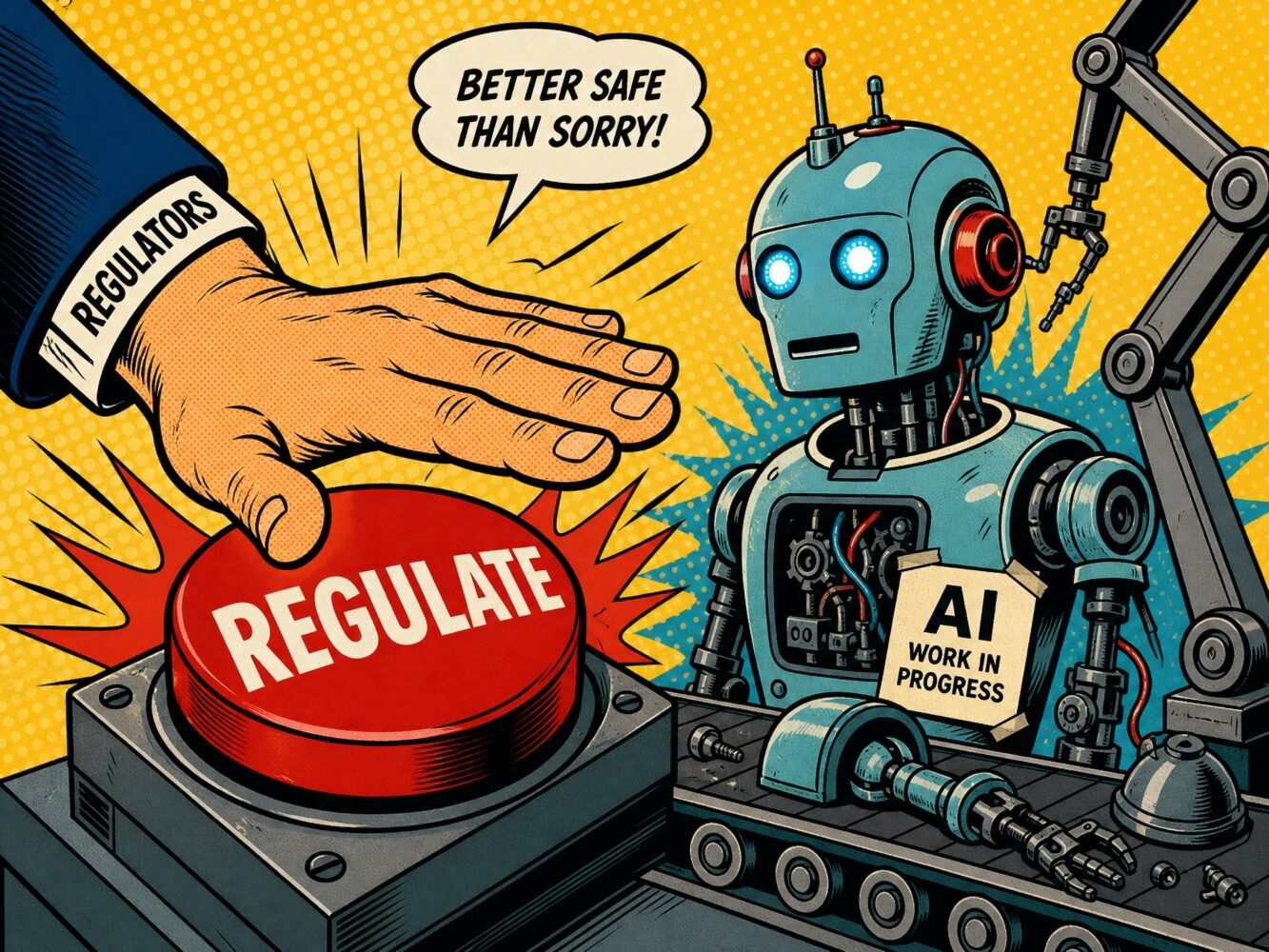
Competition enforcers appear to have discovered their own version of artificial intelligence: act first, learn later. In the span of a week, agencies across four continents moved to reshape how AI products are built, distributed, and integrated—mostly before anyone has shown, in a final appealable decision, that the challenged conduct harms competition.
Last week, a federal court in São Paulo suspended the daily fine that Brazil’s Administrative Council for Economic Defense (CADE) had imposed on Meta for refusing to open WhatsApp to rival AI chatbots. On June 5, Turkey’s competition authority announced both an abuse-of-dominance investigation into the same conduct and an interim measure giving Meta one month to admit third-party AI assistants. Three days later, the Italian Competition Authority (AGCM)—the first agency anywhere to order interim relief against the WhatsApp restrictions—closed its case in deference to the European Commission, which had expanded its own proceedings to cover Italy. Then, on June 9, the Commission adopted interim measures of its own, giving Meta five working days to restore rival assistants’ access across the European Economic Area (EEA). Africa’s Common Market for Eastern and Southern Africa (COMESA) Competition Commission, for good measure, is investigating, too.
Meta is not the only company in regulators’ crosshairs. At its developer conference on June 8, Apple announced that its new Siri AI features will not launch in the European Union with iOS 27, citing the Digital Markets Act’s (DMA) interoperability requirements. The next day, the Commission reportedly rejected Apple’s request for an 18-month exemption, characterizing the company’s decision as a business choice. Earlier this month, meanwhile, the UK Competition and Markets Authority (CMA) imposed its first AI-related conduct requirement on Google under Britain’s new digital-markets regime, governing how publisher content may be used in AI Overviews.
One week. A half-dozen authorities. Four continents.
And a common thread: nearly all of this activity is occurring before any agency has demonstrated, in a final appealable decision, that the challenged conduct actually harms competition. Interim measures, preventive suspensions, and ex ante mandates have become the enforcement tools of choice in AI markets. Whatever else one makes of these interventions, they share a defining feature: they front-load the costs of being wrong.
The Error-Cost Framework Strikes Back
The heightened scrutiny is understandable. AI technologies are likely to become important inputs across much of the economy, making concerns about future market power inevitable. Yet competition policy risks repeating mistakes from earlier periods of technological change. Regulators may be intervening before they understand how competition in AI markets actually works.
The error-cost framework associated with the Chicago School, and most prominently with Judge Frank Easterbrook’s seminal article “The Limits of Antitrust,” emphasizes the dangers of premature intervention under conditions of uncertainty. Because markets are dynamic and often self-correcting, conduct that initially appears exclusionary may ultimately prove efficient, innovative, or beneficial to consumers. Easterbrook therefore warned that false positives—mistakenly condemning procompetitive conduct—can be especially costly.
His prescription was not inaction. Rather, it was a set of sequential filters—market power first, followed by a plausible profit-from-harm theory—to screen out cases where the expected costs of error exceed the expected benefits of intervention.
Once antitrust law prohibits a beneficial business practice, the resulting loss of innovation and competition can persist for years. By contrast, many instances of market power are disciplined over time by entry, innovation, and technological change. The asymmetry is institutional. Erroneous condemnations become embedded in precedent and, if corrected at all, are usually corrected only through slow appellate or legislative processes. Erroneous acquittals remain subject to market discipline.
Put differently, Type II errors come with a built-in correction mechanism. Type I errors do not. The lesson is not that antitrust should never intervene. It is that intervention warrants particular caution when regulators have limited confidence about how markets will develop.
Many contemporary policy discussions implicitly assume that AI markets are becoming concentrated and therefore require early intervention. Current market realities suggest a far more fluid competitive environment.
OpenAI, Anthropic, Google, xAI, Meta, DeepSeek, Alibaba, Mistral, and numerous other firms continue to compete intensely across multiple dimensions, including model performance, cost, deployment strategies, and ecosystem development. Leadership at the technological frontier has changed hands repeatedly over the past three years. The DeepSeek episode—in which a comparatively small lab matched state-of-the-art performance at a fraction of the presumed cost—should have put to rest the notion that today’s leaders are already entrenched, at least for now.
Ironically, the partnerships between cloud-computing incumbents and AI startups that most concern regulators have arguably financed much of this competitive entry. Notably, every merger authority to examine those partnerships reached the same conclusion. The CMA closed all five of its AI-partnership reviews without remedies. After a 15-month investigation of Microsoft/OpenAI, the agency concluded that even the deepest of those relationships fell short of conferring control.
Competition also increasingly takes place across several interconnected layers of the AI stack, including semiconductors, cloud infrastructure, foundation models, application-layer services, and deployment environments. Success in one layer does not necessarily translate into durable dominance in another. As one of us has argued at length elsewhere, the most important competitive bottlenecks in AI may emerge at deployment interfaces—the points where users and businesses actually access AI services—rather than within foundation models themselves.
This dynamism should give regulators pause before assuming competitive outcomes that have yet to emerge.
Maybe Data Moats Aren’t Moats After All
A second feature of AI markets deserves attention, though it warrants more caution.
It is increasingly claimed—by both AI enthusiasts and critics—that AI systems improve through continuous deployment and feedback. The claim is most plausible in robotics and other physical AI applications. Unlike traditional software, which is updated periodically, these systems may evolve through ongoing interactions with users, environments, sensors, and operational constraints.
Industrial robots, autonomous systems, logistics platforms, and enterprise AI applications generate enormous amounts of operational feedback. On this account, that feedback becomes an input into future improvements. Learning is not confined to the development stage but continues after deployment. Japan’s Fair Trade Commission (JFTC) devoted a new chapter of its generative-AI market study to autonomous driving this spring for precisely this reason.
The result, at least in theory, is a recursive learning process. Deployment generates data. Data improves performance. Improved performance encourages further deployment. Additional deployment creates new learning opportunities.
The key question is how powerful these feedback loops actually are. Having enough data typically matters far more than having the most, and the returns to additional data often diminish rapidly. The same dystopian narrative that once predicted insurmountable data moats in search and social media is now being replayed for foundation models. Whether AI deployment loops will prove more durable or consequential than their search-engine predecessors remains an open empirical question, not a premise to be assumed.
Yet these feedback loops sit at the heart of virtually every theory of harm currently advanced in AI markets. The Federal Trade Commission’s (FTC) Section 6(b) report on AI partnerships relies heavily on them. So do the remedies in the U.S. Google search case, which were expressly extended to generative AI to prevent Google from converting purported data advantages into AI dominance.
Authorities that invoke these loops to justify intervention must also accept the corollary. If the loops are real and economically significant, interventions that sever them may destroy far more value than static analysis suggests. If the loops are weak, many of the underlying foreclosure theories collapse on their own terms. Either way, the case for aggressive early intervention appears weaker than it first seems.
The Cost of Being Early
Traditional antitrust interventions often assume relatively stable market structures and that corrective measures can be imposed without significantly affecting innovation. AI markets may be different.
If technological progress depends on recursive learning processes, premature intervention may disrupt the very mechanisms through which innovation occurs. Restrictions on product integration, limits on deployment strategies, or mandatory redesigns imposed before competitive harm is established may reduce experimentation, slow learning, and ultimately diminish innovation.
The costs of false positives would then extend beyond conventional efficiency losses. They could alter the trajectory of technological development itself.
That possibility makes the current enthusiasm for interim measures especially striking. Under Article 8 of Regulation 1/2003, interim relief requires only a prima facie finding of infringement and a risk of serious and irreparable harm to competition—a standard so exceptional that the European Commission invoked it only once during the regulation’s first two decades. By design, it is the enforcement tool most exposed to error costs because it rests on predictions rather than demonstrated effects.
Yet in the WhatsApp saga, interim measures have become the tool of choice. Italy used them in December 2025. Brazil followed in January 2026. Turkey and the Commission acted this month. Authorities across four continents are now rewriting the terms on which a private messaging platform deals with AI developers in real time, before any of them has established that consumers were harmed.
The concern becomes even more significant in physical AI systems. Robotics, autonomous vehicles, industrial automation, and other deployment-intensive applications depend on continuous real-world experimentation. Learning cannot be fully replicated in laboratories or regulatory sandboxes. It emerges through actual operation.
A mistaken intervention that disrupts those learning processes may therefore have consequences that persist long after the underlying enforcement error becomes apparent.
Gatekeepers, Special Responsibilities, and Other Status Crimes
These concerns are particularly relevant to the growing tendency to apply doctrines that focus more on firm status than demonstrated competitive effects.
One example is the European concept of “special responsibility,” first articulated in Michelin v Commission and steadily expanded since. Under the doctrine, firms deemed dominant often face obligations that go beyond ordinary competition-law standards.
When detached from a concrete assessment of exclusionary effects, special responsibility begins to function as a status-based constraint on conduct. Competition authorities and courts may come to treat product integration, ecosystem design, or self-preferencing as presumptively suspect simply because a successful dominant firm engages in them. That approach departs from competition-on-the-merits principles.
Nor is this logic confined to Article 102 case law—or to Europe. It is hard-coded into the DMA, whose obligations attach to designated gatekeepers regardless of demonstrated effects. The result is the spectacle of European consumers losing access to Siri AI while Brussels and Cupertino argue over whose “choice” that was.
The same logic animates the Commission’s pending Article 6(7) specification proceedings, which concern how Google must provide rival AI services with “equally effective” access to Android’s hardware and software features. One of us has criticized that interoperability theory as more slogan than substance. Similar thinking underlies the CMA’s new conduct requirements under the United Kingdom’s strategic-market-status regime. It also echoes through the WhatsApp interventions in Brazil and Turkey.
AI may therefore become the first major technology to be born into a status-based regulatory environment, rather than growing up under effects-based antitrust scrutiny.
The same impulse is beginning to reshape adjacent doctrines. Last month, Brazil’s CADE ordered the retroactive notification of Microsoft’s Inflection acqui-hire, a transaction that fell below every applicable filing threshold, on the theory that talent and licenses can substitute for an acquisition of control. The agency simultaneously opened new probes into Google’s Windsurf and Hume AI arrangements. Whatever the merits of treating acqui-hires as concentrations, the direction of travel is unmistakable: jurisdictional doctrines are being remodeled to reach AI transactions before their effects can be observed.
This danger is particularly acute in AI markets. Product integration is often not a strategy for exclusion, but a mechanism for improving performance and, if the deployment-learning thesis is correct, accelerating learning.
Integrating AI assistants into operating systems, embedding models within enterprise software, or optimizing interactions between hardware and software may generate substantial efficiencies. Those efficiencies often arise precisely because integration enables faster feedback, tighter coordination, and more effective learning.
Condemning such conduct as self-preferencing without a concrete demonstration of exclusionary effects may amount to penalizing successful innovation rather than protecting competition. Treating integration as unlawful merely because it advantages a firm’s own products departs from competition-on-the-merits principles and risks undermining the very innovation process that competition policy is supposed to protect.
Back to First Principles
None of this implies that AI markets should be exempt from antitrust scrutiny.
Exclusionary conduct remains possible. Firms that control critical infrastructure, computing resources, data assets, or distribution channels may engage in practices that genuinely foreclose rivals. If durable market power emerges and is used to restrict competition, antitrust law should respond.
The point is not that intervention is never warranted. It is that intervention should remain grounded in evidence of competitive harm, rather than assumptions based on firm size, ecosystem integration, or speculative fears of future dominance.
Nor is such restraint merely theoretical. In the U.S. Google search case, Judge Amit Mehta rejected both structural divestiture and a proposed requirement that Google provide advance notice of its AI investments beyond existing Hart-Scott-Rodino obligations because the evidentiary record could not support either remedy. Taiwan’s Fair Trade Commission reached a similar conclusion from the opposite direction. After a year of consultation, it determined that generative AI requires no new enforcement instruments. The existing Fair Trade Act, applied through an issue-driven rule-of-reason framework, is sufficient.
Effects-based enforcement is not a euphemism for inaction. It is a methodological commitment to identifying actual competitive harm before imposing remedies.
The fundamental question remains the same one that has guided sound antitrust policy for decades: does the conduct harm competition, or merely competitors?
The Machines May Be Learning. Regulators Should, Too.
The emergence of AI does not undermine the traditional error-cost framework. If anything, it reinforces its central insight. AI markets are characterized by extraordinary uncertainty, rapid technological change, and intense competition among alternative technological pathways. Under such conditions, regulators are especially likely to mistake efficient conduct for anticompetitive conduct.
That danger is magnified to the extent that AI systems—as many enforcement theories themselves assume—improve through recursive learning, deployment-driven experimentation, and continuous feedback from real-world use. Interventions that disrupt those processes may do more than reduce static efficiency. They may alter the trajectory of innovation itself.
In AI markets, the costs of false positives therefore extend beyond the immediate consequences of a particular enforcement decision. They may affect the pace and direction of technological development for years to come.
For that reason, the error-cost framework deserves renewed attention. Far from rendering Judge Easterbrook’s insights obsolete, AI may strengthen the case for caution when competitive effects remain uncertain.
The events of the past week suggest that enforcement is moving well ahead of that insight. Competition authorities should remain vigilant against genuine exclusionary conduct. They should also recognize that preserving experimentation, deployment, and innovation is itself a core objective of competition policy.
In markets defined by continuous learning and technological change, the competitive process is often best protected through patient, effects-based enforcement rather than remedies imposed before the evidence is in.
After all, if AI’s defining feature is that it learns from experience, competition policy should do the same.
