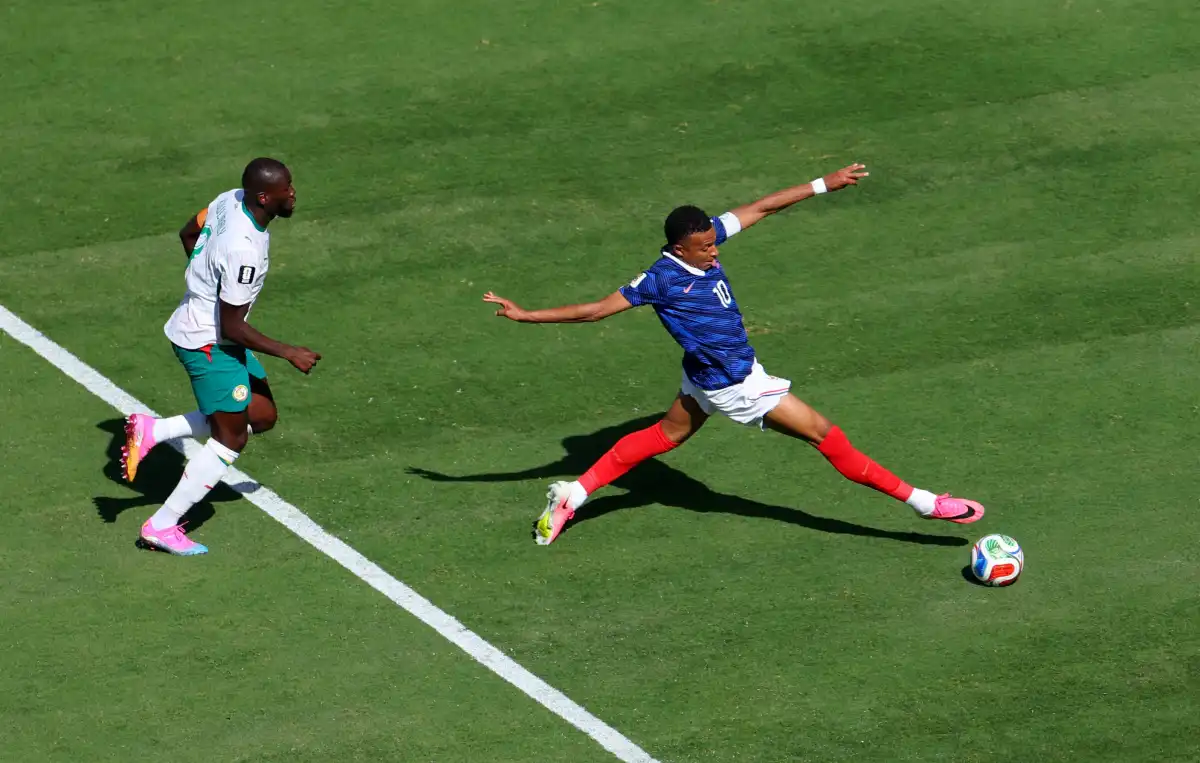
Soccer Football – FIFA World Cup 2026 – Group I – France v Senegal – New York/New Jersey Stadium, East Rutherford, New Jersey, U.S. – June 16, 2026 France’s Kylian Mbappe in action REUTERS/Mike Segar
EAST RUTHERFORD — A World Cup winner first as a player and then as a manager, France gaffer Didier Deschamps knows a good playing surface when he sees one.
MetLife Stadium does not appear to be one of them.
“It’s a special surface,” Deschamps began with a wry smile. “It’s different, for sure. You need to get used to it, I guess.”
His European powerhouses had just disposed of Senegal 3-1 in their Group I opener at the 2026 World Cup on Tuesday afternoon in the full-time home of the NFL’s Giants and Jets, and a Kylian Mbappe brace likely softened the 57-year-old’s review of the pitch.
The playing surface at MetLife Stadium has long been a point of contention. Its synthetic turf used for NFL games has claimed the ACLs and MCLs of numerous prominent stars, including Nick Bosa, Aaron Rodgers, and Malik Nabers.
Both Giants and Jets players have clamored for grass playing surfaces at their home, but now only see it being used for FIFA’s crown jewel event. MetLife Stadium is hosting five group-stage matches, two early knockout ties, and, most importantly, the Final on July 19. Once the World Cup is over, the synthetic turf will be coming back in.
“[It’s] annoying,” Giants offensive lineman Jermaine Eluemenor said when asked about seeing his home stadium covered in grass. “It’s nice playing on grass.”
But even the 100% Bermuda grass field is not up to the standards of the elite soccer world. Deschamps was particularly unimpressed by the length of the grass and the overall depth of the playing surface, prompting his team not to wear studs of any kind on their cleats.
“That might be cement below the grass,” Deschamps said. “You have very short shards of grass here. I’ve had players who have played matches here, and it was just the same. The ball rebounds the same whether the grass is moist or not. We do adjust. I’ve seen it before. If you don’t have a good depth of earth below the grass, the ground could be less supple.”

It is not the greatest endorsement, given the meticulous work that FIFA put into this. Soccer’s governing body said it took six to seven years of research to develop the perfect playing surface for these North American climates.
Warmer venues such as MetLife Stadium were fitted with that 100% Bermuda grass. Those in cooler climates were given a blend of 84% Kentucky bluegrass and 16% ryegrass.
Senegal certainly seemed more comfortable on the pitch of what is temporarily being called the New York-New Jersey Stadium by FIFA for licensing purposes. France’s attack seemed to be just a hair off, though the grass had nothing to do with its struggles to quell the African nation’s aggressive vertical attack.
After Deschamps “had words” with his team, as defender William Saliba described, they were far more crisp, scoring all three goals in the second half.
“We take those [field] technicalities into account,” Deschamps said. “I understand you need to protect the grass, but it is a little different. It does hit a little different.”
For more on MetLife Stadium and the World Cup, visit AMNY.com
