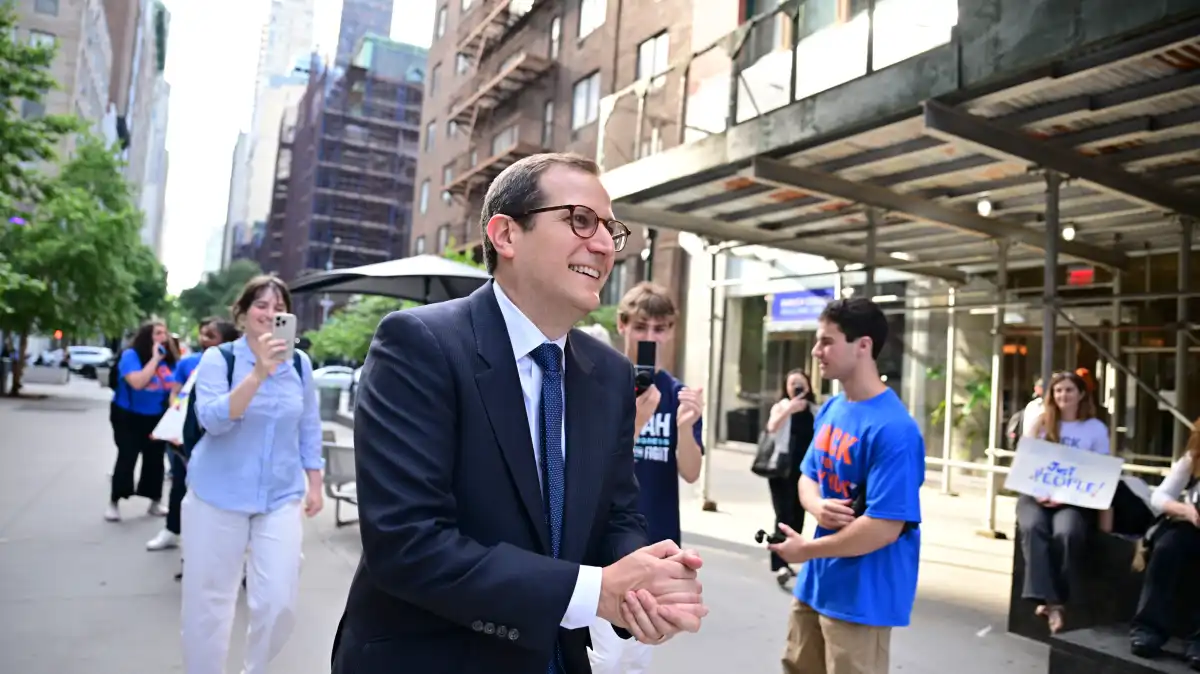
Assembly Member Micah Lasher leads among older voters in the crowded Democratic primary for New York’s 12th Congressional District, while one-fifth of respondents were undecided in a new poll released by AARP New York on Thursday.
Lasher received 32% support among likely Democratic primary voters age 50 and older, followed by Assembly Member Alex Bores at 21%, attorney George Conway at 13%, and Kennedy scion Jack Schlossberg at 9%. Public health researcher Nina Schwalbe received 2%.
Another 21% said they did not know whom they would support, leaving a sizable share of one of the district’s most reliable voting blocs still up for grabs as candidates make their closing arguments.
The poll was conducted by the Siena College Research Institute from May 27 through June 1, and included only likely voters age 50 and older, rather than the full Democratic primary electorate.
An Emerson College/PIX11 poll conducted May 16 and 17 among 425 likely Democratic primary voters of all ages found Lasher at 22% and Bores at 20%, a two-point edge in a survey with a margin of error of plus or minus 4.8 percentage points. Schlossberg received 11%, Conway had 10%, and 32% were undecided.
The new AARP poll adds weight to the possibility that older voters will decide the race to succeed retiring U.S. Rep. Jerry Nadler, who has represented the Manhattan-based district for more than three decades.
An analysis commissioned by AARP New York and released in May projected that voters age 50 and older could account for 65% to 75% of the June 23 primary electorate. The analysis found that voters in that age group made up 72% to 74% of turnout in recent congressional primaries in the district.
“Older voters will once again play a decisive role in this election,” AARP New York State Director Beth Finkel said in a statement Thursday. “These voters are looking for leaders who understand the challenges they face every day — from rising housing and grocery costs to protecting Social Security and Medicare and supporting family caregivers.”
Thursday’s poll surveyed 416 likely Democratic primary voters age 50 and older in the 12th Congressional District. Of the respondents, 303 were contacted through landline or cellphone sampling, and 113 completed the survey through text-to-web. The poll has a margin of error of plus or minus 5 percentage points.
The issues on older voters’ minds in NY-12
The candidates met for a televised debate on June 9, days before early voting starts this Saturday, June 13. The AARP poll shows older voters placing heavy emphasis on affordability, retirement security and health care, while nearly half named threats to democracy as the single most important issue affecting their vote.
Nearly nine in 10 respondents, 88%, said the affordability of life in New York City was a serious problem. Eighty-three percent said housing affordability was a serious problem.
Asked to choose their two biggest concerns related to rising prices, 51% selected groceries, 48% chose housing and 46% cited health insurance. Utilities, prescription drugs and gasoline followed.
Affordability was broadly important, but threats to democracy dominated when respondents were asked to select the single most important issue affecting their vote. Forty-nine percent chose threats to democracy, compared with 9% who selected prices and the cost of living, 8% who chose jobs and the economy and 7% who cited Social Security and Medicare.
Seventy-three percent said ensuring that full Social Security payments remain available should be a priority for the district’s next member of Congress. Seventy percent said making the cost of living more affordable should be a priority, while 68% selected lowering health care costs.
When respondents were asked to choose only one priority, 25% selected making the cost of living more affordable and 24% chose ensuring full Social Security payments remain available.
Large majorities also described health care costs, Social Security and Medicare as important to their voting decisions. Seventy-nine percent rated the cost of health care as very important, 77% said the same about Social Security and 74% cited Medicare.
The poll found that 92% would be more likely to support a candidate who advocated ensuring that workers receive their full Social Security benefits.
Seventy-nine percent said they would be more likely to support a candidate who backed funding and tax credits for unpaid family caregivers, while 76% said efforts to protect consumers from fraud and scams would make them more likely to support a candidate.
The poll also found uncertainty about whether older residents can afford to remain in the city. Fifty-two percent said they would be able to afford to retire in the city, while 22% said they would have to move somewhere with a lower cost of living. Sixteen percent said they were already retired, and 10% did not know or declined to answer.
The Democratic primary is June 23. Early voting begins June 13.
