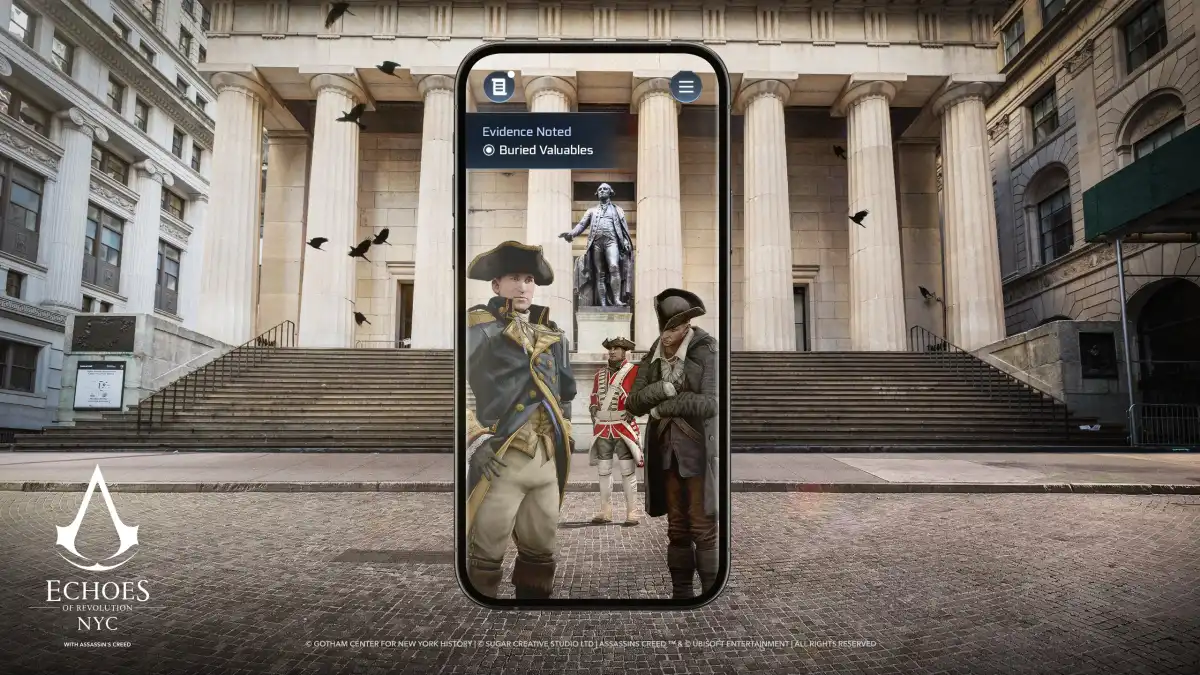
Picture it: New York, 1776. The British began their harsh, 7-year occupation of Manhattan, fighting the American colonists who wanted nothing but freedom and independence from the tyrannical King George. For the next two years, bloodshed in the name of liberty permeates the streets of New York City.
A fire breaks out in Lower Manhattan, destroying buildings and homes, including the original Trinity Church. Whether it was done deliberately by British troops, no one knows. Battles between the British and Americans rage throughout the city. Much of Manhattan’s population flees during the fight as the island swells with Redcoats (British troops) and loyalist refugees.
There is so much to learn about NYC’s role in the American Revolution, after which the country was free of all rule except its own. The war ended in 1783, leaving behind remnants, landmarks, and artifacts that still exist today in Lower Manhattan. As America gets ready to celebrate its 250th birthday on July 4, modern technology is being used to inform New Yorkers, Americans, and people of all ages what the fight was about.
The Gotham Center for NYC History at the City University of New York’s (CUNY) Graduate Center, in collaboration with video-game and tech creators Ubisoft and Sugar Cretive, made a 90-minute walking tour that people can follow digitally in Lower Manhattan to learn about the freedom fight.
Titled Echoes of Revolution: NYC, the app will launch later this month in time for July 4. It will be available for both iOS and Android.
How does the new American Revolution app work?
First, users must download the app, and then follow an hour-and-a-half walking tour through Lower Manhattan, where much of the American Revolution occurred.
As they visit historic sites such as Bowling Green, where soldiers and civilians tore down a statue of the British King, and the famous Federal Hall, the app uses augmented reality and geolocation technology to overlay a digitally reconstructed colonial New York onto today’s streets. This allows users to view scenes from the American Revolution and learn about the city’s founding history at the exact locations where they occurred.
Imagine being about to see how George Washington enjoyed dinner with his officers and held secret meetings with the Sons of Liberty at Fraunces Tavern? Or how the British used abandoned ships to house prisoners of war? (Estimates report over 11,000 prisoners died on the ships.)
The experience is not only about the technology, however. It’s about preserving history, according to the experts involved.
“New York City has long deserved a ‘freedom trail’ to spotlight its centrality in the American Revolution. But now thanks to Ubisoft and Sugar Creative, we can give people a rich visual and experiential sense of what it was like to live through this harrowing, inspiring, dramatic, and foundational moment in history,” said Peter Aigner, director of The Gotham Center for New York City History at the CUNY Graduate Center.
Ubisoft used the worlds of its Assassin’s Creed video games to create the new app. Sugar Creative, based in Wales, often works with museums and cultural institutions to provide immersive storytelling.
“Projects of this ambition depend entirely on the quality of the people you work with. We’ve been fortunate to find in Gotham Center and Ubisoft partners who care as much about getting it right as we do. It’s a source of real pride that it’s a Welsh studio helping to bring New York’s revolutionary story back to life,” said Jason Veal, managing director of Sugar Creative.
Meanwhile, coinciding with America’s 250th birthday, CUNY’s Gotham Center for New York City partnered with the Museum of the City of New York for the exhibit, “The Occupied City,” to ring in New York’s 250th celebration.
