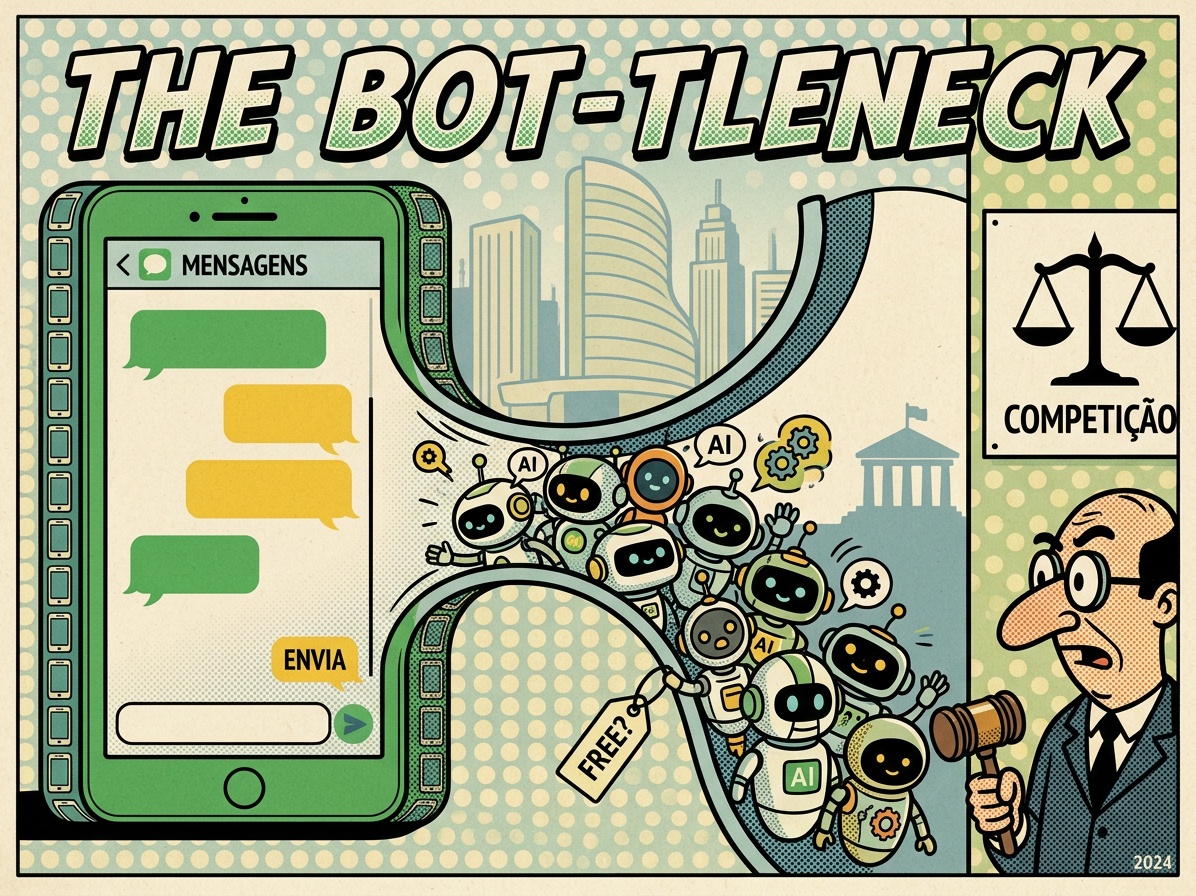
Brazil’s WhatsApp case began as a fight over access to an application programming interface, or API—the technical doorway that lets outside services connect to WhatsApp. It has quickly become a test of how antitrust law should treat AI distribution.
The Federal Court of São Paulo has now suspended the R$250,000, or about $50,000, daily fine that Brazil’s Administrative Council for Economic Defense (CADE) imposed on Meta in its WhatsApp AI-chatbots case, sending the parties into conciliation instead. The judicial decision remains under seal, but it marks the latest turn in a remarkable four-month saga.
CADE opened an administrative inquiry and imposed an interim measure. A federal court initially suspended that measure, then reinstated it after a closer look. CADE then imposed a daily fine after concluding that Meta had not adequately complied. Now, that fine has been paused, too.
The merits remain unresolved, making this a useful moment to ask what the dispute is really about—and where the harder questions lie.
The short version is that CADE’s dominance theory rests on relatively firm ground. Its theory of harm, by contrast, depends on assumptions about AI markets that the available evidence is unlikely to support. In that sense, the court’s decision to pause the fine and require conciliation may create a useful off-ramp in an important antitrust dispute.
How a WhatsApp Policy Change Became an International Incident
The case began when Meta amended its WhatsApp Business Solution Terms to bar third-party general-purpose AI providers from using the WhatsApp Business API as their primary functionality. Two AI-chatbot startups—Madrid-based Factoría Elcano, which operates Luzia, and Montevideo-based Brainlogic AI, which operates Zapia—filed a complaint with CADE’s General Superintendence (SG). They argued that the change amounted to abusive exclusionary conduct under Article 36 of Brazilian Competition Law (BCL) and sought an interim measure to preserve the status quo ante: free access to the API.
Because Meta rolled out the policy globally, the dispute has not stayed within Brazil’s borders. The Italian Competition Authority (AGCM), which had already opened an investigation into Meta AI’s integration with WhatsApp, expanded its probe to cover the new Business Terms and ordered Meta to suspend them in Italy.
The European Commission opened a parallel investigation under Article 102 of the Treaty on the Functioning of the European Union (TFEU), covering the European Economic Area (EEA) outside Italy. After Meta replaced the outright restriction with a paid-access policy of $0.06 per message, the commission issued a supplementary statement of objections, preliminarily finding that the new pricing produced the same exclusionary effect as the original ban. Meta announced last month that, “[a]s part of ongoing discussions with the European Commission,” general-purpose AI chatbots operating in the EEA would receive free access to the WhatsApp Business API for one month—effectively freezing the new terms to avoid a European Union interim measure.
Other regulators are watching, too. Investigations are underway before the Common Market for Eastern and Southern Africa (COMESA) Competition Commission, whose director has publicly ruled out an interim injunction and reportedly said COMESA “will not be influenced by the European Commission’s recent statement of objections” challenging Meta’s chatbot fees. The Turkish Competition Authority is also investigating. Onyeka Aralu has a useful recent Truth on the Market piece on the COMESA proceeding.
In Brazil, the dispute has unfolded across three parallel CADE proceedings. The first is the administrative inquiry, in which the SG is examining whether Meta’s conduct violates Article 36 of the BCL. In opening that inquiry, the SG also imposed a preventive measure under Article 84 of the BCL, suspending the new terms and preserving the prior arrangement, under which Meta did not charge third-party AI chatbots for API access.
Meta appealed to CADE’s Tribunal—the second proceeding, known as the Recurso Voluntário—and also went to court. A federal court briefly suspended the measure, then reinstated it after concluding that the record contained enough indicia of anticompetitive conduct to make the measure proportionate and reasonable. With the interim measure restored, CADE’s Tribunal unanimously upheld it, following Commissioner Carlos Jacques’ opinion.
The third proceeding concerns sanctions. Meta filed a compliance plan in March proposing to readmit AI chatbots to the API, but at a charge of $0.06 per message—the same policy it had introduced in Europe. The SG found that the practice could amount to a “constructive refusal to deal,” meaning access formally exists, but only on terms that make it practically unusable. It concluded that the interim measure required preserving the status quo ante of unlimited, free access and imposed a daily fine of R$250,000, or about $50,000, until Meta restored that arrangement.
Meta appealed, but the Tribunal unanimously upheld the fine. Jacques’ opinion drew on Erik Hovenkamp’s work on “secondary refusals” and on the European Commission’s supplementary statement of objections, which the opinion framed as “international context as a reinforcement of rationality.”
Six days later, the Federal Court of São Paulo suspended the fine and ordered Meta and CADE into conciliation. That opened a path toward settlement on terms reminiscent of the agreements recently reached with Google and Apple.
The Easy Market and the Hard One
CADE’s case rests on a two-market analysis. In the decision opening the administrative inquiry and imposing the interim measure, the SG declined to define the relevant markets precisely, leaving that question open because the investigation was still in its early stages. Jacques took the same approach in his opinion on Meta’s appeal, refraining from formally delineating the markets.
Both decisions nonetheless drew broadly on the complainants’ proposed market definitions. The first is a Brazilian market for instant-messaging services, where WhatsApp allegedly holds an uncontestable dominant position and where the challenged conduct occurs. The second is a market for AI services and solutions, whose geographic scope remains open, where Meta AI competes with rivals, including the complainants.
If CADE ultimately adopts those definitions, WhatsApp’s dominance in Brazilian instant messaging would be difficult to dispute. According to the complainants’ figures, WhatsApp has roughly 148 million users in Brazil, is installed on 99% of smartphones, and is used daily or nearly daily by 97% of users. Those numbers sit comfortably above the 20% rebuttable presumption of dominance established by Article 36, Section 2 of the BCL and would likely support characterizing WhatsApp as a virtual monopoly.
The downstream market looks very different. There, the relevant market would be AI chatbots and assistants, where Meta competes against the complainants and other firms through Meta AI. The theory of harm combines offensive leveraging—using dominance in messaging to gain an advantage in AI assistants—with self-preferencing, by embedding Meta AI directly within WhatsApp.
Jacques framed this theory through the lens of ecosystem orchestration, drawing on CADE’s recent Apple App Store case, for which I recommend Mario Zúñiga’s recent analysis. He also invoked the familiar “embrace, extend, extinguish” narrative associated with the 2001 decision in United States v. Microsoft Corp.
The upstream side of the story is plausible enough. The harder questions arise downstream, in the AI market—a part of the case CADE has not yet meaningfully examined.
The Bottleneck That May Not Be One
The theory of harm depends heavily on defining the AI-chatbot market narrowly—something like “general-purpose AI assistants distributed through consumer-messaging apps in Brazil.” Broaden the lens to AI assistants generally, which better reflects how users interact with these tools and how AI services are distributed, and the theory becomes much harder to sustain.
The evidence points away from a simple foreclosure story. As Giuseppe Colangelo documents in his recent paper, “Don’t Catch Me (Too Early) If You Can,” OpenAI’s ChatGPT accounted for roughly 86% of the global AI-chatbot market from April 2024 to March 2025, before falling to about 65% by January 2026 amid increased competitive pressure from Google’s Gemini, which surpassed the 20% market-share threshold. Meta AI, by contrast, remained below 1% of global chatbot traffic.
Dirk Auer makes a related point in his recent “Brussels’ AI Squeeze” post: Generative AI firms are aggressively expanding across distribution channels. Anthropic has Claude Cowork and Office plugins. Perplexity is available through WhatsApp, Telegram, and X, each with its own dedicated number. OpenAI offers a WhatsApp number that anyone can message. Microsoft distributes AI through Windows, Office, and GitHub. Google does the same through Search, Android, and Workspace. Even the complainants here, Luzia and Zapia, are available through proprietary apps and websites, though WhatsApp remains their main channel for Spanish- and Portuguese-speaking users.
In a market where multichannel distribution is the norm, treating any single messaging app—even one as dominant as WhatsApp—as a foreclosable bottleneck is a stretch. So is the broader Big Tech-centric theory that this market will predictably tip because of strong network effects, decisive data-feedback loops, and winner-take-all dynamics inherited from earlier platform markets. The actual evolution of AI markets points in a messier—and more competitive—direction.
Judge Amit Mehta made a similar point in United States v. Google, when he declined to impose a sweeping remedy that would have barred Google from self-preferencing Gemini in Chrome:
The bar on self-preferencing also goes too far in that it would hamstring Google’s ability to compete. Take, for example, Plaintiffs’ proposal to prohibit Google from self-preferencing Gemini in Chrome. Such a restriction would set Google apart from its competitors. It is commonplace for companies in the GenAI space to leverage their own products to distribute their GenAI technologies.
None of this means Meta cannot abuse its dominant position in messaging. It does mean that the theory of harm CADE has imported from the AGCM and the European Commission rests on assumptions about AI-market structure that the data do not support. The AI market into which Meta allegedly is leveraging its messaging dominance appears far more competitive than CADE’s current theory allows.
The Price Sheriff Problem
The Federal Court of São Paulo’s decision to pause the fine appears to turn on a tension running through Jacques’ opinion.
The preventive measure required Meta to restore the status quo ante of access to the WhatsApp Business API. The SG and CADE’s Tribunal interpreted that obligation to mean AI chatbots could resume operating on WhatsApp under the same non-onerous conditions that existed when they were classified under the “Customer Service” category.
Meta complied only in part. It allowed AI chatbots back onto the platform, but reclassified them under the paid “Marketing” category, which Brazilian small and medium-sized enterprises also use for notifications. The SG concluded that this failed to restore the status quo ante and amounted to the functional equivalent of a constructive refusal to deal. Jacques relied on Hovenkamp’s recent work on “secondary refusals” to reach a similar conclusion. CADE then imposed the daily fine.
Yet Jacques’ opinion in the sanctions proceeding also emphasized that:
In fact, it is not—and never has been—the role of the competition authority to determine what the fairest or most appropriate price for a specific market would be. CADE cannot be expected to dictate what price should be charged. Its institutional role is to identify guiding parameters to ensure that certain conduct does not have harmful effects on the market, such as raising barriers to entry or excluding competitors from the market.
That principle is unobjectionable. The difficulty is that, in practice, the order appears to require exactly a price-of-zero outcome.
The API category at issue was designed, according to Meta, for small and medium-sized enterprises’ messaging services. Under CADE’s interpretation of the interim measure, Meta may charge those firms for access through the Marketing category, but may not charge AI firms using the same infrastructure. As Meta frames the issue, the order prevents it from charging companies such as OpenAI (valued at roughly $850 billion) or Microsoft (valued at roughly $2.9 trillion), even though those firms account for about 98% of the contested API traffic.
That tension appears to have helped motivate the court’s decision to order conciliation. CADE has sought to distance itself from the image of a “price sheriff,” even as it has become increasingly involved in disputes over platform pricing. The same issue surfaced in CADE’s recent settlement with Apple, where the authority effectively shaped the fee structure governing access to the iOS ecosystem.
At the same time, CADE’s concern seems less about whether Meta may charge for access and more about Meta’s failure to restore the original arrangement. A similar nuance appeared in the Apple case, where CADE expressly recognized Apple’s right to receive reasonable compensation for granting developers access to its ecosystem.
That leaves the real question: What is the proper baseline? Is it no tariff at all, or some commercially reasonable tariff—likely below the current Marketing rate, but above zero? The court’s conciliation order may provide both the space and the incentive to answer that question.
Two Questions, One Case
It remains unclear where this case ultimately will land, and it may be far from over. The administrative inquiry continues on the merits. The European Commission is moving forward in parallel, albeit with a somewhat more measured procedural posture. Meanwhile, the Federal Court of São Paulo’s conciliation order creates a path toward negotiated terms, rather than an endless cycle of fines and counter-fines.
In the end, two questions are likely to determine the outcome.
The first is how CADE defines the relevant AI market when it reaches the merits. A narrow market centered on AI assistants distributed through messaging apps points in one direction; a broader market for AI assistants generally points in another.
The second is whether the emerging convergence among CADE, the AGCM, and the European Commission produces a coherent enforcement standard for AI distribution channels. Or whether, instead, it illustrates Auer’s warning—borrowing Robert Bork’s phrase—of a “policy at war with itself,” in which a platform is simultaneously constrained from monetizing through advertising, from sharing data across services, and from charging for API access.
Brazil is an especially important testing ground for that question because WhatsApp occupies a uniquely central place in daily life. The answer may determine not only how platforms distribute AI, but whether competition authorities can develop a theory of AI-market competition that fits the market as it actually exists, rather than the one they expected to find.
