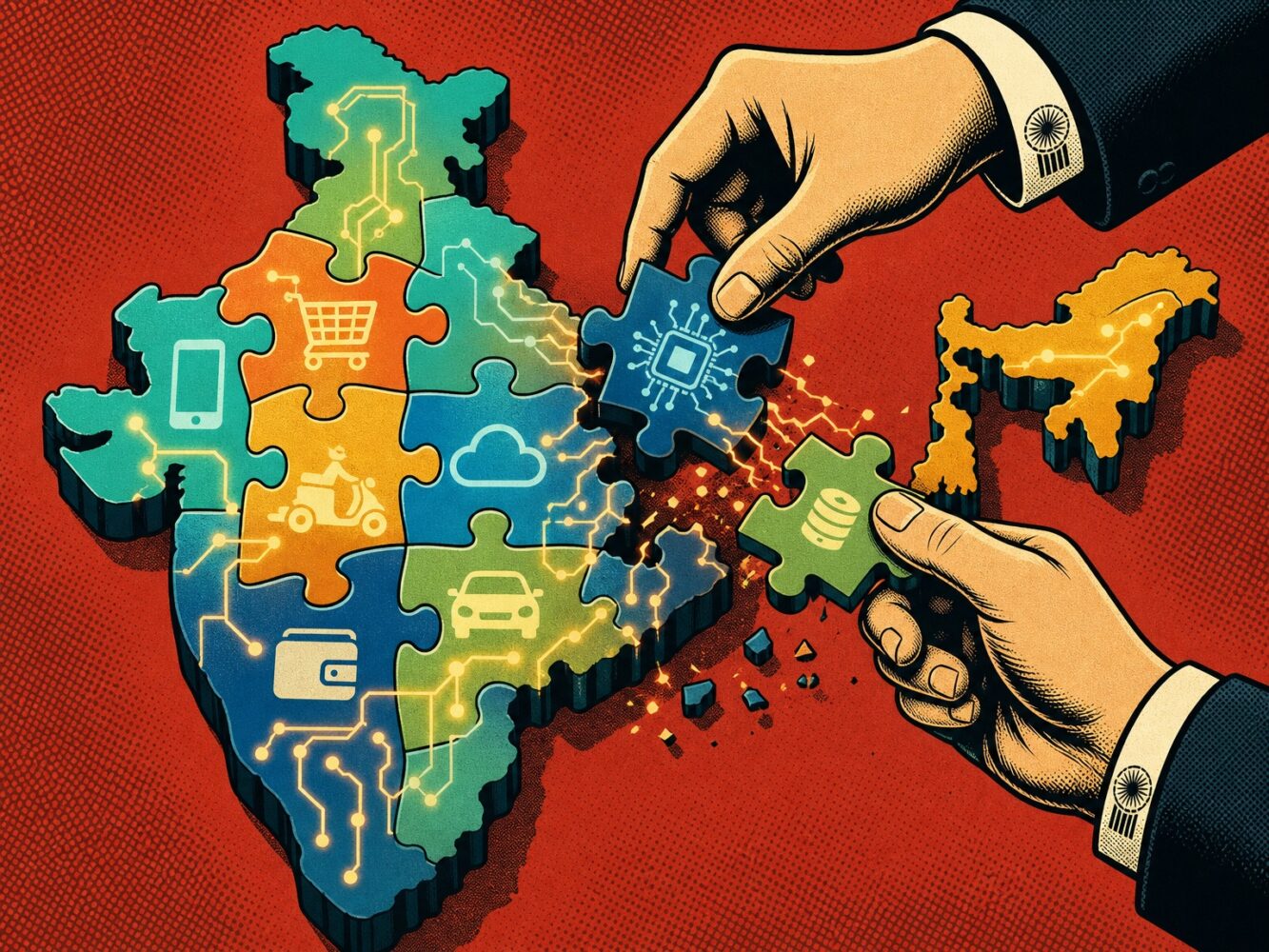
Good intentions make for lousy competition law when they are stapled to bad economics. That is the trouble with the new fashion in digital regulation: It treats integration as suspicion, product design as coercion, and innovation as something firms may pursue only after regulators decide it is sufficiently tidy.
The European Union’s Digital Markets Act (DMA) is the clearest recent example. The DMA did not emerge because economists suddenly discovered universal truths about digital markets. It reflects a specific regulatory judgment: that the costs of underenforcement in digital markets outweigh the risks of overenforcement, and that values like fairness and contestability can justify departing from effects-based analysis. Whether those tradeoffs make equal sense for countries like India is a very different question.
India’s Draft Digital Competition Law, still in gestation, appears poised to follow the same path. Both regimes treat tying and bundling by dominant digital platforms as presumptively illegal. Both impose categorical ex ante prohibitions on practices economists have long recognized as frequently efficiency-enhancing.
In doing so, both misunderstand not only the economics of digital markets, but also the basic reality of how digital products are built. The laws’ treatment of tying and bundling make that failure especially vivid. They also make it especially consequential for a country like India, whose economy increasingly depends on technological innovation and is now being reshaped by artificial intelligence (AI).
Brussels Is Not Bangalore
India’s Draft Digital Competition Law emerged, in large part, from the gravitational pull of the Brussels Effect. The two government reports that anchor the draft law—the Parliamentary Standing Committee’s 2022 report and the Ministry of Corporate Affairs’ 2024 follow-up—borrow directly from the DMA’s architecture.
On tying and bundling, the first report effectively copy-pasted Article 5(8) of the DMA wholesale. The draft article provides:
The Committee thus are, of the view that a SIDI should not force business users or end users to subscribe to, or register with, any further service as a condition for being able to use, access, sign up for registering with any of that platform’s core platform service.
That language imposes an absolute bar on gatekeepers requiring users of one core platform service to subscribe to, register with, or use another core platform service as a condition of access. No exceptions. No weighing of effects. No room for the kind of case-by-case economic analysis that has characterized competition jurisprudence in both the EU and India for the better part of three decades.
Before accepting this as a reasonable model, India should ask a question the drafters appear not to have considered: Was the DMA designed for India, or for Europe?
The answer is plainly Europe—and perhaps not even all of Europe. The DMA’s per se approach to bundling reflects a deliberate regulatory tradeoff that makes sense, if it makes sense at all, only within the EU’s specific political economy. Of the top 100 technology companies in the EU by market capitalization, 74 are American. The DMA is, at least in part, an instrument of digital sovereignty: a mechanism to constrain the dominance of U.S. platforms and clear space for European tech firms. Whether that goal justifies the economic costs is a normative question Europeans must answer for themselves. It is emphatically not India’s problem to solve.
At a more technical level, India’s draft law, like the DMA, wrongly assumes that all gatekeepers operate on similar business models and that digital markets are uniformly “winner-take-all.” The result is a one-size-fits-all set of 18 obligations that risks significant error costs—that is, the economic harm caused when regulators mistakenly condemn beneficial conduct or miss harmful conduct.
India’s digital economy has its own competitive dynamics: fierce regional differentiation, strong multi-homing, and platform markets that look nothing like the winner-take-all archetypes animating Brussels’ regulatory imagination. In India’s taxi market, for example, Uber does not dominate everywhere. Goa Miles dominates in Goa, Namma Yatri in Bangalore, and Ola competes fiercely nationwide.
Applied to India, DMA logic could sweep in many homegrown technology companies with regional strength and varied business models, categorizing them as gatekeepers despite their very different competitive realities.
Case-by-Case Beats Copy-and-Paste
Here is what proponents of India’s Draft Digital Competition Law rarely acknowledge: India already has a sophisticated, effects-based framework for adjudicating tying and bundling cases. And it works.
Under Section 4(2)(d) of the Competition Act, 2002, tying by a dominant firm is prohibited when three conditions are met: the tying and tied products are distinct; access to one product is conditioned on acceptance of the other; and that conditionality forecloses competition in the tied market. Critically, any finding of anticompetitive conduct also requires proof of an “Appreciable Adverse Effect on Competition.” That standard obliges competition authorities to weigh both pro- and anticompetitive effects ex post.
Despite periodic suggestions that Section 4 functions as a quasi-per se prohibition, the Supreme Court settled the issue definitively in Competition Commission of India v. Schott Glass India Pvt. Ltd. (May 2025). The Court held unequivocally that a per se reading of Section 4 is wrong. Demonstrable market effects must be shown, and the analysis must account for both competitive harm and legitimate business justifications.
The practical record shows the framework works as intended. When the Competition Commission of India (CCI) found Google liable for tying its Play Billing System to app distribution, it did so only after conducting a careful effects-based analysis showing concrete harms to innovation, developer autonomy, and ultimately consumer welfare. When similar claims were brought against Apple’s in-app payment rules, the same framework produced a similarly reasoned analysis.
The CCI did not need a categorical prohibition to identify abusive conduct. It needed the right analytical tools, and it already had them.
The real question, then, is not whether India needs a competition-law framework capable of handling digital tying. It already has one. The question is whether replacing careful case-by-case analysis with categorical prohibitions would improve that framework.
It would not.
Sometimes Integration Is the Product
Tying arrangements generate efficiencies across multiple dimensions. They can reduce production, distribution, and licensing costs—often substantially—when demand for bundled components is positively correlated. They can improve product quality by solving compatibility problems that arise when consumers combine components from different providers. They reduce consumer search costs, which become increasingly burdensome as products grow more technically complex. And they can solve the problem of double marginalization: when two monopolists sell complementary products independently, each adds its own monopoly markup; vertical integration through tying eliminates the duplicated markup and can reduce final prices for consumers.
These are not abstract artifacts of the Chicago School. They are widely documented empirical regularities.
In digital markets, these efficiencies do not weaken. They intensify.
Software products typically involve high fixed costs and near-zero marginal costs, which magnifies the gains from cost reduction. Compatibility problems in complex technological products are also far more severe than in traditional manufacturing markets. A smartphone operating system, cloud platform, or AI ecosystem is not a kitchen mixer with interchangeable attachments.
The value of reducing consumer search costs is especially high in markets where many users lack the technical expertise to assemble and optimize products independently. That matters in India, where digital adoption has expanded rapidly, but digital literacy remains uneven. Much of India’s 1.4 billion-person population still lacks the technical knowledge to navigate highly modular digital ecosystems efficiently.
Yet these efficiencies are largely absent from the DMA’s framework and from India’s draft law. That omission creates substantial error costs by treating potentially beneficial integration as presumptively suspect.
There is also a category of efficiency unique to technological markets that antitrust doctrine has long struggled to describe clearly—and that categorical per se rules are structurally incapable of recognizing at all. It requires its own conceptual vocabulary.
When 1 + 1 = 3
Systems theory uses the concept of emergence to describe a specific phenomenon: when components combine into a system, the system can acquire properties that are not present in—and cannot be predicted from—the individual parts.
The classic examples are physical. Water is wet; hydrogen and oxygen, individually, are not. A murmuration of starlings produces fluid, coordinated movement that no individual bird directs. Ant colonies build and maintain complex infrastructure without any ant understanding the overall design. The emergent property—wetness, coordinated flight, colony architecture—belongs to the system as a whole. Break the system apart, and the property disappears.
The same phenomenon appears in technology.
Technological integration, properly understood, occurs when two or more components are combined at a sufficiently deep technical level that the integrated system acquires a genuinely new capability—something neither component can perform independently, and something that cannot be recreated simply by running both side by side.
That distinction matters. Bundling two apps onto a home screen is not technological integration. Nor is preinstalling a search engine alongside a browser in the relatively superficial sense addressed in the Google Android case. Technological integration, in the emergent sense, occurs when components are architected together so that their interaction produces a new system-level capability.
The result is not merely Component A plus Component B. It is Product C—with distinct functionality, distinct user value, and often distinct consumer demand.
Apple’s Face ID illustrates the point clearly. Three components work together: the TrueDepth infrared camera array, which captures detailed three-dimensional facial geometry; a neural-network recognition system, which processes and matches that data against a stored template in real time; and the Secure Enclave’s cryptographic architecture, which stores authentication data and executes verification without exposing sensitive information to the operating system.
Each component can be described independently. None, standing alone, performs secure biometric authentication.
The authentication capability emerges from their integration. Remove the Secure Enclave, and the system loses its trusted execution environment. Remove the neural network, and the camera loses its matching capability. The emergent system—secure, real-time, privacy-preserving biometric authentication—depends on the integration itself. Put simply, it does not survive unbundling.
A second example comes from medical diagnostics. A medical-imaging tool integrated with a convolutional neural network trained on longitudinal patient data can forecast disease risk decades in advance. The imaging tool alone captures anatomical structure. The neural network alone classifies patterns. But the integrated system, trained on the relationship between imaging features and long-term clinical outcomes, produces predictions neither component could generate independently. The diagnostic capability emerges from the integration.
Increasingly, AI-driven product design follows the same logic. When a large language model is integrated architecturally into a productivity suite—not as a chatbot bolted onto the side of an existing application, but as a capability woven into document editing, email composition, data analysis, and workflow automation—the result is a fundamentally new kind of tool.
The product is no longer simply “word processor plus AI.” It becomes a qualitatively different productivity environment whose capabilities depend on deep technical co-design between the components.
This is precisely why the standard “separate product test” in tying analysis—which asks whether the tied and tying products had independent pre-existing demand—is the wrong framework for evaluating emergent integrations.
The test is inherently backward-looking. It asks whether the products existed separately before integration occurred. Emergence, by definition, creates something new. The integrated system could not have generated prior independent demand because it did not previously exist as an integrated system. Applying a backward-looking demand test to forward-looking innovation will systematically misclassify valuable integrations as presumptively suspect.
Before the DMA, European courts in the Microsoft litigation gestured toward a more sensible framework when they held that technological integration must produce “superior technological efficiency” specifically dependent on the tie. That standard imperfectly captures the logic of emergence. It asks not whether products were historically separate, but whether integration produced something genuinely new and better.
It is an imperfect test, but at least it asks the right question.
The DMA abandoned that approach entirely. India’s draft framework, with its backwards-looking “integral to the core service” exemption introduced in the 2024 report, risks making the same mistake.
Innovation, but Only If It Already Exists
The Ministry of Corporate Affairs’ 2024 report acknowledged, at least in principle, that a blanket prohibition would be too blunt. It proposed a narrow exemption for ties that are “integral to the provision of the Core Digital Service,” leaving the Competition Commission of India to specify, through future regulations, what qualifies.
That is better than nothing. It is not nearly good enough.
The amended draft provision provides:
15. Tying and Bundling: A SIDI shall not require or incentivize business users or end users of the identified Core Digital Service to use on or more of the Systemically Significant Digital Enterprise’s other products or services, or those of: (a) Related parties; or (b) Third parties with whom the Systemically Significant Digital Enterprise has arrangements for the manufacture and sale of provision of services Alongside the use of the identified Core Digital Service, unless the use of such products or services is integral to the provision of the Core Digital Service.
Explanation: For the purpose of this section, the Commission may specify, by regulations, the nature of products or services that may be considered ‘integral’ to the provision of a Core Digital Service.
The exemption is backward-looking by design. If a product feature was not already part of the core service, it may not count as “integral” to that service—no matter how transformative the integration may be. This freezes product definitions at the moment of designation and penalizes precisely the kind of forward-looking, emergent innovation that drives value in digital markets.
The rule effectively tells firms that technological improvement through integration is presumptively unlawful unless it mirrors the historical baseline. When innovation arises through emergence—where combining products A and B creates a new product C—a legal framework that tethers the value of C to the original provision of A risks pixelating emergent innovation, reducing a novel creation to its constituent inputs.
The exemption also introduces a new and more opaque form of legal uncertainty. By delegating the definition of “integral” to future regulation, it replaces judicial standards with discretionary administrative determinations. Those determinations may be made without transparent market studies, meaningful appellate mechanisms, or stable limiting principles—and may be reclassified at any point.
That is not an improvement over the effects-based framework. In important respects, it is worse: less predictable, more susceptible to capture, and further removed from principled economic analysis.
Crucially, the exemption makes no room for economic justification. It does not ask whether a tie reduces search costs, counters double marginalization, resolves compatibility problems, or produces superior technological efficiency. Those are precisely the factors Indian courts have long weighed in Section 4 cases.
Under the draft law, they disappear entirely.
The exemption is not a return to economic reasoning. It is a fig leaf on top of a prohibition.
The AI Problem the DMA Cannot See
The inadequacy of both the DMA and India’s draft framework becomes clearest in frontier cases.
Consider, hypothetically, Microsoft’s integration of OpenAI’s model into Microsoft 365 through Copilot. Under the DMA, the threshold question is whether Microsoft’s AI offering qualifies as a “core platform service,” and whether Article 5(8) therefore applies at all. If AI-generated content tools do not qualify as core services, the analysis reverts to traditional Article 102 doctrine.
At that point, the familiar problems return. Does an iterative, self-learning AI assistant have independent demand apart from the productivity suite into which it is integrated? The answer is far from obvious. So, too, is whether the integration produces the kind of “superior technological efficiency” recognized in the pre-DMA Microsoft jurisprudence—the standard European courts developed before the DMA largely swept it aside.
Those are difficult questions. A per se rule simply refuses to ask them.
Under India’s draft framework, the result is arguably worse. Microsoft Office would likely qualify as the core digital service. Copilot would be supplied through a commercial arrangement with a third party. On a literal reading of Section 15 of the draft law, the integration would therefore be unlawful unless Copilot were “integral to the provision” of Office.
But Office plainly functions without Copilot.
The rule would thus classify a genuine AI-driven productivity innovation as an anticompetitive tie in complete disregard of emergence. Not because the integration forecloses competition. Not because it harms consumers. But because the capability did not exist in the product before.
That is not effects-based competition analysis. It is regulatory formalism masquerading as technological neutrality.
Europe’s Regulatory Politics Are Not India’s Future
India should resist the DMA’s pull—not because tying is always benign, but because the economics of tying are always contextual. That is especially true in the age of AI.
The right framework starts from the premise that tying warrants scrutiny, not automatic condemnation. A structured effects-based analysis should weigh demonstrated harms—leveraging, foreclosure, and price obfuscation—against the full range of pro-competitive efficiencies, including technological integration in the emergent sense described above.
The European Commission’s pre-DMA approach—which asked whether an integration produced “superior” functionality genuinely dependent on the tie—offers a workable and economically coherent template. India’s Competition Act, updated to codify explicit exemptions for emergent technological integration and to clarify the role of multi-homing and switching costs in foreclosure analysis, would be far better equipped to handle AI-era tying cases than any per se rule imported from Brussels.
Multi-homing matters here, especially in India. Users routinely rely on multiple platforms simultaneously across food delivery, payments, ride-hailing, messaging, and e-commerce. That reality substantially weakens the lock-in logic underlying many foreclosure theories. Strengthening data portability through frameworks like the Data Empowerment and Protection Architecture (DEPA) would weaken switching costs further, limiting the anti-competitive potential of even aggressive tying strategies.
The goal of competition law, as the Indian Supreme Court reaffirmed in Competition Commission of India v. Schott Glass India Pvt. Ltd., is to protect competition through consumer welfare—not to protect competitors from competition.
Protecting competition in India’s digital economy means preserving incentives to innovate through integration, not sacrificing them in pursuit of regulatory symmetry with the EU.
India does not need a digital competition regime that mistakes integration for abuse, innovation for foreclosure, and product improvement for coercion.
It certainly does not need to reinvent the License Raj for the AI era.