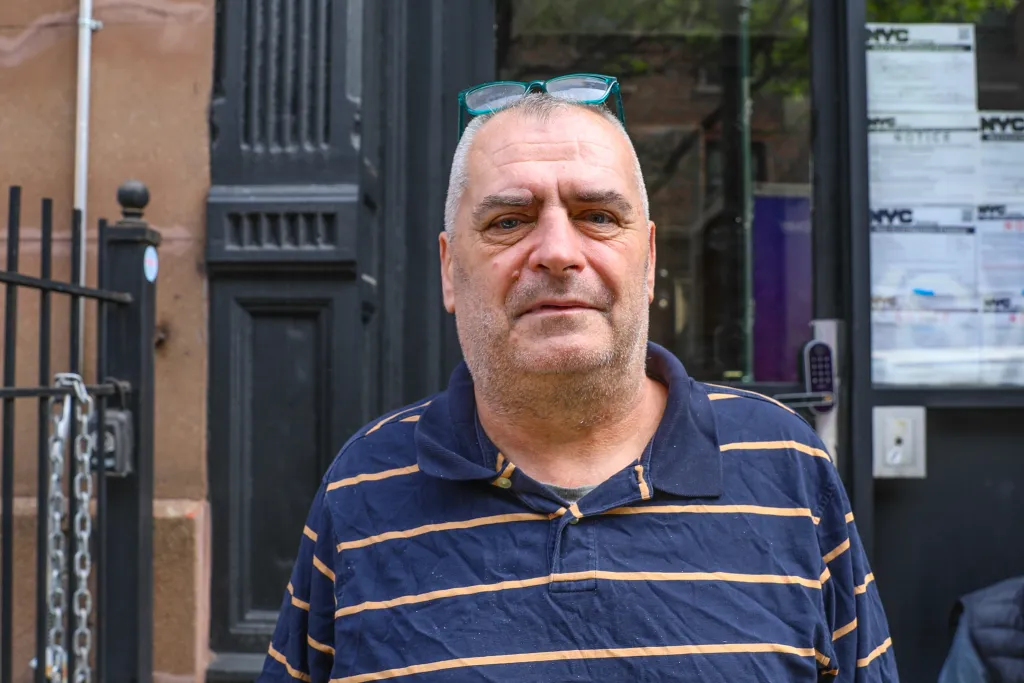
By the time the police took him away, Garratt Kennedy had already been at war for months with his landlord, a new owner who was trying to turn the gritty Hell’s Kitchen SRO Kennedy called home into a slick Times Square hotel.
Kennedy is 59 and had lived in his cramped, 100-square-foot, rent-stabilized SRO room for more than 25 years when the owner began tearing the place up, ripping out the staircase and blocking access to a shared bathroom on his floor. Which was why he says he had to break the lock on a shower room a floor below to bathe.
The next morning the police arrived. The landlord accused him of breaking the lock “with a hammer,” which “caused pieces of the doorframe to chip off.” Kennedy was charged with criminal mischief.
“That Saturday they handcuffed me and brought me down the stairs, the whole nine yards,” he recalled. “I had to go to Midtown North precinct. They put me in a cell, then they let me go.”
Kennedy’s Nov. 28 arrest was a small engagement in the raging war over real estate and affordable housing in New York. Single-room occupancy apartments — where residents share common bathrooms in exchange for lower-cost housing — are the most threatened form of affordable housing in the city. In the early 20th Century, New York had an estimated 100,000 SRO units; today, it’s around 30,000.

Weeks after Kennedy’s arraignment, his lawyer, Kathy Huang, got the charge dismissed, but the landlord soon moved to evict him, alleging he was two months behind on rent.
Kennedy says he paid his rent — as he has since the building changed owners in 2024 — with money orders, while the landlord says it hasn’t received them. A judge recently postponed the eviction request, ordering Kennedy to provide proof of the payments.
The retired electrician’s eviction case is one of nine lawsuits the owner has filed against SRO tenants in the building over the last year; several packed up and left. As of last week, 12 of the property’s 18 rooms had been converted to hotel rooms, their key locks converted to code pads.
The four-story tenement at 417 West 44th St. is a relic of a bygone age when Hell’s Kitchen was home to hundreds of SROs and the rent went for hundreds rather than thousands of dollars a month. Back in the day, the Irish-American gangsters the Westies claimed Hell’s Kitchen as their own, as did Daniel Patrick Moynihan, the future statesman and U.S. Senator who grew up there.
Those gritty streets have slowly receded, transformed by economic forces. Times Square’s reputation as a haven for mob-controlled porno theaters was replaced by Disney-oriented entertainment on 42nd Street that’s attracted a new wave of family-oriented tourists seeking hotel rooms in Manhattan’s new hot locale.
Last year the owners who acquired Kennedy’s building began advertising the building on booking sites as the 417 Aycee Hotel, describing it in stilted English as “nestled in the Broadway Theater district, merely 1.5 KM from sports attractions, such as the multi-purpose indoor arena ‘Madison Square Garden‘.”
The “Aycee” offers small rooms with free Wifi, air conditioning and not much else for $220 a night. The ads do not mention the SRO tenants living down the hall who are fighting eviction. On a recent day, THE CITY watched as SRO tenants and hotel guests passed each other in the hall.
For generations, SROs served a much-needed role in a city with a persistent dearth of affordable housing. Replacing these lower-priced SRO units with hotel rooms would diminish the already anemic supply of desperately needed housing that for years offered rent those with limited means could afford, said Helene Hartig, a lawyer representing another tenant in 417 W. 44th.
Hartig says converting an $800-a-month SRO unit to a hotel room that could net $6,600 a month has created an impossible dynamic for longtime residents.
“The landlord is making money hand over fist, which incentivises them to kick out the old timers,” Hartig said. “If he cleans out the building, it will be a hotel — not an SRO. Even though this may be technically legal, it goes against the need for affordable housing.”
“All they want is to pay their rent and be left alone,” she added. “I mean, where are they going to go?”
Hartig questioned whether the owner is following the law in ripping up the building while moving to evict the SRO tenants, all of whom live in units that are rent stabilized. She notes that because the building is designated as “SRO restricted,” the owners must first file a Certification of No Harassment with the city — documentation in which the tenants attest that they haven’t been intimidated by the landlord — before performing major renovations.
“I believe that a certificate of non-harassment is needed to amend the certificate of occupancy. Significant renovations were made — including bathrooms that were closed for months,” Hartig said.
The limited liability corporation that owns the property, 417 West 44th LLC, has filed no such certification, despite the fact that they’ve already conducted major renovations and some tenants allege that the owners have launched a harassment campaign to get them out.
The owner has moved to evict Hartig’s client, John Down, 66, who also insists he’s paid consistently and on time by money order. In a court filing, Down charged the owner with trying to evict “all the old timers,” and accused him of harassment.
“My mean spirited landlord even recently closed off the bathroom on our floor,” he said. “I was forced to use the local gym to shower. I was forced to climb up and down the stairs in the middle of the night — risking a fall — to use the bathroom.”
Following THE CITY’s inquiry about whether Certifications of No Harassment are required at the building, Andrew Rudansky, a spokesperson for the Buildings Department, said the agency has opened an audit of the owner’s filings regarding the scope and nature of the work performed there.
In New York City, only properties designated either as SROs or hotels — dubbed B-Buildings — are permitted to rent out rooms for less than 30 days. But to be declared a hotel, as the owner of Kennedy’s SRO is doing on booking sites, the building must have at least 30 “sleeping rooms.” This building has 18. An official with the Mayor’s Office of Special Enforcement, which enforces the law regarding transient rentals and hotels, said they were looking into the 30-room requirement at 417 W. 44th St.
On a recent visit, one of the owners, who declined to give his name, said the conversion was legal because it is a B-building. A lawyer for the owners, Howard Chun, didn’t immediately respond to a request for comment.

Kennedy — who says he’s lived at 417 West 44th for more than 25 years — plans to fight his eviction by tracing the money orders he says he wrote for his rent. He recently stood in his small room, his knee wrapped in a makeshift brace made of duct tape after he broke his leg in a recent slip-and-fall, showing a reporter receipts for those payments.
His room included a double-bed that took up nearly a third of the space, a flat-screen TV on the wall, a small fridge and hot plate. Boxes of clothing and his life’s accumulations filled much of the rest of the space.
Down the hall Hartig’s client, Down, said he, too, must prove that he’d paid the landlord with money orders the landlord denies receiving. He says he spoke with a postal supervisor who told him his money orders had been cashed.
His arms folded across his chest, Down said: “I’m not going nowhere.”
Our nonprofit newsroom relies on donations from readers to sustain our local reporting and keep it free for all New Yorkers. Donate to THE CITY today.
The post ‘They Put Me In a Cell’: Old-Timers Fight Eviction From the New Times Square appeared first on THE CITY – NYC News.