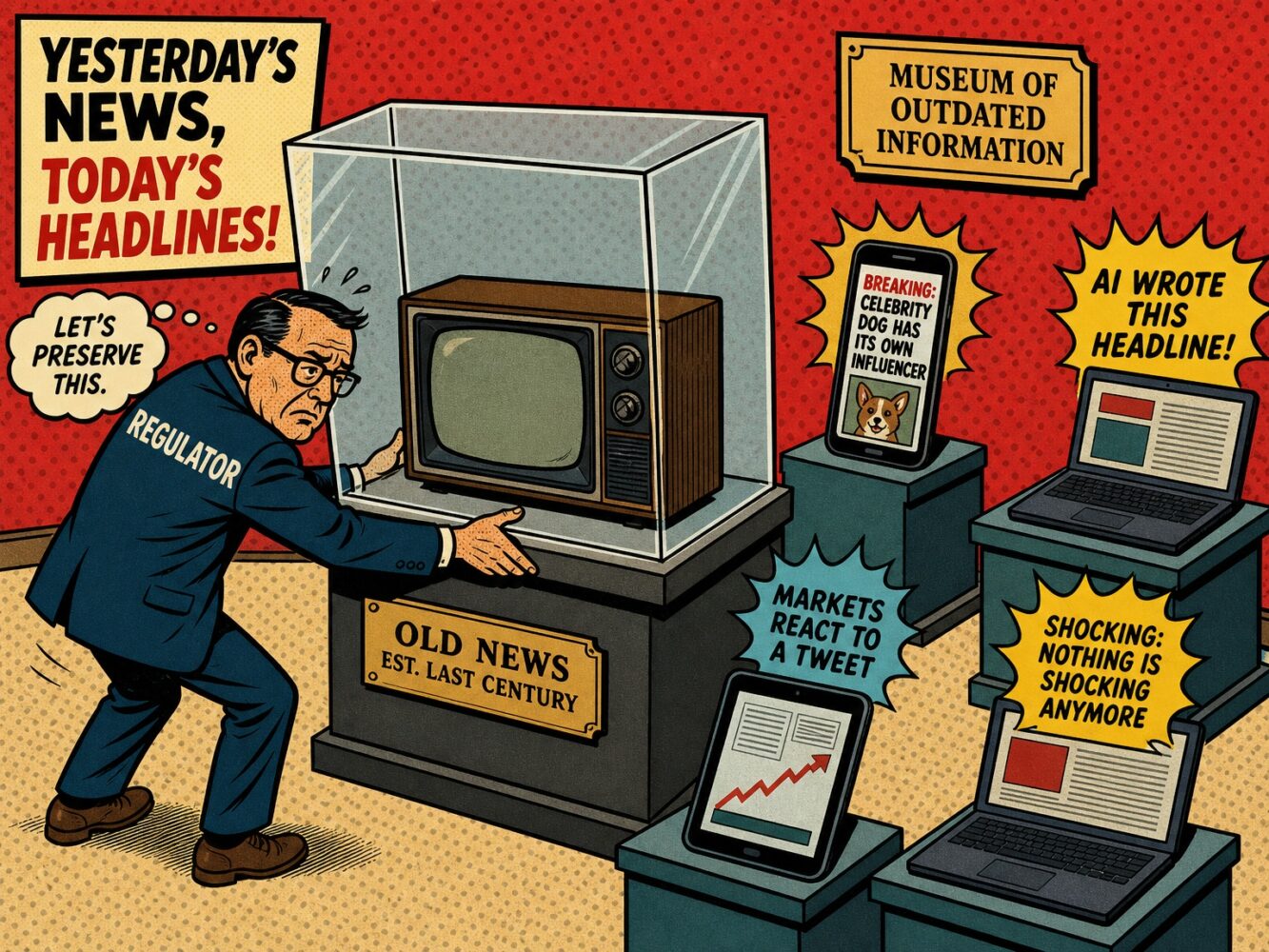
The local news business has spent the past two decades being “saved” by people who mostly seem to want it embalmed. Every new shift in how Americans consume information—websites, social feeds, newsletters, podcasts, short-form video, artificial-intelligence summaries—gets treated less like evidence of adaptation than proof that civilization will soon forget how school-board meetings work.
That anxiety is understandable. But preserving the old delivery system is not the same thing as preserving journalism.
The News Business Is Evolving. Washington Wants It Taxidermied.
In “The Future and Its Enemies,” Virginia Postrel framed the central political conflict as one between dynamism and stasism. Dynamism treats the future as fundamentally unknowable. The best outcomes emerge through experimentation, competition, and individual choice. Stasists, by contrast, see change as a threat and prefer a predictable, stable, orderly world managed by institutions and experts. Postrel further divided stasists into two camps: technocrats, who believe change should occur only under expert supervision toward some rationally designed end, and reactionaries, who long to restore a perceived “golden age.”
Modern debates about journalism policy often manage to combine both instincts at once.
The rise of the internet disrupted the traditional business models of television broadcasters, forcing firms to adapt to changing consumer preferences. Broadcasters consolidated. Large station groups acquired local outlets. Newsrooms shrank. Cue the predictable policy panic. Commentators and lawmakers increasingly argued that government should protect local broadcast television from competitive pressures in order to preserve local journalism.
Indeed, it is a technocratic program in service of a reactionary goal: preserving an older media structure because the alternative feels unfamiliar, chaotic, or uncomfortable.
The problem is that stasism consistently overestimates what regulators can know about fast-moving markets. Policymakers may look at the closure of a local broadcast newsroom and conclude that local news itself is disappearing. But the decline of one legacy distribution model does not necessarily mean consumers receive less local reporting overall. It may simply mean audiences—and advertisers—have moved elsewhere.
Viewed through a dynamist lens, the news industry is not collapsing so much as mutating, sometimes awkwardly and noisily, into something new. New business models, distribution strategies, and products continue to emerge to meet consumer demand in formats audiences increasingly prefer. Some experiments will fail. Many already have. That is what experimentation looks like outside a PowerPoint presentation.
Regulators cannot reliably predict which models will succeed because no central planner possesses enough information to forecast the future of a rapidly evolving information market. Markets exist precisely because knowledge is dispersed. Consumers, entrepreneurs, advertisers, journalists, and platforms all respond to localized information and changing incentives in ways no regulator can fully aggregate in advance. Protecting incumbent broadcasters merely because policymakers cannot imagine what comes next risks preventing those alternatives from emerging at all.
Much of the current debate surrounding “local news” nonetheless treats the decline of traditional broadcasting as either sudden or temporary. It is neither. Consumer migration toward digital distribution began more than two decades ago, back when people still willingly used Internet Explorer. Policymakers should therefore resist framing the issue around preserving legacy institutional arrangements or reacting to anecdotal examples of newsroom decline featured in the very outlets under discussion.
The relevant question is not whether a particular historical market structure survives indefinitely. Very few do. The relevant question is whether consumers continue to receive access to information, civic reporting, and local accountability through evolving competitive mechanisms.
More to the point, local news has not disappeared. It has increasingly shifted to digital markets. That transition will inevitably involve instability, failed business models, and periods of genuine disruption. But that process is also how sustainable digital media ecosystems develop. If regulators decide intervention is necessary, they should focus on identifiable consumer harms, rather than attempting to engineer the “correct” structure of the media market from Washington.
Local News: Not Quite Dead Yet
Pew Research Center has extensively documented the long-term shift in how Americans consume news, particularly local television news. In 2024, only 32% of Americans identified television—including local cable channels—as their primary source of local news. In 2018, that figure was 41%. The trajectory is not subtle.
Radio, by contrast, has remained surprisingly stable. Roughly 9% of Americans prefer it as their primary local-news source, and that figure has held relatively steady over time. That suggests at least some baseline audience for traditional broadcast formats may persist. But “persist” is not the same thing as “dominate.”
Ratings data reinforce the broader trend. In 2016, affiliates of ABC, CBS, Fox, and NBC averaged just under 4 million viewers during primetime news programming and just under 2.5 million viewers during midday broadcasts. By 2022, those figures had fallen to roughly 2.2 million and 1.8 million viewers, respectively. Consumers are not abandoning news altogether. They are abandoning scheduled television viewing.
That shift has obvious consequences for the economics of local broadcasting. Over-the-air advertising revenue has steadily declined for years. In 2004, local television advertising revenue reached $22.4 billion. Today, it sits at roughly $15.5 billion—a 56% decline after adjusting for inflation.
Retransmission fees paid by multichannel video programming distributors (MVPDs), meanwhile, continue to rise. But those fees can be misleading as a measure of the value consumers place on local news itself. Retransmission-consent rules, many of which date back to a very different media environment, distort the market. In practice, MVPDs largely pay for access to high-value national programming, especially live sports and marquee network content such as Sunday Night Football. Because local broadcasters operate as network affiliates, national networks can effectively require stations to pass a substantial share of retransmission revenue upstream.
At first glance, those numbers paint a fairly bleak picture for local broadcasters. Curiously, though, declining broadcaster stability has not necessarily translated into less local news programming. Quite the opposite. Over the past 20 years, the average number of local TV news hours broadcast per weekday increased from just under 4 hours to more than 6.5 hours.
That does not mean local journalism is flourishing. Newsrooms around the country continue to face layoffs, budget cuts, and consolidation pressures. But it does suggest broadcasters still view local news as a valuable way to differentiate themselves in an increasingly fragmented media market. The quantity of local broadcast news available to consumers has not declined nearly as dramatically as the broader rhetoric surrounding “news deserts” might imply.
There is, of course, an important caveat. Local broadcasters—particularly those owned by large national groups—increasingly blend national content into local broadcasts. Syndicated stories and nationally produced segments allow station groups to spread production costs across multiple markets while preserving the appearance of robust local coverage. In effect, broadcasters can maintain the volume of news programming while reducing the cost of producing genuinely local reporting.
The News Survived the Medium
Importantly, declining viewership and shrinking advertising revenue for local broadcast stations do not necessarily mean the overall supply of local news has declined. In many respects, the opposite appears true. Consumers have not stopped consuming local news. They have simply migrated to digital platforms where news is cheaper, faster, and more convenient to access.
Local broadcasters themselves increasingly acknowledge this reality. Many stations now maintain substantial digital operations that no longer function merely as sidecar websites for broadcast content. Digital publishing increasingly operates alongside television production as part of an integrated newsroom strategy designed to avoid duplicative work, expand audience reach, and attract younger consumers who regard appointment television the way earlier generations regarded carrier pigeons.
These digital platforms also create new advertising opportunities while funneling some viewers back toward traditional broadcasts. Consumers benefit from additional engagement opportunities with local outlets and from receiving news in formats they actually use, rather than formats policymakers nostalgically wish they still used.
Newspapers have undergone a similar transition. Faced with declining print revenue and distribution costs that increasingly resemble a hostage situation, many local papers shifted aggressively toward digital subscriptions and online advertising. Some of those efforts are working. Top-performing news organizations have experienced 77% growth in digital subscriber volume, while 83% of local media companies forecast digital advertising revenue to either increase or remain stable in 2025.
The Minneapolis Star Tribune offers a particularly instructive example. After emerging from bankruptcy in 2009, the paper reorganized as a for-profit public benefit corporation and focused heavily on “utility reporting”—coverage that readers find directly useful in their daily lives, from local politics and schools to weather and community events. That strategy helped the paper surpass 100,000 digital-only subscriptions.
Many successful digital models also increasingly rely on bundling. News subscriptions now frequently include games, recipes, podcasts, or other lifestyle features that encourage consumers to engage multiple times throughout the day. Critics sometimes dismiss these features as distractions from “real journalism.” Consumers, meanwhile, appear to like receiving products they actually use.
The News Desert Might Have Wi-Fi
To be sure, the decline of traditional broadcasters and newspapers can leave some communities with fewer legacy-news options. That phenomenon has given rise to the now-common term “news deserts”—geographic areas with little or no access to professional local journalism. The problem stems from pressures facing both broadcasters and local newspapers. In 2024 alone, 127 newspapers ceased operations, and more than 200 U.S. counties reportedly lacked a single locally based news outlet.
That sounds alarming because, in many cases, it is. Local reporting serves important civic functions. Somebody needs to sit through city council meetings, track school-board disputes, and notice when the county comptroller suddenly starts billing taxpayers for suspiciously frequent “consulting retreats” in Boca Raton.
Still, the existence of a market gap also creates a market opportunity.
In many communities, hyperlocal digital outlets have emerged to fill at least part of the vacuum. Hyperlocal journalism focuses on highly specific geographic communities—sometimes a single town, neighborhood, or suburban corridor—and covers issues larger regional or national outlets often ignore. These publications emphasize intensely local concerns: zoning fights, municipal budgets, high-school sports, local business openings, school-board politics, and the like.
Historically, hyperlocal journalism struggled because small audiences rarely generated enough revenue to offset the high fixed costs of print production and distribution. Running a newspaper turns out to be expensive when one must physically manufacture and deliver thousands of copies every day.
Digital infrastructure changes that equation considerably. Online distribution dramatically lowers overhead costs, allowing smaller publications to survive with narrower audiences. Digital distribution also expands the potential readership beyond the immediate community itself. Former residents, local alumni, nearby commuters, and people with niche regional interests can all consume the same content without ever touching a print edition. Ironically, the internet may make certain forms of intensely local journalism more economically viable than they were during the supposed golden age of local newspapers.
Walter Cronkite Never Had a Substack
Relatedly, many Americans now receive news primarily through social media platforms rather than traditional news outlets. Approximately 53% of U.S. adults access news through social media—a larger share than those who primarily rely on television or news websites and apps. Much of that shift comes from younger consumers. Adults under 30 increasingly treat social media as their default information environment, while older Americans remain far more attached to legacy media.
Traditional news organizations still operate on these platforms, of course. But social media has also lowered the barriers to entry for entirely new kinds of news providers. So-called “news influencers” now serve as a primary news source for roughly 37% of Generation Z and nearly 20% of Americans overall.
Part of their appeal is stylistic. These creators often adopt a conversational, peer-to-peer tone that feels more authentic—or at least less corporate—than traditional broadcast journalism. They also operate outside many of the institutional constraints that govern legacy newsrooms. Without layers of editors, producers, standards departments, and legal review, influencers can respond more quickly, speak more casually, and tailor content specifically for platform algorithms and audience engagement.
Just as importantly, many of these creators are building business models designed for the internet, rather than awkwardly retrofitted onto it. Revenue from platform partnerships, sponsorships, direct subscriptions, and services such as Substack can allow smaller creators to monetize niche audiences more effectively than some legacy outlets still trying to preserve advertising models built for the Clinton administration.
This shift also reflects a broader change in how audiences evaluate credibility. Traditional media institutions historically acted as information gatekeepers, applying editorial standards intended to filter errors, verify claims, and limit the spread of misinformation. That role had real benefits. It also created growing public suspicion that institutional media selectively filtered or framed information in ways audiences perceived as incomplete, biased, or overly curated.
As a result, many consumers increasingly place trust not in institutions, but in social relationships and perceived authenticity. In practice, people often evaluate information based less on the original source than on who shared it. A news story posted by an unfamiliar influencer may carry little weight on its own. The same story shared by a trusted friend, family member, or online personality can suddenly appear far more credible. Economists sometimes describe this as distributed trust. Everyone else describes it as “my cousin saw it on TikTok.”
People Are Informed-ish
The data increasingly point in one direction: consumers are moving toward digital sources for information and news. The stasist response—that policymakers should use technocratic tools to protect broadcasters from competition—rests on an assumption that now appears increasingly implausible. Namely, that without traditional broadcast newsrooms, citizens would simply stop consuming news and become less informed altogether.
Consumers plainly still want information. They are just consuming it differently.
That does not mean the transition to digital news comes without tradeoffs. It does mean policymakers should focus on identifying concrete harms rather than trying to preserve legacy broadcasting models for their own sake. Protecting incumbent broadcasters from competition will not reverse underlying shifts in consumer behavior any more than subsidizing fax machines would revive long-distance correspondence.
One genuine concern is that digital news consumption often encourages passivity. Consumers still want to stay informed, but many no longer want to spend 10 minutes reading a fully developed article or sitting through an evening broadcast. Historically, newspapers and scheduled broadcasts required a more intentional form of engagement, even if headlines and cable-news tickers always rewarded some degree of superficial consumption. Today, algorithmic feeds, AI-generated summaries, short-form videos, and audio briefings allow users to absorb a constant stream of information with remarkably little effort.
The result is a strange informational equilibrium in which people know a little about nearly everything and not very much about any particular thing.
A second concern involves monetization. Passive consumption weakens business models that rely on subscriptions or sustained audience engagement. If consumers feel sufficiently informed after reading an AI summary or skimming several posts on social media, the incentive to pay for deeper reporting declines. That dynamic creates a classic free-rider problem: consumers continue benefiting from original reporting while increasingly bypassing the outlets that actually bear the cost of producing it.
The internet, unfortunately, remains extremely good at distributing information and somewhat less good at convincing people to pay for it.
A third concern involves misinformation and sensationalism. Digital platforms dramatically lower barriers to entry for publishers, commentators, influencers, and outright cranks. If revenue depends primarily on advertising and engagement metrics, publishers face strong incentives to maximize clicks, shares, outrage, and virality. Sometimes rigorous reporting generates engagement. Sometimes “This Celebrity Lost 20 Pounds With One Weird Breakfast Food” performs better.
None of this is entirely new. Sensationalism predates the internet by quite a bit. But digital distribution increases both the scale and speed at which misleading or false information can spread.
Even so, nostalgia for an idealized era of local broadcasting will not solve these problems. Consumers who prefer passive news consumption are unlikely to abandon algorithmic feeds in favor of sitting through a 30-minute local newscast simply because regulators wish they would. Likewise, misinformation would persist even in a world with more local broadcasters and newspapers. False information is a function of human behavior and incentives, not merely the distribution technology used to deliver it.
These challenges may warrant policy responses. But they will not be solved by artificially propping up legacy media models that consumers increasingly choose to leave behind.
The News Keeps Surviving Its Obituaries
The conflict between dynamists and stasists runs through nearly every modern debate about journalism and media policy. The decline of legacy broadcast newsrooms understandably creates anxiety about the future of the profession. Local television stations and newspapers long occupied a central role in American civic life, and watching those institutions shrink can feel unsettling.
But institutional change does not necessarily mean the public becomes uninformed. Nor does it mean journalism disappears altogether. Consumers still demand news, information, commentary, and accountability reporting. What has changed is the technology used to deliver it, the business models that support it, and the ways audiences choose to consume it.
The stasist argument for protecting broadcasters at the expense of competing technologies rests on a flawed premise: that legacy media institutions are synonymous with journalism itself. They are not. Legacy outlets are already adapting to digital distribution, while entirely new forms of news production continue to emerge. Some business models will succeed. Others will fail spectacularly and probably launch a podcast on the way down. That process is not evidence of market failure. It is what experimentation looks like.
Policymakers should resist the temptation to freeze the media landscape in place simply because the future feels uncertain. A dynamist approach recognizes that innovation, competition, and consumer choice—not regulatory nostalgia—offer the best chance of producing sustainable forms of journalism over time.
The printing press disrupted scribes. Radio disrupted newspapers. Television disrupted radio. The internet disrupted everything. The news survived every time.
