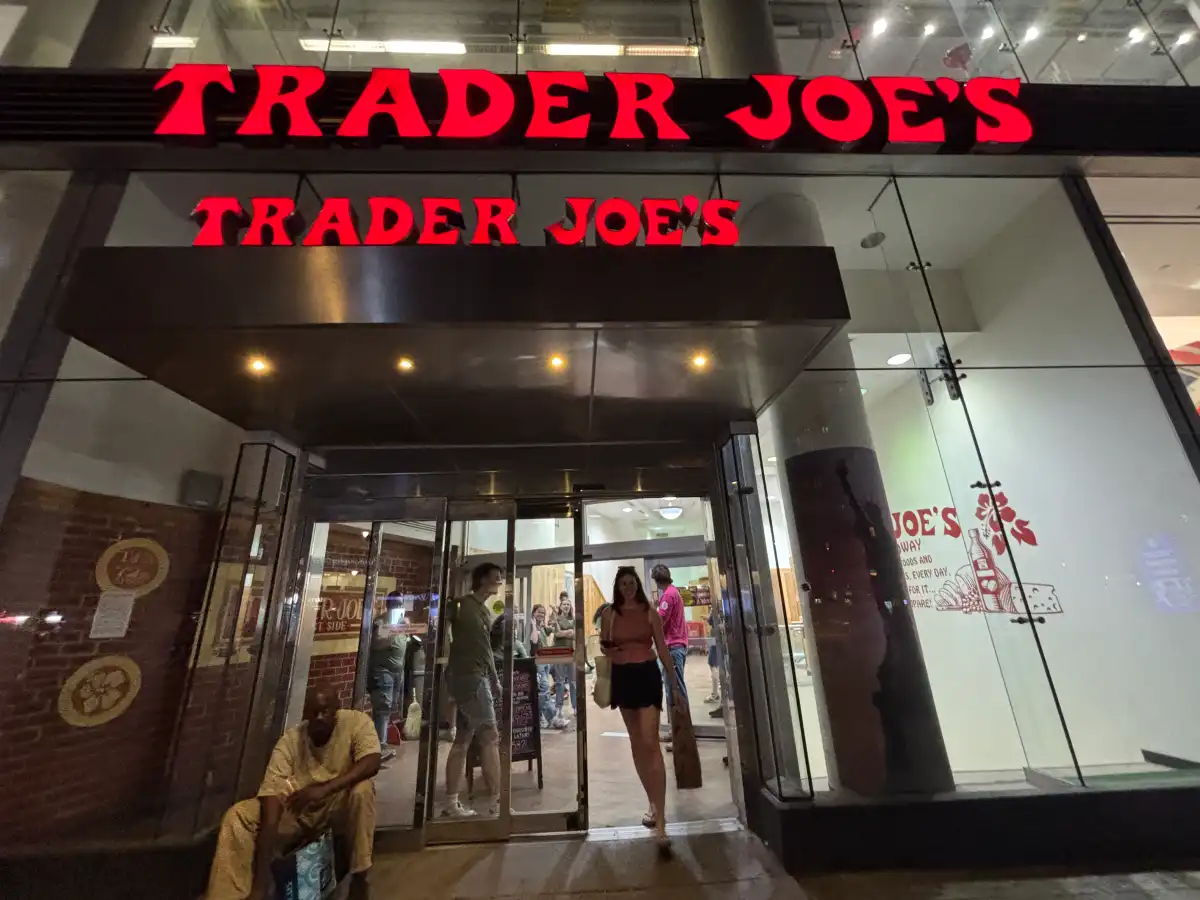
Employees of Trader Joe’s near 72nd St. on Manhattan’s Upper West Side counted down from ten at 9 p.m. on Sunday night before the doors closed, barring other customers from entering as it headed toward renovation.
But even after the countdown, as stragglers left the store at 2073 Broadway, often with one or two items from largely bare shelves, two local residents emerged, holding a time-stamped receipt as the last customers that night.
“This is the Trader Joe’s I’ve been going to my whole life,” said Adrian, a local resident. “I know this isn’t closing permanently, but I really wanted to come out here, see the vibe, see the people and see the store in a condition that you’ll never be able to see it again.”
He went shopping with a friend named Noam, hoping to be one of the last customers, seeing the Store 542 (on Trader Joe’s list) one last time before it reopens after a renovation.
“I thought that’s a unique experience and let’s try it out, so I went and I’m glad I did,” Noam said after they were cheered as they left with a 49-cent lemon. “It was fun and we’re the last customers.”
While the evening ended, the 72nd St. store is slated for a new beginning, as it undergoes a “major” renovation to reopen in the fall, including new escalators, a new elevator, new refrigerated cases, new floors as well as other changes befitting the highest, or one of the highest producing, stores in the chain.
“Due to major renovation plans, we will be temporarily shutting our doors. We promise not to be gone too long & will reopen as soon as we can!” a sign said. “Our last day open will be MAY 17th. This is not a goodbye, but a see you later!!”
Other Manhattan Trader Joe’s, such as 405 E 59th St., also are in the running for among the busiest Trader Joe’s.

“Honestly, we didn’t remember this was the last day,” a customer named Derek said as he exited with Mia. “We asked when is it going to close and when we went downstairs, there was nothing there.”
The store closed its upper floor first, with final customers shopping the lower floor’s often stark shelves, with bread, milk and not much else left. Items left over are being donated to City Harvest.
Trader Joe’s supports more than 2,100 Neighborhood Shares partners nationwide through donated food such as Food Rescue, Feed the Children and Food Connect Group.
Employees said they were being deployed to other locations, while the store is renovated before reopening as the company continues to open new units, including one that opened May 7 in Woodinville, WA, another in McKinney, TX, and one slated for Herriman, UT, soon.

Meanwhile, employees from a nearby Fairway handed out coupons, hoping to attract customers down the block.
Employees waved from the lower floor to customers outside the windows, as if they were friends saying a temporary goodbye.
Customers leaving the store talked about where they would shop next, although some Trader Joe’s fans said they might travel to other locations.
“They have excellent products at excellent prices and equally important, the atmosphere in the store is very wonderful,” said a customer named Naomi. “Their hiring practices are effective because everyone is lovely to interact with.”
Trader Joe’s, based in Monrovia, California, was founded in 1967 by Joe Coulombe in Pasadena, Calif., and today operates roughly 630 locations nationwide, selling primarily private-label products.
The company touts itself as a grocery store with low prices and a good selection, including private label.

It has been performing well at a time when at-home food costs have been soaring, leading to concerns about food prices overall.
A study by New York State Comptroller Thomas DiNapoli, released April 30, found food prices in the New York City metropolitan area rose 25.2% since 2019, initially fueled by the pandemic.
“Now the implementation of tariffs and potential cuts to federal food and other support programs may exacerbate the problem,” DiNapoli said.
Food nationally made up the third largest share, or 12.9%, of overall annual spending for the average household, or about $9,664, in 2022-23, while the New York City metropolitan area food costs comprised the fourth largest share (12.5%) at $11,288, according to DiNapoli.

“I have no idea,” Derek said when asked where he would shop in the interim, although there are numerous options. “What do you recommend? Where should we go?”
Naomi said she might travel a little further to another Trader Joe’s, although she probably couldn’t carry as much as she does from the nearby store.
“I’m near other Trader Joe’s in other parts of the city,” Naomi said. “I’ll pick things up, but I mean, I usually drop by, and I pick up a lot, and I carry a lot. I’m going to have to be more organized and that will be difficult.”
Meanwhile, Adrian and Noam left the store, looking back at the lit windows as workers closed down for the night, and they walked away.
“The last thing we bought was a lemon at 9:04 p.m.” Noam said as he held the last bright yellow lemon sold at the store before the temporary closing, “and that’s how I’m ending my evening.”

