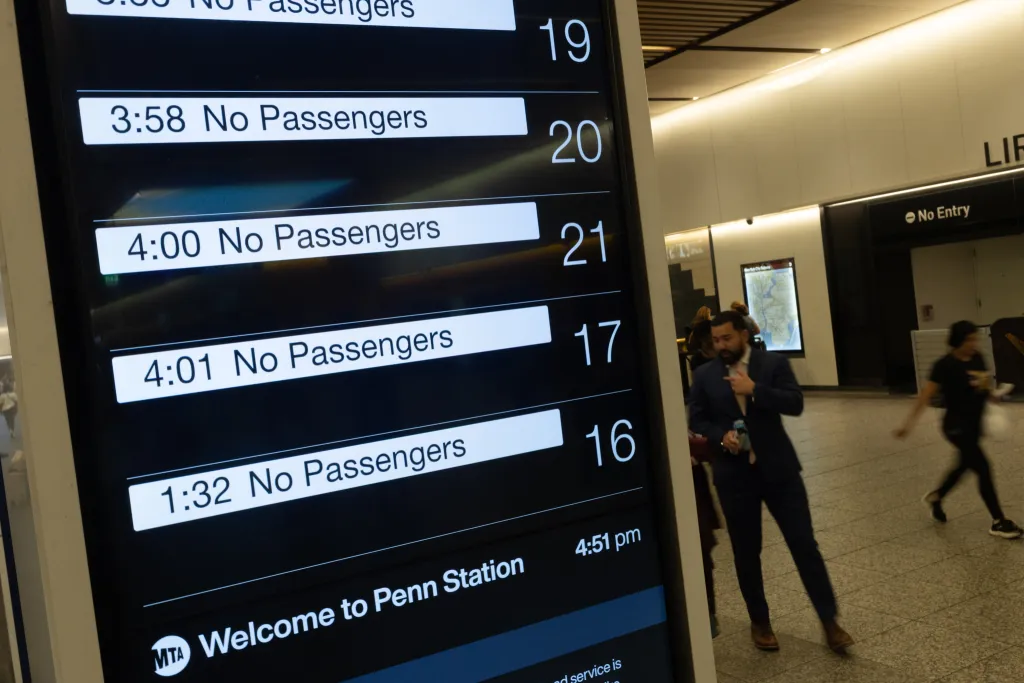
Hundreds of thousands of New Yorkers are bracing for the first weekday without Long Island Rail Road service after a strike shut down the country’s largest commuter railroad for the first time in more than three decades.
More than 3,500 LIRR employees will enter a third day off the job Monday as representatives from five labor unions and management at the Metropolitan Transportation Authority remain at odds over worker pay, forcing close to 300,000 commuters to find alternate ways in and out of New York City.
At a briefing Sunday, Gov. Kathy Hochul urged the two sides to get back to the negotiating table.
“We all know that the railroad is the lifeblood of Long Island — without it, life as we know it is simply not possible,” Hochul said. “The bottom line is, no one wins in a strike, everyone is hurt.”
Starting early Monday, the MTA will operate free weekday shuttle buses during peak hours between the LIRR’s Huntington and Ronkonkoma stations and the F line’s Jamaica-179 Street terminal.
Similarly, shuttles will run between the Bay Shore, Hempstead Lake State Park, Hicksville and Mineola stations and the Howard Beach-JFK Airport stop on the A line.
The shuttle service for essential workers is scheduled to run between 4:30 to 9 a.m. for Manhattan-bound service and from 3 to 7 p.m. to Long Island.
Parking will also be available for $6 at Citi Field for a connection to the No. 7 line at the Mets-Willets Point station.
“Now everyone knows, these alternatives are not business as usual,” Hochul said. “But unfortunately, they are the direct result of this strike.”
Officials have urged LIRR riders to work remotely during the strike, saying it’s “impossible” to fully replace service on the commuter railroad.
Those who must report to work in-person are not looking forward to a daily commute crippled by the first labor shutdown on the commuter railroad since a three-day walkout in June 1994.
“My only way out, I think, is the subway — take the E train, come to Penn [Station], then grab my [New Jersey Transit] train to Newark,” said Donovan Farquharson, who commutes daily from the Rosedale station in Southeast Queens, near the Nassau County border. “I’m really hoping to be in Penn Station Monday morning.”
The strike started at 12:01 a.m. Saturday after a breakdown in talks between the MTA and a coalition of five unions, including the Brotherhood of Locomotive Engineers & Trainmen, the Brotherhood of Railroad Signalmen and the International Association of Machinists and Aerospace Workers.
In a statement Sunday, two of the labor groups — the International Association of Machinists and Aerospace Workers and the Transportation Communications Union — disputed Hochul’s claim that the MTA “needs a partner.”

“The dedicated Long Island Rail Road workers represented by our unions are not asking for special treatment — they are simply fighting to keep up with the skyrocketing cost of living in the New York region after years without a raise,” the unions said.
Janno Lieber, MTA chairperson and chief executive, said he’s not concerned about the potential for Metro-North Railroad or New York City Transit employees slowing service in a show of support for the striking workers.
“They understand their obligation is to show up for work and they haven’t suggested otherwise,” he said. “And in fairness, they understand that the guys who went out on strike are asking for a better deal than they got.”
John Samuelsen, international president of the Transport Workers Union, urged TWU members at the Nassau Inter-County Express bus service to “stand in support” of the striking workers.
NICE is adding service on routes that serve key Long Island transit hubs in Hicksville, Freeport, Great Neck and Mineola.
“Don’t let the bosses alter your routes,” Samuelsen posted on X. “Don’t let the bosses bully you into undermining your friends and neighbors working on the railroad.”
But as the work stoppage extends beyond the weekend, it now threatens to disrupt not only the daily commute, but the regional economy. Thomas DiNapoli, the state comptroller, estimated Friday that the strike could result in more than $60 million daily in lost economic activity.
“A LIRR strike will be felt far beyond the tracks, triggering the loss of millions of dollars per day in lost economic activity, disrupting thousands of riders and throwing the region’s transit service into chaos and gridlock,” DiNapoli said.
Suburban commuters accounted for just over 50% of LIRR ridership in the first quarter of 2026, according to the MTA, with 37% from Nassau County and 15% from Suffolk. Manhattan riders comprised about a quarter of total ridership, followed by close to 20% from Queens and the remainder from Brooklyn.
Maulin Mehta, the New York director for Regional Plan Association, said fallout from a longer strike could be felt through increased congestion if New Yorkers affected by the loss of commuter rail service opt to drive instead.
“That’s going to deplete the quality of life for everybody for the duration of the shutdown,” he said.
For Jeff Jacquez, who prior to the strike traveled daily on the LIRR between Jamaica and Penn Station, that impact to his quality of life will mean grudgingly commuting via the E train.
“I’ve been here my whole life, so it’s just another headache I’ve got to get over,” said Jacquez, who works in Hudson Yards. “It’s nothing too serious, I guess, but at the same time, it’s going to be annoying.”
Our nonprofit newsroom relies on donations from readers to sustain our local reporting and keep it free for all New Yorkers. Donate to THE CITY today.
The post Manic Monday: New Yorkers Prep for Morning Rush With LIRR Still On Strike appeared first on THE CITY – NYC News.
