Folk art may be the closest visual language to the human condition because it begins before theory, before permission, before the academy has time to name it. It begins with the hand. It begins with need, loss, devotion, labor, memory, and the human instinct to give form to what might otherwise disappear.
A quilt, at its highest register, is not merely sewn. It is argued into being. Emotion is cut, pieced, repaired, and restructured into warmth. Fabric becomes evidence. Pattern becomes survival. The seam becomes a record of tenderness refusing extinction.
This, perhaps, is the unfounded glory of folk art. It does not ask to be legitimized by marble rooms or sanctioned language. It rises from the private theater of ordinary life and exposes the arrogance of any culture that confuses training with truth. It reminds us that art was never born in the academy. Art was born in the hand, the wound, the ritual, the home, and the almost violent human need to make meaning from what remains.

There is always a lazy temptation to make folk art sound quaint. It is anything but. Folk art is not the polite cousin of fine art. It is one of its most brutal and beautiful truths. It holds the record of those who made without waiting to be invited: quilters, carvers, painters, metalworkers, sign makers, visionaries, artisans, and anonymous hands who turned necessity into symbol and survival into form. It contains labor, faith, humor, rebellion, mourning, regional memory, and private cosmology inside objects the larger world too often mistook as simple.
With this in mind, last week’s American Folk Art Museum Gala at the Mandarin Oriental felt far larger than a benefit dinner. It was a tribute to an institution that has spent more than six decades protecting the strange, sacred intelligence of makers who created because something inside them demanded form. What began in a modest second-story space above a Manhattan deli has become the nation’s essential home for folk and self-taught art, now located on Broadway near Lincoln Square, where New York’s cultural bloodstream moves with theatrical force.
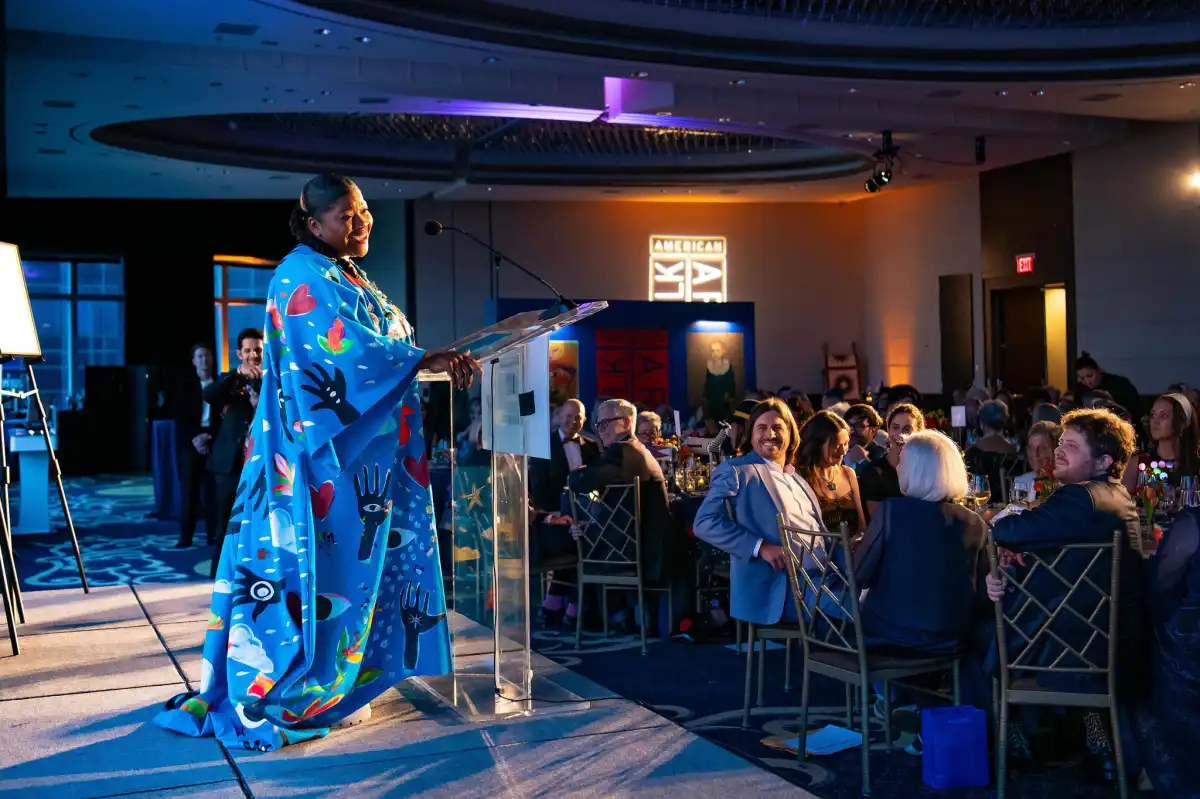
Approximately 200 guests gathered in the Ballroom at the Mandarin Oriental New York, overlooking Columbus Circle and Central Park, only five blocks from the museum itself, for an evening honoring Elizabeth V. Warren, the museum’s first-ever full-time curator and outgoing Board President; Vanessa German, recipient of the Audrey B. Heckler Visionary Award; and Harvey Fierstein, the Broadway icon, writer, performer, advocate, and quilter whose unmistakable voice carries the gravel, wit, and heartbreak of American theater.


The power of the evening was not in the sequence of speeches, but in the way each honoree enlarged the argument for folk art itself. Warren’s honor carried particular gravity because her work has never treated the field as charming residue. As curator, scholar, collector, and outgoing Board President, she has helped insist upon its authority, sharpening the museum’s intellectual architecture without draining the work of its pulse. Her early writing on weather vanes feels almost prophetic in this context. A weather vane is both instrument and omen. It reads the wind, yet in the hands of a maker, it becomes animal, silhouette, mythology, metal, motion, and imagination against the sky. It is utility turned into poetry, function transformed into a declaration of taste, place, and human invention.
Vanessa German brought another register entirely, one of voltage, spirit, and almost unbearable sincerity. Her sculptures do not simply occupy space. They radiate, assembled from relic, wound, prayer, altar, armor, memory, and spell. Beads, crystals, glass, found objects, and figurative forms become spiritual instruments that seem to look back, as though they know something about grief, love, and transformation most of us are still trying to learn. In accepting the Audrey B. Heckler Visionary Award, German did not merely receive an honor; she broke down what it meant. Heckler, in her telling, emerged as a disruptive and powerful force, a woman who understood that vision is not passive admiration, but insistence, interruption, and the courage to push a field forward before the world has caught up. How fitting, then, that German would receive an award bearing her name. German does not separate beauty from healing, imagination from responsibility, or art from action. This became literal when she offered the dress she was wearing, one she had made herself for the occasion, for auction. It raised an additional $10,000 for the museum, transforming the room from witness to participant. Art was not being politely praised. It was being surrendered into action.


Fierstein, introduced by Mary-Louise Parker, brought the room into yet another kind of truth. His unmistakable voice, that holy gravel of Broadway, cinema, activism, humor, and American nerve, arrived with all the force one expects, yet what made him so moving was the humility beneath the iconography. Fierstein has spent his life expanding the boundaries of who gets to be seen, desired, mourned, complicated, hilarious, wounded, glamorous, enraged, and fully human. His work has never merely entertained, though it has done that with ferocious command. It has made room. It has made language. It has challenged shame as an organizing principle and replaced it with tenderness, defiance, theatricality, intelligence, and joy. His devotion to quilting, in this context, feels almost inevitable. Fierstein understands construction, rupture, pattern, excess, timing, memory, wit, and the radical act of making fragments whole. In his hands, quilting becomes philosophy: take the pieces, honor the seams, refuse erasure, and make the fragments sing.
By evening’s end, the gala had become more than a celebration of 65 years. It became a reminder that museums matter most when they protect not only objects, but ways of seeing. AFAM’s commitment to free admission, public programming, scholarship, and collection care is not a gentle virtue. It is a public necessity.
That is what the American Folk Art Museum does so beautifully. It teaches us how to look again. It takes the object we thought we understood and cracks it open until history, labor, imagination, and beauty come rushing out. From a room above a deli to its luminous place on Broadway, AFAM has become something rare in New York: an institution with scholarship, soul, and the courage to remind us that art does not need permission to become eternal.
Visit FOLKARTMUSEUM.ORG
