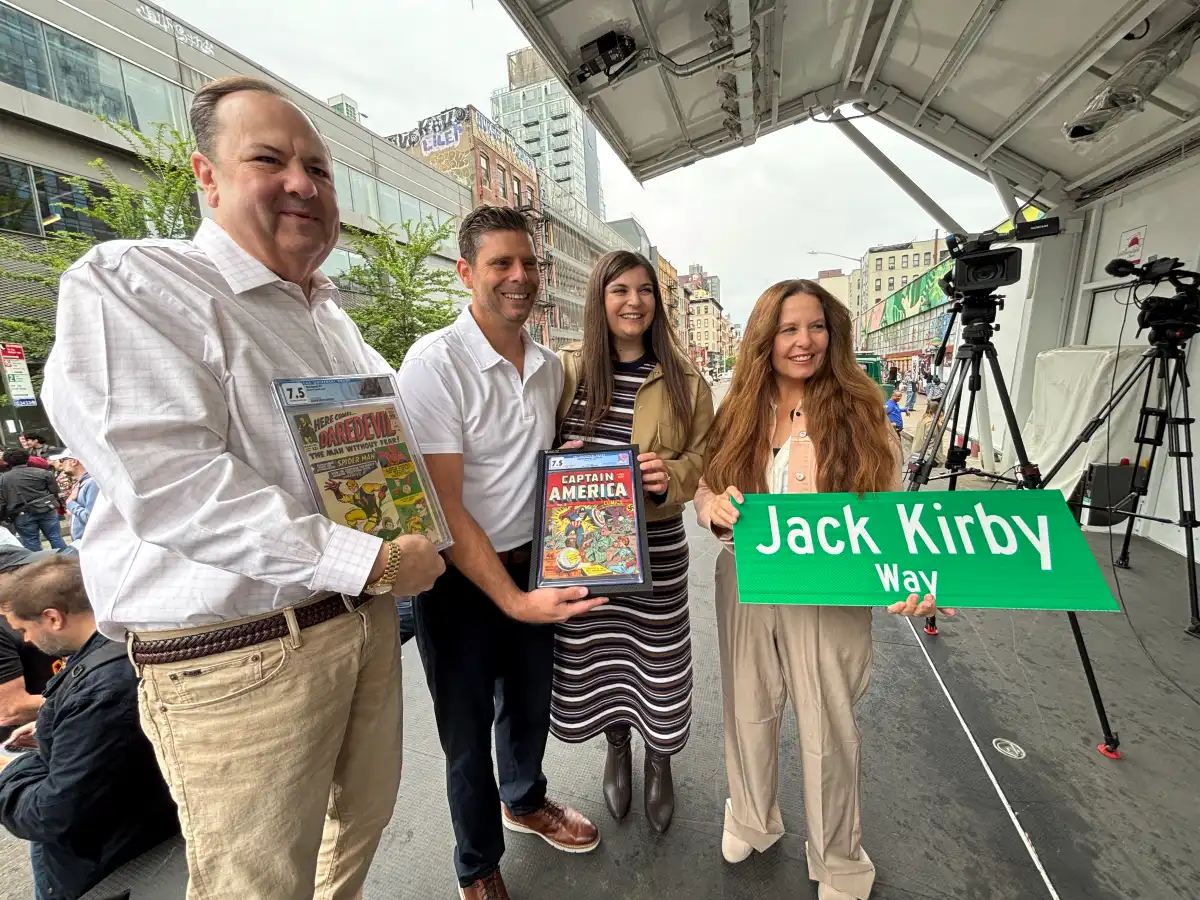
Hundreds of Jack Kirby fans gathered as the street where he grew up was closed, and a sign was unveiled proclaiming “Jack Kirby Way” to honor the comic book illustrator who helped create some of the genre’s best-known heroes.
Some showed up in superhero costumes, other wore “Captain America” shirts and some wore suits as the man who helped create so many heroes got his own hero’s treatment.
Kirby co-created many of Marvel’s best-known figures, as the artist behind the Fantastic Four, Captain America, the Hulk, Iron Man, the Avengers, the X-Men, Silver Surfer, Black Panther, and helped create Spider-Man.
Pop culture historian Roy Schwartz led the push to honor Kirby near his birthplace, a cause taken up by Councilmember Christopher Marte who shepherded it through the Council.
The co-naming, also attended by members of Kirby’s family, occurred 30 years after Kirby’s death in 1996, amid growing recognition of the role, craft and importance of those who created comic books and characters and superheroes.
“Jack Kirby isn’t just arguably the most important artist in the history of comics,” Schwartz, also a member of the board of the American Jewish Historical Society, said. “He’s one of the most important artists of the 20th century he’s a pioneer of pop art and a pop culture. He created a significant chunk of a beloved American mythology.”
Schwartz added the co-naming’s significance is amplified in that he is being honored a block from his birth, where his journey started, helping spawn superheroes and stories in which New York City locations sometimes were included.
“It’s important that this is in New York City,” Schwartz said. “Kirby fans came not just from around the city, around the country, but from around the world.”
Jack Kirby was born Jacob Kurtzberg in 1917 and grew on the Lower East Side, at 147 Essex Street, now marked by a red door covered with graffiti down the block from the green street sign that now bears his name.

“It was a long time coming, but it’s so important to honor him in the neighborhood where he grew up and where his identity was formed,” Jillian Kirby, his granddaughter, said. “It’s great to have this as a permanent reminder of his impact on the Lower East Side community and the comic book industry.”
Comic book collector Todd Zimmer believes appreciation of the art and comics is coming of age.
“I think a lot of people looked at modern creators and didn’t really ask the question, ‘Where did it all start?’” Zimmer said. “As collectors, we’re looking at the older books and sort of seeing where these all started and developing appreciation for it.”
Yusuf Lamont, who studied art and designed packaging for toys and other items, engages in his own annual Kirby memorial, going to draw outside Kirby’s birthplace each Aug. 28, the artist’s birthday.
“Kirby has been a major artistic influence in my life from the time I was seven years old,” Lamont said. “He was really what they call at Disney an Imagineer who envisioned an entire world.”

Academics embracing comic books as craft, character, narrative and American culture, the way jazz has long been, joined in the celebration of Kirby as a cultural figure.
Columbia University’s Curator for Comics and Cartoons Karen Green, who also pushed for the memorial, said he “immortalized that neighborhood in several comics.
An exhibit titled “The Jack Kirby Way: How a boy from the Lower East Side became the King of Comics,” opened the same day at the Center for Jewish History, near Union Square, running through November 30.
“I would hope if they don’t know who he is when they look at the sign that they at least look him up and find out a little more,” Jillian Kirby said of people who might see the sign and not know it honors a creator of superheroes.
Lamont, meanwhile, would like some commemoration at the building where Kirby lived down the block. “I’m trying to maybe get them to put a little bronze marker or something to indicate that,” he said.


