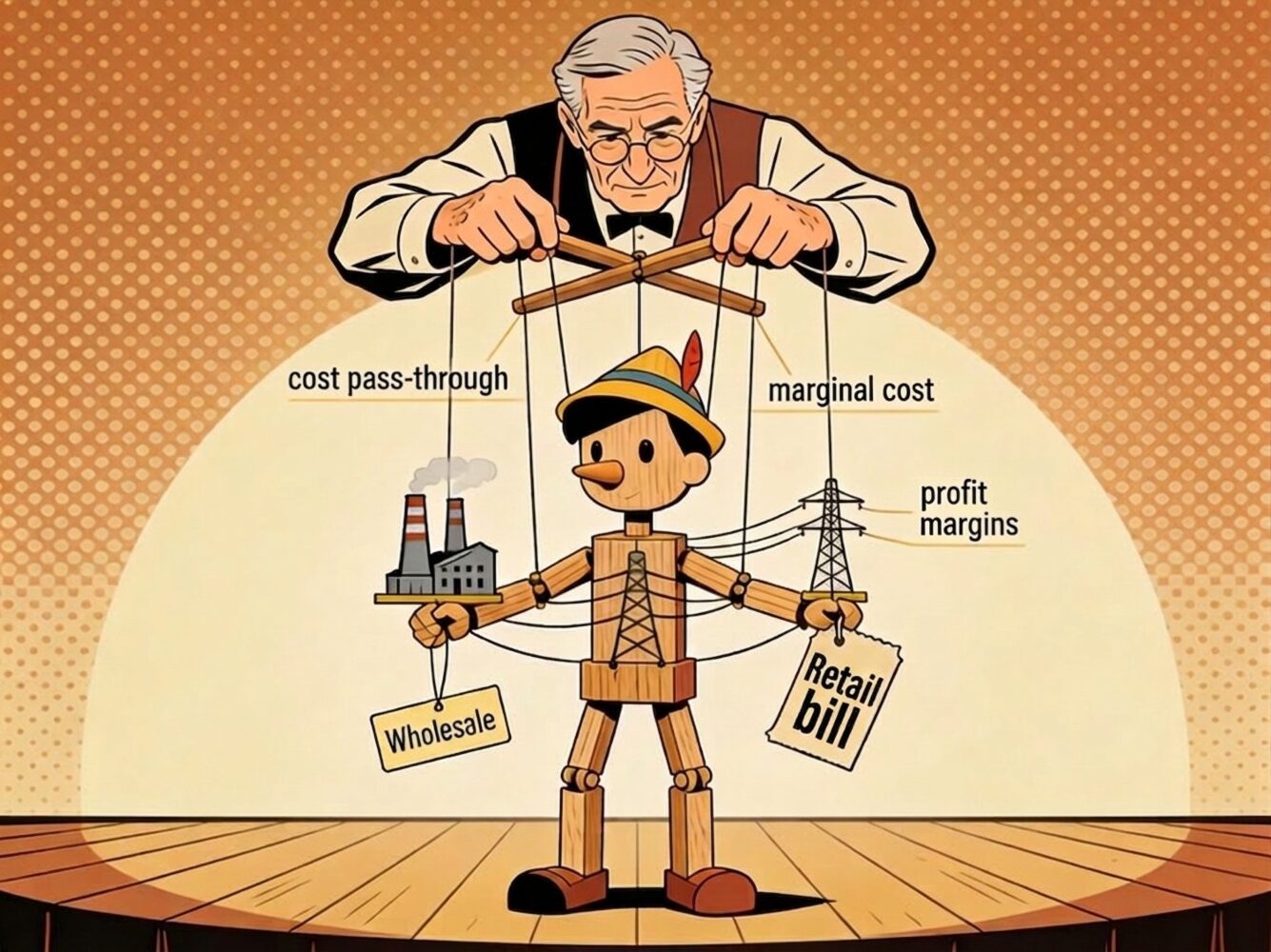
If regulators could make markets behave simply by watching them more closely, Italy would be about to crack the code.
Instead, the Italian government’s latest energy measures suggest something else: when prices rise, the instinct is not just to subsidize costs, but to supervise how those costs flow through the system—down to how firms bid, price, and earn margins. The result looks less like market oversight and more like a slow drift toward price control, dressed up as “pass-through” enforcement.
That shift matters. It reflects a broader belief that competition can be fine-tuned from above by monitoring costs, constraining pricing, and scrutinizing margins. The two decrees at the center of Italy’s response—the Decreto Carburanti and the Decreto Bollette—put that belief into practice.
Two Decrees, One Direction
As energy prices soar, the Italian government has moved to make energy products more affordable, including road fuels, electricity, and natural gas. It has temporarily cut excise taxes by €0.20 per liter of road fuels (down from the ordinary €0.67 per liter for both gasoline and diesel) and reinforced a prior decree aimed at trimming certain components of electricity bills.
But the government has not limited itself to taxes and levies. Both the Decreto Carburanti (road-fuel decree) and the Decreto Bollette (power-bills decree) introduce measures with clear competition-policy implications.
The Decreto Carburanti requires oil companies to publish their suggested gasoline and diesel prices online each day, and bars them from raising prices more than once daily. It also directs the Ministry for Industry and Made in Italy to monitor prices at individual gas stations. If the ministry detects an “anomalous or sudden price increase” relative to international benchmarks, it must ask the Guardia di Finanza—Italy’s financial and fiscal police—to investigate the entire value chain and report its findings to the national competition authority. These measures broadly track the approach discussed in a prior Truth on the Market post on Germany’s Fuel Market Intervention Package by Mario Zúñiga and Dirk Auer.
The Decreto Bollette goes further.
Issued Feb. 20—before the onset of the Iran crisis—the decree aims to close a persistent gap between Italian electricity prices and those in the rest of Europe, a gap widely seen as putting Italian firms at a competitive disadvantage. Parliament is still reviewing the measure. The energy-price shock triggered by the Third Gulf War has only heightened its political urgency.
To bring prices down, the decree introduces a complex mechanism—loosely inspired by the “Iberian exception” adopted during the 2022 crisis—that subsidizes gas-fired generators. The subsidies offset part of their marginal costs, including the cost of CO? allowances under the EU Emissions Trading System and certain network charges.
The decree then attempts to ensure that these cost reductions translate into lower prices through full pass-through at both the wholesale and retail levels. In practice, however, the mechanism comes close to imposing price controls under a system that formally preserves free pricing.
At the wholesale level, the regulator must “verify” that generators fully reflect the subsidies in their bids. If they do not, generators must repay the subsidies, plus a sanction to be determined. The decree also requires the regulator to monitor bidding strategies to prevent “economic withholding” of capacity—conduct that, when it departs from the “fair interplay of demand and supply,” may amount to unlawful market manipulation. To do so, the regulator must assess whether bids align with estimated marginal costs.
At the retail level, suppliers must submit periodic reports—at least annually—detailing their profit margins by type of offer and customer.
When ‘Economic Withholding’ Becomes a Cost-Based Straitjacket
At the wholesale level, the decree intervenes in two ways. First, it requires the regulator to ensure full pass-through of subsidies to gas-fired generators. Second, it directs the regulator to prevent “economic withholding” of capacity.
The concept of economic withholding comes from the EU Regulation on Wholesale Energy Market Integrity and Transparency (REMIT, Regulation (EU) 1227/2011), which defines it as:
Actions undertaken to offer available generation capacity at prices which are above or at the market price and do not reflect the marginal cost (including opportunity cost) of the market participant’s asset, which results in the related wholesale energy product not being traded or related asset not being dispatched.
As Luca Lo Schiavo has argued, three conditions must hold simultaneously to establish economic withholding: a price condition (“the offered price must be greater than or equal to the zonal market price”); a cost condition (“the zonal price must be greater than the short-run marginal cost of the production unit, including opportunity costs”); and a rejection condition (“the offered quantity must be rejected by the market algorithm”). When all three are met, a bid above marginal cost may indicate market manipulation, insofar as it contributes to higher prices by keeping otherwise available capacity out of the market.
REMIT does not prohibit economic withholding per se. It does so only within a framework of market manipulation—and only where that manipulation is established. Even then, liability does not attach if “the person who has entered into the transaction or issued the order to trade demonstrates that his reasons for doing so are legitimate” (Article 2(2)(a)(ii)). In other words, proving economic withholding is not enough; the operator may still show a legitimate justification. (See European Agency for Cooperation of Energy Regulators (ACER), Guidance on the Application of Regulation (EU) No 1227/2011 (2024) para. 281.)
Critics have argued that this framework lowers the standard of proof relative to traditional antitrust enforcement or shifts the burden onto the operator. Even so, it still requires case-by-case analysis under due process—not merely an algorithmic check of the three conditions. That requirement helps explain the relatively small number of economic-withholding cases brought under REMIT in the European Union.
More importantly, European regulators already have the tools to address manipulation through economic withholding. Only ACER may issue guidance under Article 16(1) of REMIT to ensure coordinated and consistent enforcement. Italy’s regulator, the Regulatory Authority for Energy, Networks and Environment (ARERA), conducted a fact-based investigation of the day-ahead market in 2025, covering 2023-24, which raised suspicions of potentially illicit behavior. It has not yet opened individual cases. A separate case involving alleged capacity withholding in 2022 remains pending, with results expected soon.
The Decreto Bollette takes a different approach. It effectively assumes that capacity withholding is generally illicit or harmful and instructs the regulator to “adopt one or more measures for the assessment of economic withholding practices by wholesale market operators.” Those measures “shall provide that, with reference to sell offers submitted in the day-ahead market, opportunity costs that can be estimated at the time of trading constitute the only legitimate economic justification for offering at a price above the marginal cost of generation capacity.”
The implications are hard to miss. First, the regulator must systematically estimate generators’ marginal costs. Second, market participants must calculate and document their opportunity costs—i.e., the value of alternative uses of capacity—with sufficient rigor to withstand scrutiny. Third, in a case-by-case review, operators may have to justify their bids based on those costs. If bids exceed estimated costs without adequate justification, regulators may presume unlawful capacity withholding—at least where offers were rejected and prices covered costs.
This framework raises at least three major concerns.
Start with substance. If day-ahead bids must align with estimated costs, generators cannot pursue bidding strategies beyond cost recovery. Once firms procure inputs upstream, the downstream market ceases to play any meaningful role in price formation. The market no longer allocates resources; it simply mirrors costs.
Next, the decree assumes that regulators can observe—or reliably estimate—those costs for each generating unit, in every market time unit (MTU), typically every 15 minutes. That assumption stretches credibility. It also treats each MTU in isolation, ignoring how firms optimize across time. Generators do not bid for a single 15-minute interval in a vacuum; they manage portfolios subject to technical constraints, intertemporal tradeoffs, and expectations about future demand, supply, and network conditions.
Finally, the decree assumes that regulators can systematically estimate not only actual costs—fuel, carbon allowances, transport rights, hedges—but also opportunity costs. In practice, opportunity costs depend on forward-looking strategies and alternative uses of assets, which are inherently firm-specific and context-dependent.
Push the logic a step further. If regulators can observe costs and opportunities with this level of precision, why rely on markets at all? Regulators could simply dispatch plants, procure inputs, and optimize capacity use directly—both in the short and long run.
Of course, regulators are not—and cannot be—omniscient. A legal regime that restricts bids to observable costs, while presuming that regulators can observe those costs, effectively denies any meaningful role for markets. It replaces decentralized decision-making with centralized estimation—and assumes away the very information problems that markets exist to solve.
Chasing ‘Margins’ in a Market That Sells More Than Megawatts
The Decreto Bollette also reaches into the retail market. It tasks ARERA with collecting—at least annually—extensive data from electricity and gas retailers on their “profit margins by type of offer and by type of customer.”
As at the wholesale level, this requirement assumes that “profit margins” can be observed and, once observed, will yield insights useful to “promote transparency, competition, and the correct functioning of energy markets,” as the decree’s preamble puts it.
That assumption runs into at least two problems.
Start with scale. Italy has roughly 630 electricity and gas retailers, offering thousands of service and price offers. Offers typically fall into four categories: variable-price and fixed-price, each either with or without additional services (such as green-energy guarantees, bundles, or loyalty programs). Many include temporary discounts. On top of that, suppliers serve multiple customer types—residential users, micro-businesses, small and medium-sized enterprises, and large industrial consumers. The decree asks suppliers to estimate a “profit margin” for each combination of offer and customer.
Then comes the harder question: what, exactly, is a “profit margin”?
A natural reading would treat it as a gross margin on energy supply. But that raises immediate complications. How should firms allocate fixed costs? How should they account for financial hedges? How should regulators compare offers with different features? Two examples illustrate the point.
Example 1: Fixed-price contracts as risk transfers. In 2024—the most recent year with available data—about 54.8% of residential customers chose fixed-price contracts. These contracts embed a wager: if wholesale prices rise above the agreed price, the customer benefits; if not, the supplier does. Under normal conditions, fixed-price contracts cost more than variable-price ones, because they bundle energy supply with a financial hedge against price volatility. But when shocks hit—as in 2022 or after the Third Gulf War in 2026—fixed-price customers gain protection. Looking only at gross margins in “normal” periods misses the point. Many customers willingly pay a premium for insurance against price spikes. What appears as a higher margin may simply reflect a different allocation of risk—not exploitation.
Example 2: Bundles and value-added services. About 98% of fixed-price customers and 72% of variable-price customers opt for bundled offers that include additional services. The most common is a guarantee that electricity comes from green sources. These “green” offers typically carry a premium. If margins are calculated as the spread between retail and wholesale electricity prices, they may appear unusually high—but that may say little about profitability once procurement costs for green energy enter the picture. The problem only deepens with more complex bundles, such as those including hardware or energy-efficiency advisory services. A supplier might charge higher per-unit prices while helping customers reduce overall consumption or shift usage to lower-cost periods. The supplier earns higher margins; the customer still saves money. Margin data alone misses the mutual gains.
The broader point is straightforward: estimating profit margins by offer and customer type is inherently difficult. Profitability depends on procurement strategies, customer loyalty, pricing structures, and operational efficiency—factors that often emerge only at the aggregate level, in financial statements. The problem worsens when offers change frequently in response to market conditions and consumer preferences.
But there is a deeper issue. Even if regulators could obtain precise, offer-level margin data, it would reveal little of value for “transparency, competition, and the correct functioning of energy markets.”
Transparency is already high. Italy has multiple price-comparison tools, including one run by the state-owned Acquirente Unico and overseen by ARERA. Suppliers must upload their offers to this public portal as they take effect, and the data are available in open format for third-party comparison tools.
As for competition and market functioning, profit margins alone say very little. ARERA and the Italian Competition Authority (AGCM) already have the tools to detect and sanction misconduct—and they use them. ARERA’s investigation of the day-ahead wholesale market in 2023-24 (discussed above) and AGCM’s enforcement actions against retail abuses make the point. Adding offer-level margin data does not meaningfully improve regulators’ ability to identify wrongdoing. It risks generating noise without insight.
If Regulators Know the ‘Right Price,’ Why Have Markets at All?
The new provisions—aimed at preventing (almost unconditionally) economic withholding in wholesale electricity markets and extracting granular “profit margin” data at the retail level—rest on a simple premise: competition can be engineered from the top down. If that were true, there would be little point in maintaining markets at all. Regulators could just as well take over suppliers and manage the entire value chain.
The problem runs deeper than administrative burden or questionable compatibility with European law, which assigns price formation to markets, not regulators. The real flaw lies in the premise itself. Markets exist precisely because no central authority can know the “right” price of goods and services in advance.
Italy—and many other countries—has already tested vertically integrated, state-directed energy systems. They did not work. Reintroducing them, even under the banner of “free pricing,” will not change the outcome.
Dress it up as oversight or call it transparency—but if regulators set the terms, police the bids, and second-guess the margins, the market becomes a formality. And when markets become a formality, they stop doing the one thing we need them to do: discover prices.
