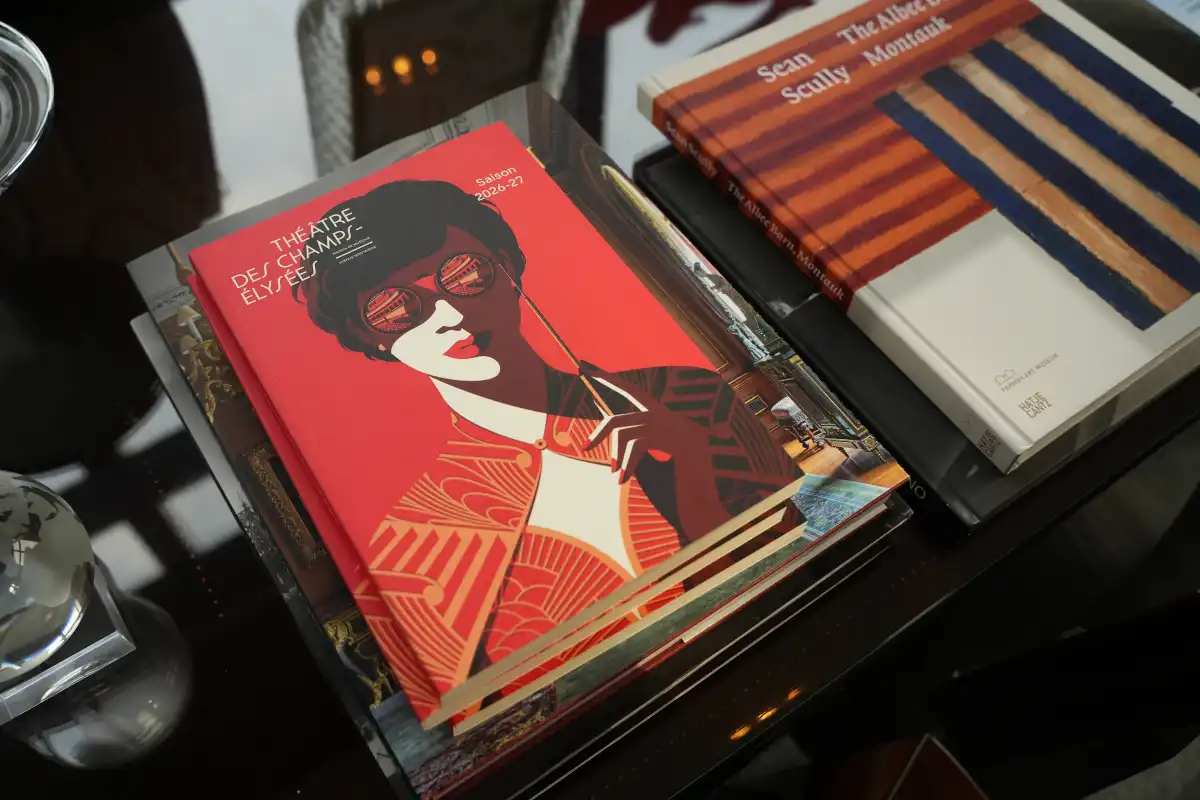
The voice pierces through silence like light through glass—clean, exact, and impossible to ignore. It arrives almost unexpectedly, settles into the body, and begins its quiet work. A vibration hums beneath the skin, a chill traces the spine, and something deeply interior responds before the mind has time to translate. Meaning, quite remarkably, is no longer tethered to language. The message transfers through sound alone, and the human body reveals itself as both vessel and instrument, capable of holding melancholy and elation within a single, sustained note.
That sensation unfolded high above New York City, where the International Circle for the Théâtre des Champs-Élysées gathered in a private residence that seemed suspended between skyline and sky. Champagne caught the ambient glow of evening, conversation moved with a kind of effortless elegance, and the room held that particular balance of intimacy and distinction that only a private home at this level can offer. Among those gathered were John M. Beck, Elbrun and Peter Kimmelman, Anthony Atiyeh, Grigoriy Arutyunyan, Christian-Frédéric Bloquer, Richard Colker and Lucy Lamphere, François de Panisse-Passiss and Caroline Hubbard, Amanda Hathaway, Joel Bell, Janet Hopkins, Laura Lobdell, Domitille Marchal Lemoine, Nesrine Methlouthi, and Elizabeth Velez, a constellation of patrons and cultural figures whose presence, perhaps quietly, underscores the ecosystem that sustains the arts at this level.


Opera has, for centuries, demanded this kind of attention. Its origins trace back to late sixteenth-century Italy, where composers sought to revive the emotional immediacy of ancient Greek drama, though what emerged was something far more expansive—a synthesis of music, poetry, and performance that would come to define cultural refinement across Europe. By the time it reached Paris, opera had become a total experience, where architecture, sound, and narrative converged into something both monumental and deeply personal. A single aria can carry the weight of an entire story, and a single voice can alter the emotional temperature of a room.
Few institutions embody that lineage with the same authority as the Théâtre des Champs-Élysées. Founded in 1913, the theater remains a cornerstone of modern performance, its Art Deco presence housing some of the most pivotal moments in cultural history, including the premiere of The Rite of Spring, a work that reshaped the trajectory of twentieth-century music. That legacy is not static. It continues to evolve under the direction of Baptiste Charroing, whose vision centers on cultural exchange, the elevation of emerging voices, and the continued relevance of transatlantic artistic dialogue.
The evening itself, co-chaired by Marifé Hernández and Jean-Marc Daillance, carried a sense of ease that belied its significance. This was not a performative gathering. It was, more meaningfully, an alignment of individuals who understand that institutions such as the Théâtre des Champs-Élysées require stewardship—intentional, sustained, and often unseen. In a moment where the movement of artists across borders is increasingly complex, that stewardship becomes not only relevant, though essential.


Then the room shifted, quite naturally, as Ermonela Jaho began to sing. Excerpts from La Traviata and Maria Stuarda unfolded with a clarity that felt almost disarming in its intimacy. Without the distance of a formal theater, each note carried differently, moving through glass, air, and body with equal precision. Conversations came to a halt, glasses remained suspended, and attention transfixed fully into the experience. Opera, in this context, revealed its most essential quality: its ability to communicate directly, to command without translation, without barrier.
The significance of evenings like this rests not only in their fanciful beauty, though in their purpose. The arts, particularly at this level, do not sustain themselves passively. They rely on a network of patrons, advocates, and institutions willing to create the conditions in which they can continue to exist and evolve. The International Circle operates within that understanding, fostering a transatlantic dialogue that ensures the continued vitality of one of Europe’s most important cultural institutions.