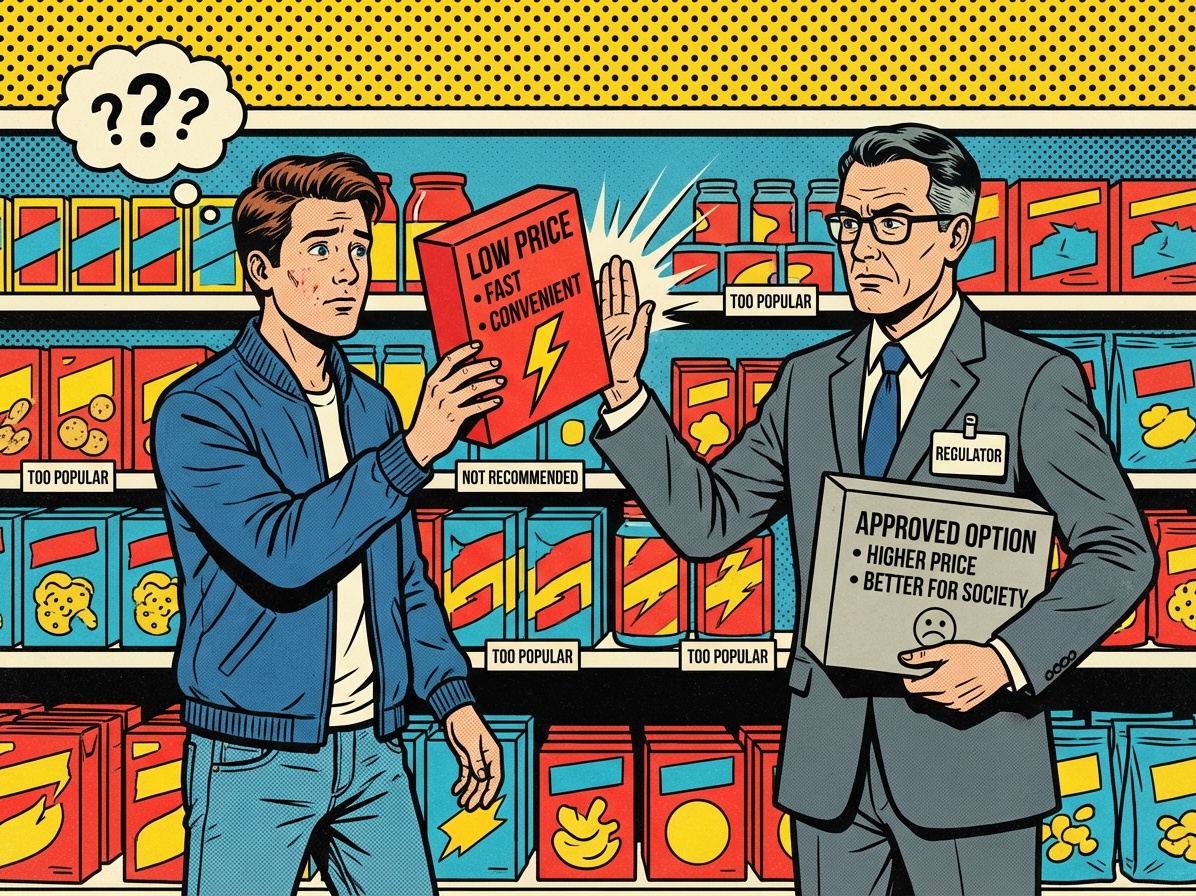
Antitrust used to ask a simple question: are firms making consumers worse off? Increasingly, it asks a different one: are consumers making the “wrong” choices?
The consumer welfare standard (CWS) often draws criticism as narrow or inattentive to broader concerns. That familiar critique rests on a basic misunderstanding of what the standard is designed to do.
At bottom, the disagreement concerns what should trigger antitrust intervention. Under the CWS, intervention is warranted when market power distorts consumer demand—when firms restrict output and raise prices, blocking transactions that would otherwise occur. The issue is not what consumers choose, but whether firms have constrained or manipulated those choices.
Many contemporary critiques start from a different premise. They would justify intervention even when consumers freely select among available options. On this view, market outcomes—the dominance of certain platforms, levels of concentration, particular business models—count as problematic not because demand is distorted, but because they reflect preferences that regulators or scholars dislike. Neo-Brandeisian theorists have pushed to replace the CWS with a new legal standard, arguing that the existing framework errs in “orienting antitrust toward material rather than political ends” and should instead serve as a tool for “improving democratic self-government.”
That shift creates a paradox. Proponents frame their approach as populist and democratic , urging that antitrust operate “not solely as part of corporate law, but also as part of political law” in service of the “public interest.” Yet it requires sidelining the preferences of the very consumers it claims to protect.
In practice, this approach replaces the public’s revealed preferences with an abstract vision of what regulators think the “Public Interest” should be. That vision often runs in the opposite direction—correcting, rather than enabling, consumer choices. We call this “anti-consumer welfare antitrust”: anti-consumer in substance, while functioning as a welfare check for laggard competitors, politically salient groups, and other rent-seekers.
The result is predictable. Real consumers end up footing the bill for regulators’ paternalism and for the academic theories that encourage it.
The Anti-Consumer Turn in Antitrust
This critique reflects what might be called the preference-substitution fallacy: the idea that antitrust should not merely correct distortions in market outcomes, but should steer those outcomes toward arrangements regulators or scholars deem superior.
The German Bundeskartellamt’s recent Amazon decision illustrates the point. The agency did not sanction Amazon for harming consumers by showing less relevant or more expensive products. Quite the opposite. Amazon had relegated more expensive products to secondary pages or delisted them altogether.
That enforcement posture carries an implicit premise: consumers should choose higher-priced products because regulators prefer a different distribution of rents among sellers—one that favors less-efficient firms for political, social, or ideological reasons. In that framework, antitrust does not protect the consumer so much as it overrides her.
The distinction is straightforward. Under the CWS, intervention targets distortions in what consumers would otherwise buy. Under an anti-CWS approach, intervention targets the fact that consumers buy what they do. Antitrust shifts from protecting consumer choice to substituting it.
Your Preferences Are Not on Trial
The point comes into sharp focus when we consider what antitrust law actually measures. The framework is deliberately agnostic about the social value of any given product. It does not ask whether consumers should prefer lower-priced alcohol or tobacco, or whether their privacy preferences are sufficiently developed. The inquiry remains constant: are firms restricting output such that prices rise above competitive levels?
Whether the product is bread or bourbon, milk or cigarettes, the analysis does not change. When firms collude or exercise market power to restrict output and raise prices, consumers suffer because transactions that would have occurred at lower prices no longer happen. Cartels involving alcohol or tobacco face condemnation on the same grounds as cartels involving staple goods. The nature of the product does not drive the analysis; the effect on output and prices does.
Antitrust protects the process through which consumers express preferences—and the metrics used to evaluate outcomes: prices, output, and, where appropriate, innovation. It does not police the content of those preferences. That neutrality, however, is under increasing strain. As Francisco Marcos observes, recent enforcement trends have shifted toward structural and noneconomic considerations, departing from traditional consumer-welfare analysis.
Too Popular for Comfort
Once the framework comes into view, the trajectory of many contemporary policy proposals becomes clearer—and more troubling.
Digital markets present the paternalist regulator’s nightmare. Consumers have real choices, and they have voted with their clicks—consistently and at scale. They prefer Amazon to local retailers, Google Search to privacy-focused alternatives, and Apple’s closed, curated ecosystem to the open smorgasbord regulators would impose. They choose convenience and low prices over whatever else regulators think they should value. This is not market failure. It is market success—and that, it turns out, is the problem.
The Digital Markets Act (DMA) reflects this logic. Through mandatory choice screens, limits on self-preferencing, and data-sharing mandates, it aims to reshape patterns of use rather than correct output restrictions or price increases. The goal is to reengineer outcomes regulators dislike—perceived dependence on a handful of large U.S. platforms—even when those outcomes reflect consumer preferences.
Apple, for example, must now allow alternative app-distribution channels and payment systems, despite evidence that many users prefer the integrated App Store. Users who wanted a more open ecosystem already had Android. Google must implement search-choice screens on Android in the European Union—not to remedy a demonstrable restriction on output, but to redirect consumer choice. In effect, consumers themselves become the problem: they have produced what regulators view as an unacceptable outcome—the success of a few firms—without any clear sense of what the “right” number of firms should be.
A similar dynamic appears outside the European Union. In South Africa, the Competition Commission required Google to modify its search results to promote local firms through a dedicated carousel, explicitly prioritizing certain outcomes over revealed user preferences. Authorities have also imposed measures that tilt competition toward local players, including free advertising and training. The premise remains the same: consumers are choosing “wrongly”—favoring foreign-owned products when they should prefer domestic alternatives.
In each case, the concern is not that firms restrict output or raise prices. It is that consumers keep choosing certain products, platforms, and business models—and that those choices deliver the “wrong” results.
Philistines at the Checkout
The CWS is often defined broadly to include not just price and output, but also quality, service, and innovation. Even so, its focus remains on access to these options—not on judging the preferences themselves. The CWS does not assume consumers choose “correctly” in any normative sense. It takes their preferences as given and asks whether market power has impaired their ability to act on them.
Contemporary proposals increasingly invert that logic. They treat certain outcomes as problematic precisely because they reflect what consumers choose. Intervention rests less on constrained choice than on the “wrong” results—too few firms, too many American or foreign ones, or the “wrong” privacy-insensitive platforms prevailing. Choice screens, for example, purport to expand options. But those options already existed. Consumers could choose a different browser or a more “open” operating system. The real objective is not to create choice in the abstract, but to steer how it is exercised—away from so-called gatekeepers and toward preferred alternatives, often local or homegrown.
Proponents often cast these interventions as populist and democratic. Margrethe Vestager, introducing the DMA, warned that gatekeeper power “threatens our freedoms, our opportunities, even our democracy.” The underlying premise runs in the opposite direction. This tradition has deep roots. Justice Louis Brandeis himself argued that consumers needed protection from their own tendencies, describing them as “servile, self-indulgent, indolent, ignorant.”
Once intervention rests on the view that consumers choose the wrong products or services, it assumes their preferences cannot guide market outcomes. Consumers become unreliable—philistines who cannot be trusted to organize markets. Policy no longer follows the consumer; it corrects him.
This tension surfaces clearly in “curse of bigness” arguments. Proposals that treat firm size as inherently suspect often proceed without evidence that large firms restrict output or raise prices. They also discount evidence that scale can produce efficiencies, higher wages, and innovation. By treating size as a proxy for harm, these approaches conflate market structure with market performance. They replace consumer outcomes with a normative preference for smaller or more locally distributed firms. That sits uneasily with any serious claim of populism. Neo-Brandeisian and recent populist approaches converge on a shared skepticism of observed market outcomes: consumers overvalue price, convenience, and integration, and undervalue the factors regulators seek to promote.
When Antitrust Turns on the Consumer
An antitrust framework centered on output and prices imposes a real constraint. It requires evidence that firms are restricting output, raising prices, or otherwise harming consumers. That keeps enforcement tethered to identifiable harm and observable effects.
Relax that constraint, and the basis for intervention shifts. Market structure, firm size, or patterns of consumer use can become triggers for enforcement—without any neutral benchmark. As Brian Albrecht and Eric Hovenkamp observe, a framework that tries to weigh competition against democracy, inequality, or firm size inevitably “collapses into subjective speculation”—a wishing well “into which one may peer and find nearly anything he wishes.”
The shift also changes what antitrust scrutinizes. The focus moves from conduct that distorts competitive outcomes to the outcomes themselves. When consumers consistently favor certain firms or business models, their preferences no longer guide analysis—they become the problem.
Antitrust, recast this way, does not protect consumers. It protects regulators and scholars—and their preferred vision of how markets should look—from the consumer’s inconvenient, and often uncouth, choices.
In the end, the question is simple: should antitrust correct markets, or correct consumers?
The post The Nanny State Goes Shopping appeared first on Truth on the Market.
