Over the last few decades, antitrust scholars and practitioners have scrutinized the role of platforms—particularly intermediaries—in the internet economy. Many intermediary platforms also compete in the markets they facilitate. That dual role raises familiar concerns about self-preferencing and the risk that a firm may advantage its own products or services.
Regulators have focused primarily on large technology firms that develop mobile operating systems, app stores, and online marketplaces. The European Union’s Digital Markets Act (DMA) imposes obligations on statutorily defined “gatekeepers.” In the United States, Congress has floated parallel proposals, including the American Innovation and Choice Online Act (AICOA) and the Open App Markets Act (OAMA). Commentators have dissected these measures at length, often faulting their thin treatment of consumer effects and their break from traditional economic analysis of allegedly anticompetitive conduct.
Video markets have likewise drawn scrutiny for decades. Broadcast-ownership caps, retransmission-consent rules, and streaming mergers remain live policy flashpoints as consumers migrate to streaming as a primary viewing mode. Fights over market definition and consumer welfare persist, illustrated by the proposed Warner Bros. Discovery–Netflix transaction and consolidation involving broadcasters Tegna and Nexstar.
The television itself has escaped comparable attention.
For most of its history, the television was straightforward hardware—a display for external video inputs. Sets bundled broadcast receivers and ports for cable boxes, gaming consoles, DVD and Blu-ray players, and other peripheral devices.
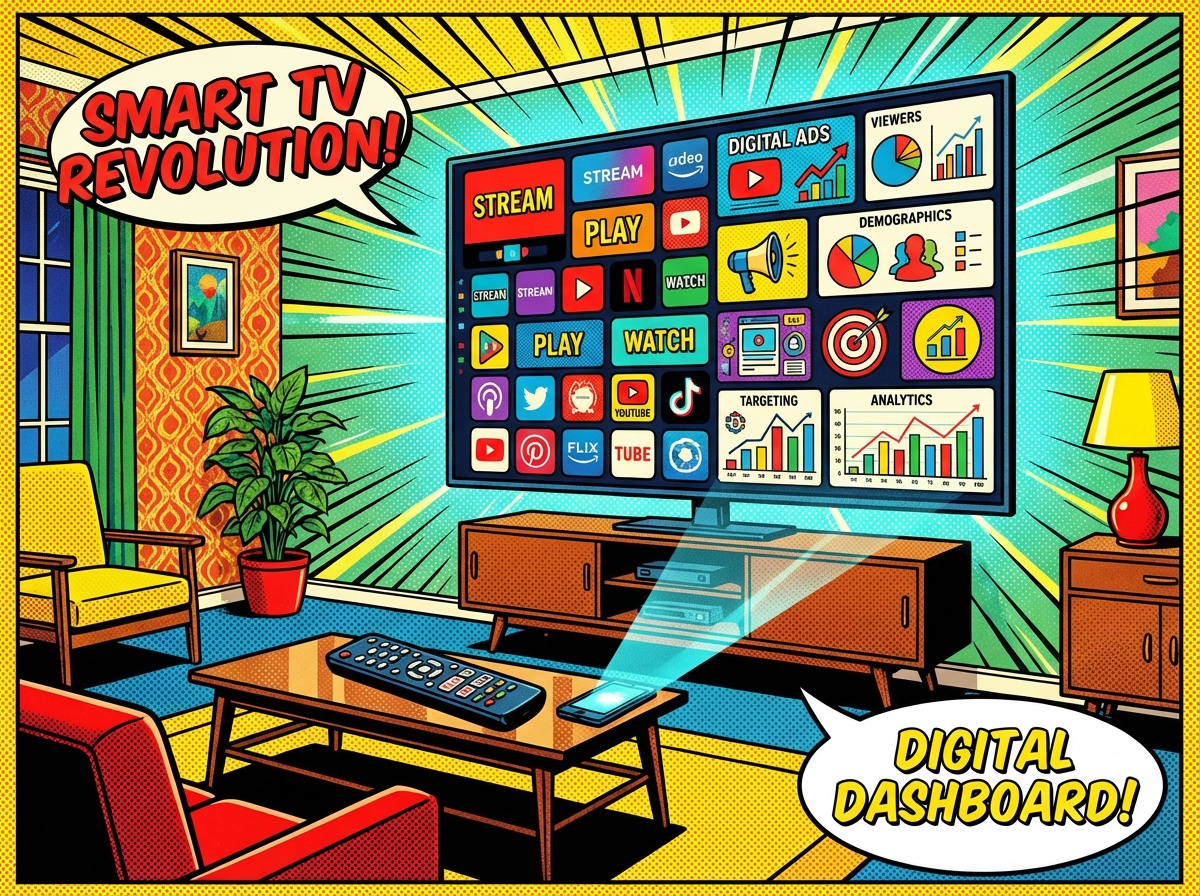
That paradigm has shifted. Smart TVs—internet-connected sets that host downloadable media apps—now dominate the market. Aside from periodic litigation over user-privacy practices, regulators have largely left Smart TV platforms outside the platform-governance frame. That omission may prove temporary as the sector expands.
Smart TV platforms deliver many of the same procompetitive benefits seen in other digital intermediaries. Vertical integration across the television technology stack enables original-equipment manufacturers (OEMs) to cut retail prices and improve the precision and quality of television advertising.
Your TV Works for Advertisers Now
Historically, television manufacturers operated along a linear value chain: component procurement, assembly, distribution, and retail sale. Firms earned profits on the spread between input costs and retail prices. That model has eroded. Hardware margins have compressed to near zero, pushing the major OEMs toward platform-centric strategies.
Under this model, the television functions as a loss leader—or, at best, a low-margin gateway to a high-margin software ecosystem. OEMs such as Roku, Amazon, Samsung, and LG no longer sell hardware alone. They operate integrated advertising platforms and, in many cases, their own free-streaming services.
This lifecycle monetization strategy rests on three principal revenue streams:
- Platform Licensing and Revenue Sharing: OEMs charge subscription video-on-demand services—e.g., Netflix and Disney+—for platform placement or take a percentage of subscription revenue.
- Advertising Inventory: OEMs control and sell video-ad slots across ad-supported video-on-demand and free ad-supported streaming TV (FAST) environments.
- Data Monetization: Automated content recognition (ACR) technology captures granular viewing data. OEMs sell this data to advertisers or deploy it within proprietary ad networks.
The shift to Smart TVs has reshaped the video ecosystem. Internet-connected sets have displaced legacy, non-connected devices at scale. The global Smart TV market reached approximately $246.96 billion in 2025 and is projected to exceed $673 billion by 2033. Smart TVs accounted for more than 89% of television sales in 2025, a share likely to grow.
Smart TV OEMs typically integrate four key layers. The hardware-firmware layer encompasses the physical chassis, chipsets, and embedded firmware. The operating-system layer includes proprietary platforms such as Tizen (Samsung), webOS (LG), and Fire OS (Amazon). The application-distribution layer features OEM-controlled app stores and proprietary FAST services—e.g., Samsung TV Plus and The Roku Channel. The stack culminates in the ad-tech layer, where inventory management, targeting, and measurement occur.
This vertically integrated architecture allows OEMs to monetize each stage of the content-delivery chain while subsidizing device prices. ACR technology is central to that strategy. It provides OEMs with application-agnostic insight into what users watch, regardless of source.
That data is highly valuable to advertisers—and, by extension, to content creators. Its collection has also triggered consumer-protection scrutiny, particularly on privacy grounds. Texas, for example, has sued Samsung, alleging unlawful deployment of ACR technology without informed user consent.
Antitrust Issues, Preinstalled
Regulators assessing Smart TV platforms must weigh alleged anticompetitive conduct against demonstrable procompetitive benefits. There are four conduct areas that dominate the antitrust discussion.
Advertising-Inventory Expropriation
A common industry practice requires content publishers to surrender a share of their advertising inventory to the device platform. Roku, for example, typically claims 30% of ad inventory from ad-supported applications, which it then sells directly. Amazon applies a similar rule to apps exceeding 50,000 hours of monthly usage, requiring integration with Amazon Publisher Services and the transfer of 30% of impressions.
Critics argue this structure can resemble an unlawful tying arrangement, echoing theories advanced in the Google Ad Tech litigation. Publishers must accept these terms to reach the platform’s user base. The 30% inventory transfer may also pressure rival apps to increase ad loads within their remaining inventory, potentially degrading user experience. OEM-owned apps do not face equivalent constraints, raising self-preferencing concerns.
ACR Data Advantages
ACR technology compounds these risks. ACR captures on-screen pixels in near real time and matches them against reference databases to identify viewed content. OEMs thus obtain platform-wide visibility into viewing behavior: they observe watch time across every app and program, while individual services see only in-app activity.
When OEMs keep ACR data proprietary—or restrict access within vertically integrated ad-tech stacks—they may raise entry barriers for rival ad-tech firms. Advertisers unable to access equivalent granular targeting data on third-party demand-side platforms face diminished competitive viability.
User-Interface Steering and Default Bias
Control over the user interface creates an additional vector for competitive leverage. App placement, default positioning, and navigation design shape consumer behavior. As in the ongoing Google Search litigation now on appeal, OEMs can privilege affiliated services or negotiate default placement with third parties.
This steering extends to hardware. Remote controls frequently include preprogrammed shortcut buttons for selected apps—placements that distributors often purchase. Search functionality presents similar risks, allowing OEMs to prioritize affiliated video stores or services over rivals, a theory central to debates surrounding AICOA, OAMA, and the DMA.
Contractual Leverage and Dispute Constraints
OEMs can also wield terms-of-service provisions as enforcement tools. Roku, for instance, has barred mass arbitration in its user agreements. When users declined updated terms, the company locked device functionality until consent was granted, limiting practical avenues for legal recourse.
Exclusion Is Costly in a Competitive Living Room
If these theories sound familiar, they should. Variants have surfaced across multiple platform contexts, with mixed legal success. Each ultimately turns on market definition and monopoly power. Antitrust liability requires more than contested conduct; it requires the ability to profitably raise prices or restrict output above marginal cost. Absent that power, the case for regulatory concern weakens.
Consider an OEM that conditions platform access on an app’s surrender of 30% of its advertising inventory. If a service such as Netflix refuses and the OEM responds by excluding the app, the OEM bears downstream risk. Consumers value device access to popular applications. Exclusion would make the OEM’s televisions less attractive, depressing device sales and, in turn, weakening the OEM’s bargaining leverage.
Market structure reinforces that constraint. The Smart TV platform market remains competitive, with no firm approaching durable monopoly power. Roku OS held the largest share at 34% in Q1 2025, while no rival platform exceeded 25%, even as several of the world’s largest technology firms compete in the market actively across operating systems, hardware, and distribution layers.
Consumer substitution further disciplines OEM conduct. If negotiations between OEMs and apps fail, users retain multiple pathways to access the same content—even on the television itself. Viewers can watch via smartphones, laptops, or tablets, and cast content through devices such as Google Chromecast connected to HDMI ports. Gaming consoles and wired streaming devices provide additional access points.
This device-level and cross-platform substitutability makes sustained exclusion costly. OEMs that impose unpopular terms risk losing both viewers and hardware sales, limiting their ability to engage in durable anticompetitive conduct.
The Consumer Case for Vertical Integration
Even assuming OEMs possess monopoly power, vertical integration in the Smart TV stack generates substantial procompetitive benefits that can offset concerns about exclusionary conduct.
Hardware-Price Deflation
The most immediate benefit is lower device pricing. Smart TV manufacturers subsidize upfront hardware costs with downstream revenue from advertising and data monetization. Television prices have fallen at an average annual rate of roughly 6.5% to 7%. Lower entry barriers expand consumer access to high-definition and 4K displays, broadening the addressable audience for content producers. Greater distribution, in turn, supports higher investment in programming quality. Without ACR-enabled data monetization and integrated ad platforms, premium displays would likely remain luxury goods, rather than mass-market commodities.
Double-Marginalization Mitigation
Vertical integration also addresses double-marginalization problems across the technology stack. When separate firms control hardware, operating systems, distribution, and advertising intermediation, each layer imposes its own markup. The cumulative effect raises costs for content producers and, ultimately, consumers. Integrated OEM platforms can internalize these margins and price more efficiently.
Advertising Efficiency Gains
Integration improves ad-targeting precision. Operating-system-level visibility allows OEMs to identify relevant audiences and optimize ad delivery. More accurate targeting reduces wasted impressions, increases advertiser return on investment, and may lessen viewer annoyance by limiting irrelevant ad loads.
Interplatform Advertising Competition
Smart TV advertising ecosystems also introduce new competitive pressure into digital advertising markets. As OEMs scale ad-tech capabilities, they challenge incumbents in adjacent sectors. The Walmart-Vizio transaction illustrates the dynamic. By linking Vizio viewership data with retail purchasing behavior, Walmart can develop closed-loop attribution models that connect ad exposure to in-store sales, expanding competition in measurement and attribution services.
The Perils of Solving the Wrong Problem
If anything, the Smart TV sector illustrates how robust digital-market competition can blunt the case for aggressive antitrust intervention or statutory expansion. As in broader “Big Tech” debates, regulators often identify theoretical harms while discounting a market’s actual competitive dynamics.
Enforcers frequently treat rivals’ inability to match dominant platforms’ scale or innovation as evidence of market failure. That framing risks conflating competitive disadvantage with anticompetitive conduct. Platform participation within adjacent markets can raise legitimate questions, but integration often generates measurable consumer benefits.
Ignoring those economic effects carries policy risk. Overbroad or poorly calibrated intervention can erode the very gains—lower prices, improved product quality, expanded access—that platform integration helps produce.
