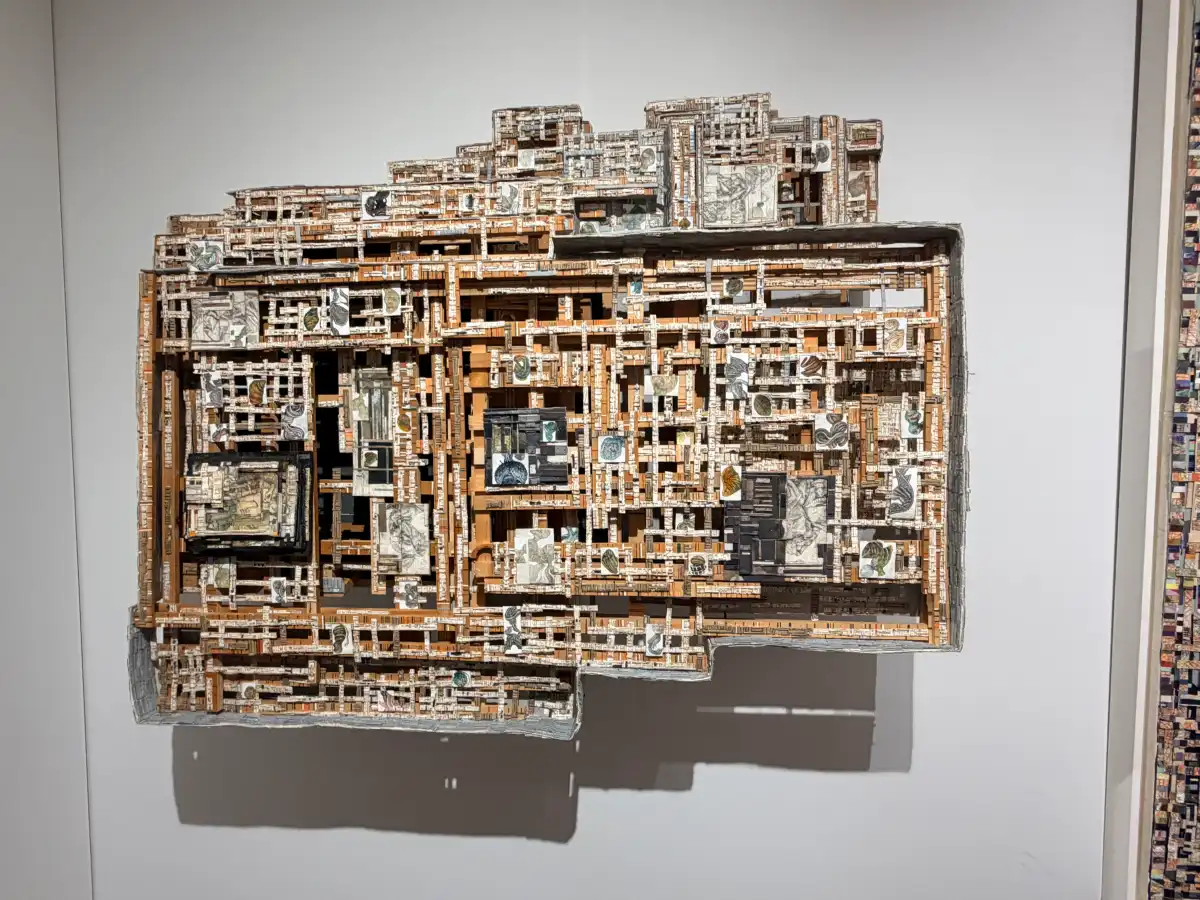
The Outsider Art Fair has returned to Chelsea.
Photo by Avalon Ashley Bellos
Jerry Saltz, in one of his near-omniscient dispatches, suggested—perhaps more accurately, insisted—that the Outsider Art Fair 2026 was not to be missed. There are moments when one listens. Even while hovering somewhere between resilience and complete physical collapse—bronchitis, uninvited yet unwavering—I found myself there on a Saturday afternoon, slightly fevered, entirely compelled, and, in retrospect, exactly where I needed to be.
“Outsider” is a word that, quite often, suffers from overuse, though here it lands with uncommon precision. The fair does not attempt to position itself as alternative within the existing system. It exists, more interestingly, adjacent to it—unconcerned with assimilation, uninterested in approval. This is not a polished rendering of the art world. It is something other, something that resists refinement in favor of raw articulation. It allows one, rather generously, to meander—to think, to question, to step outside the rigid scaffolding of expectation that so often governs how we are taught to see.
There is, perhaps, a quiet intellectual liberation in that.
The Outsider Art Fair 2026, now in its 34th edition at the Metropolitan Pavilion, gathers 68 exhibitors from across the globe, presenting artists who operate beyond formal training and outside established art-historical narratives. What unfolds is not a singular aesthetic, but a constellation of impulses—work driven by instinct, by necessity, by an almost private compulsion to create.

Textiles, in particular, assert themselves with a kind of tactile intelligence that feels both intimate and expansive. There are hand-sewn compositions that read like coded diaries, stitched with a patience that borders on devotion. Fabrics are dyed, layered, assembled—less as decoration and more as language. One senses histories embedded in thread, gestures repeated until they become ritual. These works do not merely hang; they hold. They carry memory, labor, and a distinctly human touch that feels increasingly rare in a world inclined toward speed.
RUN STORE by Susan Cianciolo leans fully into this sensibility, offering an environment that feels less curated and more lived-in, as though one has stepped directly into the interior landscape of an artist’s mind. Quilts spill across the floor, garments hover somewhere between costume and artifact, objects accumulate with a logic that resists conventional display. It is immersive, slightly disorienting, and deeply affecting.
Elsewhere, From the North introduces a different, though equally compelling, register. Inuit artists bridge ancestral knowledge with contemporary expression, their works carrying a quiet authority that resists simplification. There is a sense of continuity here—of histories not abandoned, but extended, reframed, and allowed to evolve on their own terms.

Even outside the fair’s walls, the refusal to conform continues. Dindga McCannon’s Ode to the Bronx! transforms a vehicle into a moving archive, a vibrant and unapologetic celebration of place, memory, and community. It feels, in many ways, emblematic of the fair itself—mobile, expansive, and entirely uninterested in staying within prescribed boundaries.
What becomes clear, perhaps gradually, is that this is not an “entry point” into the art world, nor is it seeking to be one. It is something more otherworldly, more self-contained. The artists here are not waiting to be folded into the canon. They are, quite simply, operating outside of it—building their own systems, their own visual languages, their own definitions of value.
There is a kind of cerebral pleasure in that realization, a loosening of the need to categorize or resolve. One is not asked to understand everything. One is invited to experience, to sit with ambiguity, to allow the work to unfold without immediate conclusion.
The market, naturally, is beginning to circle closer. Attendance continues to grow, collectors are paying attention, institutions are listening more carefully. Yet the true vitality of the Outsider Art Fair lies in its resistance to that gravitational pull. It remains, at least for now, gloriously uninterested in being fully absorbed.
One leaves altered, if only slightly. The edges of perception feel softer, more permeable. The definition of art expands, not dramatically, but just enough to matter.
Bronchitis, it turns out, was a small and rather necessary inconvenience.
