If the Whitney Biennial takes the temperature of American artwork—and of the society that produces it—the cacophony of fragments, relics and semi-fictional or dystopian allusions on this version captures the fractured sense of actuality and dissociation defining the current second, as the good narratives that when structured collective which means seem more and more distorted or dissolved. As if, within the irremediable unraveling and collapse of techniques as soon as perceived as steady—ideological, political, financial—all that continues to be is to ponder the fragments and relics of a civilization approaching its personal exhaustion. Hovering between horror and hallucination, this Biennial displays a picture of America, each for itself and for the world, outlined by uncertainty, fragmentation and a shifting sense of actuality and humanity.
But the response supplied right here is nothing overtly revolutionary or explicitly political. In an age of heightened scrutiny and institutional warning implementing political correctness, artists—notably within the U.S.—have realized to evoke modern tensions by way of oblique routes, working by way of allegory and symbolic displacement. As consensus tradition turns into more and more strained by systemic breakdown, the 2026 Whitney Biennial merely permits the collective shadows to emerge. The primary gesture appears to be to acknowledge and present the fracture, the wound and the failure—and, from there, playfully interact with the self-created dystopia that follows or retreat into the intimacy of the personal sphere, the place area can nonetheless be carved out for care, kinship and private connection regardless of the forces unraveling all the things round us.
This 12 months’s Whitney Biennial gives each paths, relying on the place one begins. Beginning on the sixth flooring, Michelle Lopez’s immersive meditation on human-made catastrophe—offered within the type of a planetarium—instantly set the tone of all the Biennial for me with its terrestrial system imploding and crumbling simply above our heads. Its title, Pandemonium, additionally feels uncannily apt for describing on a regular basis actuality, notably because the starting of the 12 months, amid a relentless information cycle of U.S. politics and rising geopolitical tensions providing little respite. Information and pictures from all over the world have by no means been extra available than in right now’s atmosphere of knowledge and knowledge oversaturation, but the world—and, by extension, human habits—appears more and more illegible, recalling Jean Baudrillard’s notion of hyperreality, during which representations start to precede and reshape the actual. Displayed on a round display screen overhead, this chaotic rumbling mixture of animated imagery and swirling newspaper clippings turns into a damaging storm that completely displays media overload, disinformation and environmental collapse.

In a local weather the place the query of “Americanness”—and what it even means to name one thing “American”—is turning into more and more urgent in addition to delicate, curating the eighty-second version of the Biennial is a process few would eagerly tackle. Marcela Guerrero and Drew Sawyer have largely averted overt political statements, and the identical is true of a lot of the works on view. But a major shift is already embedded within the intergenerational and worldwide number of 56 artists, duos and collectives, reflecting the thought of a “Larger United States.” Shifting past the id politics that dominated many latest institutional exhibits within the U.S., there’s a clear effort right here to widen the angle and look at deeper historic layers of collective trauma that contributed to the by now broadly acknowledged—and even instrumentalized—“unsure, bitter and divided state of the nation.”
Artists from areas formed by the worldwide attain of U.S. energy—from Afghanistan and Iraq to the Philippines and Vietnam, passing by way of Hawai‘i—carry this American artwork biennial into confrontation with the enduring penalties of U.S. imperialism. Their presence feels notably resonant as new geopolitical tensions escalate through the very days of the exhibition’s opening, repeating lots of the dynamics these artworks quietly bear witness to. Many works operate virtually like signs that echo an authentic trauma whereas revealing the extended malaise it has left behind, a part of a historic course of that appears suspended in time and area, with unresolved histories.
Proper on the entrance, the grotesquely surreal work and extra intimate, spontaneous drawings by Ali Eyal evoke the anxieties of battle by way of the lens of childhood reminiscence. The artist returns to a last second of innocence, when his mom took him and his sisters to Baghdad’s largest amusement park shortly earlier than the outbreak of the Iraq Conflict in 2003. But the specters of battle creeps silently into the scene, rising by way of shadows with an ominous presence of dying. Your entire composition shares a hallucinatory distortion recalling Goya’s The Disasters of Conflict, suspended someplace between nightmare and documentary.
Conflict—the violence of our time—is usually offered by way of this technique of distortion, as if the trauma of systemic violence had ruptured notion itself and with it the very material of actuality. This dynamic is especially evident in Aziz Hazara’s Moon Sightings, the place battle imagery is abstracted by way of technological imaginative and prescient. These uncanny, vivid inexperienced and purple photos derive from retinal scans and biometric knowledge extracted from night-vision goggles typically deserted in battle zones. Hazara examines the availability chains and afterlives of surveillance applied sciences produced throughout navy occupations.

But the actual query might be: which actuality are we ? Technological techniques and mass media have inevitably altered the best way we understand the world. The technological dysmorphia and dystopia rising from the more and more unstable ambiguity between the bodily and the digital—reshaping the best way we orient ourselves, arrange expertise and course of actuality—turns into one other recurring thread all through the Biennial.
Related dynamics unfold in Basel Abbas and Ruanne Abou-Rahme’s video set up Till We Turned Fireplace and Fireplace Us, during which the artists discover the fluid narrative area opened by digital media. Drawing on fragments of footage associated to the Gaza battle, they reframe the spectral absence imposed by battle imagery, reworking it right into a layered assemblage of storytelling and sound. By means of this course of, the work virtually alchemically converts the rhythms of destruction into extra poetic, summary and expansive narratives—reclaiming by way of the digital not solely company over photos formed by censorship or propaganda but additionally the potential for resistance, life and creation within the face of tragedy.
In the meantime, simply in entrance of Hazara’s dazzling composition, a line of screens presents the digital summary compositions of pioneering Palestinian-born, Tribeca-based artist Samia Halaby. Developed by way of early self-taught laptop programming, these kinetic works remodel streams of information into mesmerizing constellations of shade and motion, revealing the underlying construction of latest photos: strings of code and numbers that more and more form our unstable and malleable sense of actuality.
Past Halaby, totally digital artwork has a restricted presence within the Biennial, with the primary exception of Leo Castaneda’s interactive simulation of a fictional ecosystem. Drawing on online game aesthetics and 3D modeling strategies, the Colombian-born, Miami-based artist incorporates work by his grandmother, Maria Thereza Negreiro, to assemble a fantastical panorama of Colombian and Brazilian environments infused with Latin American surrealism. Guests navigate this digital terrain—the place delusion and expertise merge—trying, like online game protagonists, to change the course of a looming cataclysmic explosion or just play inside it.

As a substitute, it’s extra typically a digital-physical mash-up and reshuffling—and the reorganization of the physique inside that area—that prevails all through the exhibition, typically taking distinctly dystopian turns. Gabriela Ruiz’s centrifugal multimedia set up gives maybe probably the most dramatic interpretation of this body-mind dysmorphia. Combining sculpture, surveillance footage and video projections, her Homo Machina takes the type of a life-size digital console functioning as a self-portrait. The work displays the continual negotiation between bodily and digital identities as our bodies more and more carry out inside algorithmically pushed techniques that regulate visibility, labor and management.
On the fifth flooring, Cooper Jacoby takes this inquiry additional with works that discover how technological progress—and now A.I.—has reshaped not solely our relationship to the physique but additionally notions of intelligence and reminiscence. Reused intercom techniques activated by way of A.I. fashions educated on social media posts of deceased people start to talk by way of simulated reminiscences. Impressed by his discovery that insurance coverage corporations more and more calculate one’s “organic age” by way of predictive algorithms, Jacoby’s installations Mutual Life (40.4 years) (2026) and Property (January 21, 2016) (2024) power viewers right into a confrontation—fairly actually, as their reflective surfaces draw one into the work—with one of the crucial unsettling questions of our time: how synthetic intelligence would possibly replicate, simulate and even lengthen facets of human consciousness past the bounds of the physique itself.
Disjointed our bodies and interrupted ecosystems reveal the fracture
The thought of disjointed, fractured, endlessly malleable our bodies—dysmorphed and dismembered—recurs all through the present, at instances revealing in that very queerness the potential for new types of relation and collective turning into.
A very theatrical second unfolds within the set up by Korean artist Younger Joon Kwak, the place an ensemble of fragments drawn from particular person our bodies expands and blends right into a kaleidoscopic immersive atmosphere, steadily coalescing right into a collective physique in area—very like the best way particular person presences dissolve right into a shared rhythm when everybody strikes collectively on a dance flooring. Composed of casts taken from members of the artist’s queer and trans neighborhood in L.A. and paired with a musical rating, the work unfolds as an ephemeral choreography that invitations viewers to see themselves mirrored in its mirrored surfaces. In doing so, it dissolves the boundaries between spectator and paintings, between the person and the collective, turning the room right into a rotating constellation of our bodies—an ephemeral choreography of presence hinting at the potential for an alternate, autonomous neighborhood suspended exterior the same old societal dynamics.

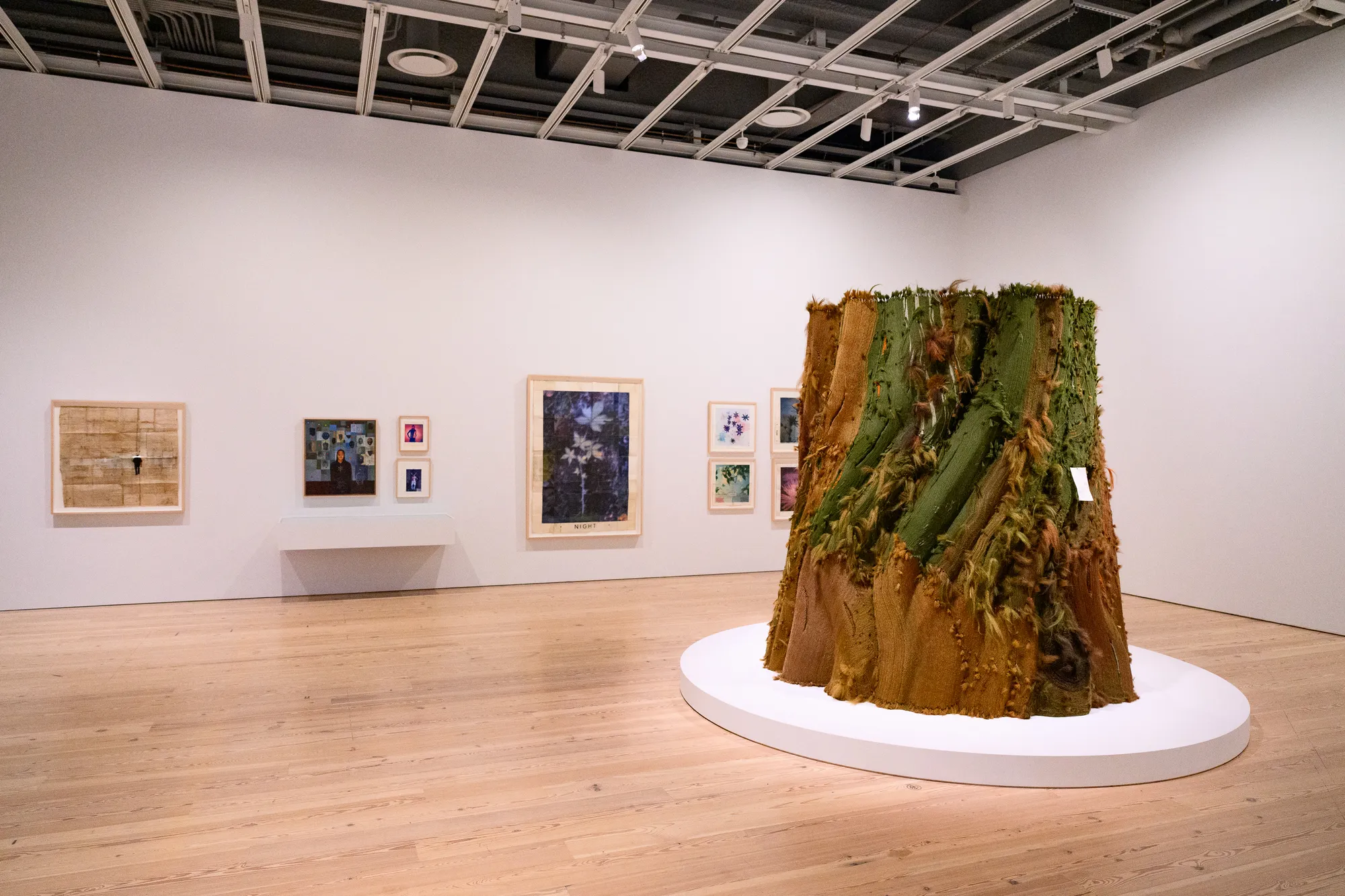
This impulse to heal the fracture between the person and the collective by way of a transpersonal embodied expertise resurfaces elsewhere within the exhibition. A hanging instance is Malcolm Peacock’s set up 5 of them had been hers, and he or she carved shelters with home windows into the backs of their skulls (2024), which reimagines a coastal redwood tree the artist encountered throughout repeated journeys to the Pacific Northwest. Impressively composed of roughly 3,500 hand-braided strands accomplished over 10 months, the sculpture incorporates excerpts from the autobiographies of Frederick Douglass and Malcolm X throughout its floor, weaving histories of battle and resilience right into a monumental but intentionally constructed imaginative and prescient that seeks to reconnect the private, the collective and the ancestral with the land. As Peacock has defined, the work additionally displays on his relationship to the “Nice Open air,” a social and ancestral infrastructure that has traditionally maintained an absence of Black presence. By utilizing the labor-intensive braiding approach—generally known as a protecting fashion—that he realized from his mom to interpret a redwood tree, whose power relies on unseen interconnections, the artist raises questions on security, safety, progress and the need of religious kinship when navigating unfamiliar environments.
The identical energy of kinship by way of shared battle can also be celebrated by the eccentric improvised altars of the self-described “road queen” Agosto Machado. On these shrines, collected objects and memorabilia honor the queer neighborhood that sustained him through the AIDS disaster, memorializing a community of care constructed within the face of loss. As a result of, as Lewis Mehl-Madrona reminds us, past any approach, it’s relationships that heal.


From these works emerges a dominant poetics of relics—remnants, detritus, what stays after successive forces of occupation, extraction and destruction have handed. This situation turns into notably evident in Kainoa Gruspe’s fragments of rock, stone and plant matter gathered from landscapes reshaped by navy bases, golf programs and resort developments in Hawai‘i. The artist “rescues” these supplies and transforms them into sculptural doorstops that anchor his work—objects that metaphorically maintain the door open to future actions whereas concurrently confronting the extractive relationship between the U.S. and Hawai‘i and the erasure of its authentic heritage.
This poetics of remnants, nonetheless, additionally raises a broader query. The prevalence of works constructed from poor or repurposed parts—typically visibly fragile or improvised of their materials execution—could function symbolically, nevertheless it additionally factors to the circumstances beneath which artists within the U.S. are actually working. In lots of instances, the reliance on such supplies appears much less a purely aesthetic resolution than a mirrored image of the financial realities shaping inventive manufacturing right now, the place the rising prices of area, fabrication and labor more and more constrain the size of inventive ambition.
It’s comprehensible that within the apocalyptic ambiance of the current, the grand utopian gestures of earlier avant-gardes really feel troublesome to maintain. But this side—strikingly absent from many different evaluations to date, though writing a few Biennial must also contain analyzing the fabric circumstances of artwork making—factors to deeper financial and sociological tensions embedded within the American cultural system itself: the widening hole between cultural and monetary capital, the rising precariousness of inventive labor and maybe not least the gradual disappearance of artisanal infrastructures able to supporting extra advanced manufacturing. One thing that artists in lots of elements of Europe and Asia can nonetheless obviate, counting on regionally embedded traditions of craft and technical data—types of collective experience that proceed to maintain materially formidable practices.
Confronting the shadow of the current
What turns into more and more clear is that the roughness—and typically outright ugliness—of many works within the Biennial intentionally brings to the floor a number of demons haunting the current second. A number of items evoke a darkish emotional register nearer to the Gothic grotesque the place social anxieties and historic violence resurface in distorted, unsettling types.

This assault on the specters of the American dream and its mannequin is seen in works reminiscent of Ignacio Gatica’s Sanhattan—which attracts on the monetary district of Santiago, Chile, constructed shortly after Augusto Pinochet’s violent U.S.-backed dictatorship and deliberately designed to resemble Manhattan—nevertheless it emerges much more explicitly in Devil in America and Different Invisible Evils: Experiments / Experimentos de escultura pública (Public Sculpture: Demon, Splay) (2026) by Isabelle Frances McGuire. Drawing on the imagery of the Salem witch trials, the set up’s three burning witch our bodies conjure a imaginative and prescient of persecution and paranoia that feels uncannily modern. The title itself says sufficient, suggesting a nation perpetually haunted by the invisible forces it has traditionally tried to suppress or exile.
In the identical days I used to be reflecting on this Biennial and scripting this overview, I occurred to complete studying Attuned: Training Interdependence to Heal Our Trauma—and Our World by Thomas Hübl. Its title alone may virtually function a becoming subtitle for the exhibition. Hübl’s work focuses on collective trauma and its transmission by way of societies, insisting that trauma isn’t purely particular person however saved throughout the social physique itself. Historic occasions—wars, slavery, genocide and colonization—go away unprocessed emotional residues that turn out to be embedded in establishments, cultural narratives and patterns of interpersonal habits. When these wounds stay unacknowledged, trauma repeats throughout generations by way of cycles of violence, denial and fragmentation. As Hübl writes, “To not handle the hidden wounds of the collective human physique is to put our planet additional in peril and the survival of our personal species at grave threat.”
To concurrently really feel and witness these wounds—first as people after which inside a shared collective course of—will be the solely solution to start integrating and metabolizing not less than some portion of this collected trauma vitality. Confronting the ruins turns into a aware first step within the lengthy strategy of therapeutic.

There may be, after all, rather more to say and course of about this Biennial, which requires a number of visits. But the secret is that by grounding itself across the notion of relationality, the exhibition succeeds in brazenly exposing—making us really feel and witness—the chaotic disorientation and fragmented nature of an America confronting its personal which means and contradictions barely 250 years after its founding, as a lot because the broader Western techniques upon which it was constructed.
What emerges is a portrait of a civilization dwelling amid systemic fracture the place our bodies, ecosystems, infrastructures and historic narratives all register the identical damaged situation. And all of the makes an attempt at kinship and therapeutic all through the Biennial finally reveal unresolved—and maybe unresolvable—tensions between its many elements: fragments of a fractured American narrative that may not be reconciled right into a single picture however persist as an alternative as scattered relics. But this deep sense of disorientation that many really feel right now—personally, nationally and globally, as if estranged from the very techniques that arrange our lives—is exactly what calls for a brand new degree of human collaboration and reattunement.
As Hübl suggests, trauma freezes and fragments previous and current expertise, storing and constantly reviving elements of life within the shadows till they will safely return to consciousness. Therapeutic requires what he describes as a “liquification” of trauma throughout three intertwined dimensions—the person, the ancestral and the collective—all of which appear to be activated concurrently all through the Biennial.
And but it could be exactly inside this second of historic fracture and implosion that the potential for reinvention and regeneration emerges. Kelly Akashi’s Monument (Altadena) on the terrace turns into a robust assertion of this hope. Created after the Eaton Fireplace in California in January 2025 destroyed the artist’s house and studio, the work reconstructs the chimney that remained standing after the hearth, rebuilt in luminous glass brick alongside the walkway that when led to the home. Echoing the traditional mythic perception that each origin story additionally carries inside it a narrative of destroy—and vice versa—the hearth itself, even in its devastation, opens a cathartic area from which one thing completely new would possibly start, suggesting that destruction could turn out to be the precondition for renewal. On this sense, the ruins of the current second that the artists are creatively participating with would possibly already resemble what German thinker and cultural critic Walter Benjamin as soon as described because the particles of progress.

