A king could stake his claim to posterity on the tilt of a chin. Earlier this fall, at the Cincinnati Art Museum, I came upon two Black women in Kehinde Wiley’s The Two Sisters, and for a moment the other faces I had passed seemed to recede. Coral and gold flowers run across their white Givenchy gowns, yet it was the quiet fact of their royalty that made me stop. They had the unhurried bearing of people accustomed to being waited for. In those halls of European portraiture, where porcelain complexions had so often been given the place of honor, that assurance was enough to change the character of the room.
Wiley took the composition from Théodore Chassériau’s 1843 portrait of his sisters. It is worth remembering, however, how differently a Black figure could be made to serve in a European court portrait. Beside Pierre Mignard’s Duchess of Portsmouth stands a young girl holding coral and pearls. She was probably enslaved, according to London’s National Portrait Gallery, which suggests that her complexion was used to make the duchess appear paler. The painter could give a child’s face his closest attention and still make her beauty serve someone else’s. The more often paleness appeared as a sign of rank, the easier it became for a prejudice against dark skin to pass for taste.

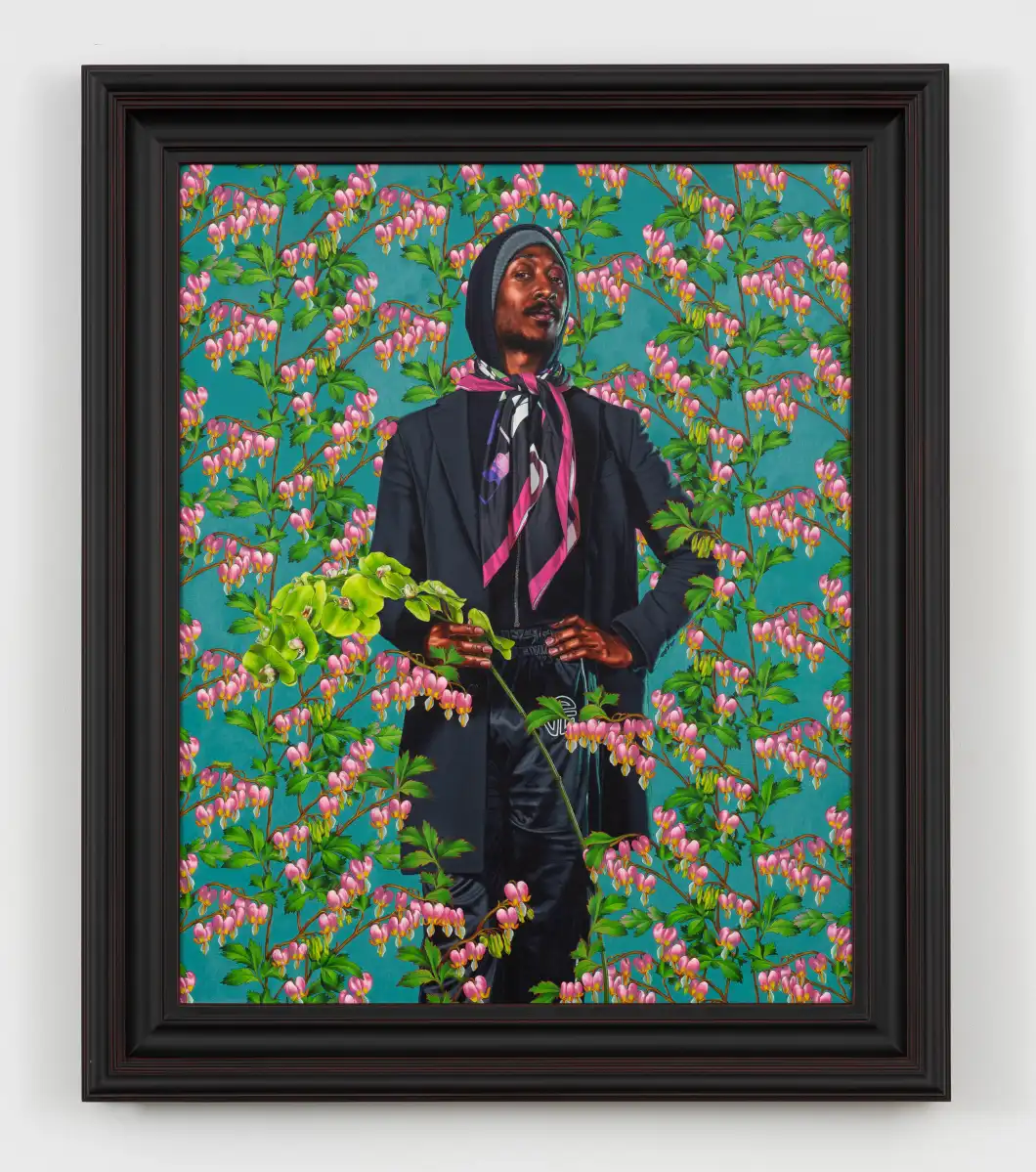
With that in mind, consider What the Light Becomes, an exhibition that opened last week at Sean Kelly Gallery. Wiley paints New Yorkers he met by chance, attending to the sanctity of a moment that might pass between any two strangers on the street. Among the portraits that hold the room is Crash Colon’s. He turns toward us from inside a navy hood, one hand still in the pocket of his magenta puffer. Pink blossoms pick up the sheen of the jacket, and blue foliage repeats the color of his jeans. A branch crosses the denim just as the body seems poised to leave. What an eighteenth-century court painter might have signaled with a jeweled crown, Wiley establishes in the small interval between a shoulder turning away and a pair of eyes coming back to meet ours.
In the portrait of Madison Billups, a crooked branch lies across a dark blue jacket with the ceremony of a scepter. Scarlet flowers recur with the density of woven silk, until a leaf crosses the sleeve and the pattern seems to occupy the same air as the figure. The reds keep the eye moving, and it is Billups’s face, held in a stillness the pattern can never quite overtake, that gives the painting its gravity. Dante LaGuerre, meanwhile, lifts his chin amid turquoise leaves and lilac blossoms, his shoulders drawn back and his arms crossed. The splendor around him seems almost excessive until you meet his gaze. Then it feels entirely in proportion.

In 2005, Wiley placed a Black man in camouflage and Timberlands on the rearing horse of Jacques-Louis David’s Napoleon. The pose that once made conquest look inevitable gave a man the street might pass by the stature of someone history expects us to remember. In the new Portrait of Dave Williams Jr., a gold scroll is held open for us to read. It cuts across the olive of his jacket as pink blossoms crowd its edges. The Latin follows a line from Henry David Thoreau’s journal, urging us to live in each season as it passes, to breathe the air and taste the fruit. Wiley took Vivaldi’s The Four Seasons as a point of departure for the exhibition. Here, what looks at first like a proclamation turns out to concern the pleasures of being alive. Williams holds it as though these pleasures were matters of state.
That ease takes different forms. Tim Smith wears checkerboard sneakers beneath a profusion of orange blossoms. Sakyra Vincent gathers her hands close within a burgundy coat against cream and powder blue, a private gesture in a painting that can draw you from across a room. Then there is Barri Yoko, a familiar presence on the New York art circuit and almost invariably on the dance floor. Knowing Barri in motion changes the feel of that painted stillness.

I think here of Rembrandt, who at thirty-four painted himself in velvet and a jeweled cap and at sixty-three made the weight of the flesh beneath one eye as worthy of attention as anything he had ever worn. Francis Bacon studied a late Rembrandt self-portrait and saw how a likeness could emerge from brushstrokes that scarcely described a face. In Bacon’s portraits, a person could remain unmistakably themselves even as the face we take for granted began to come apart. With Wiley, however, the revelation comes by way of splendor. The longer you look, the more all that color seems equal to the human presence it was made to hold.
The film accompanying the paintings and oil studies gives several of the people Wiley portrays time to tell something of their lives. In the paintings, however, a life can make itself felt in the few seconds it takes for a gaze to meet ours. What these people keep to themselves feels as present as what they show. It is here, I think, that Wiley makes his claim to being the portraitist of our time. He can paint a Black figure with all the authority of a sovereign and leave intact the privacy of someone who decides how much of a life to let us see. I think again of those two women in Cincinnati, and I wonder how much of what we call royal I might have walked past on my way to the museum.
What the Light Becomes is on view at Sean Kelly Gallery, 475 Tenth Avenue, New York, through December 23, 2026.