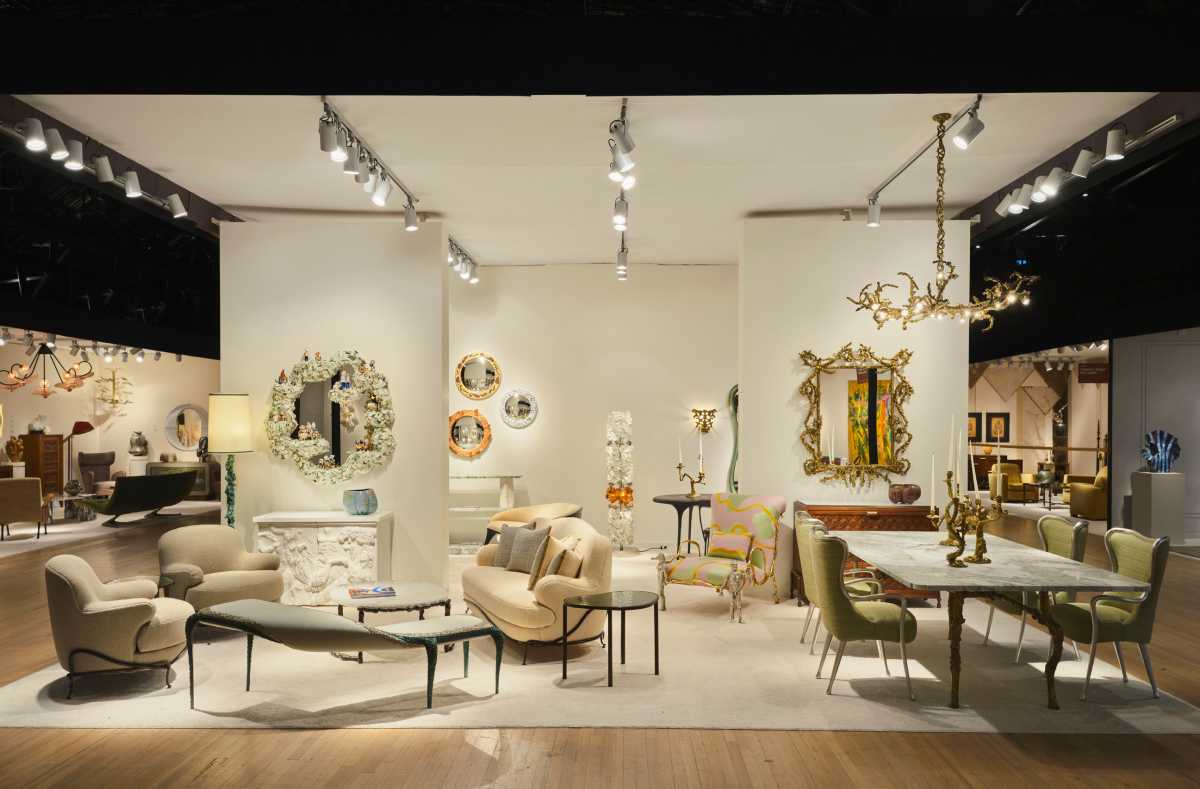
The Park Avenue Armory has excellent manners. For five days in November, Courtney McLeod of Right Meets Left Interior Design gave it the pleasure of forgetting them. Her Impossible Blooms, conceived for the fifteenth edition of Salon Art + Design, recast the foyer as a garden out of Lewis Carroll’s Alice in Wonderland. In the book, a change in scale can make the familiar strange. McLeod took a similar liberty with a space usually crossed in a few strides, making the interior itself the first thing worth lingering over.
The organizers counted roughly 3,300 guests at the opening, which began with a champagne preview hosted by Nathalie de Gunzburg in support of Dia Art Foundation. With Drew Barrymore, Ralph Lauren and Irina Shayk in attendance, people-watching was, of course, a perfectly respectable diversion. The real sport, though, was discovering what might draw the eye away from the crowd.
Some of that irreverence carried into ABASK’s presentation, where floral artist Hamish Powell arranged some 1,500 repurposed corn husks around a selection of collectible lighting. Helle Mardahl’s hand-blown glass mushroom had the slightly illicit allure of something Alice might have been warned against touching. There was a subtler pleasure, too, in the way Powell layered the husks around Jorge Suárez Kilzi’s Feather desk lamp. Seen through the dry fibers, its glow took on a grain, an effect that depended on a material ordinarily discarded after harvest.


Fantasy acquired a more serious purpose at Phoenix Ancient Art, where two Roman marble sarcophagi formed the fair’s most incisive pairing. Sea centaurs and monsters surge across the relief from the Giustiniani collection. At its center, a seashell takes the place of the round shield that traditionally framed a likeness in an imago clipeata. The substitution suggests the birth of Venus, lending the funerary scene the peculiar vitality of a beginning.
The example once owned by Isabella Stewart Gardner is altogether quieter. A draped figure holds a scroll above crossed cornucopias, and winged Erotes sleep at the corners. There is an almost domestic tenderness in their unguarded repose. The provenance feels especially apt given the care Gardner took over her own interiors. At Fenway Court in Boston, she determined how furniture, paintings and sculpture were seen together. The arrangement was, in its own right, an act of authorship.
Bossa Furniture brought a similar sensibility to A Casa Paulista, its evocation of a 1950s São Paulo living room. Lina Bo Bardi’s Bowl Chair, designed in 1951, reduces the silhouette of an armchair to a hemisphere cradled in a slender metal ring. The handwoven fabrics were easier to overlook, though they were central to Bossa’s research into the period’s showrooms. Upholstery, after all, seldom survives as well as the frames it covers. The display gave makers such as Irene Ruchti, who designed textiles for Branco & Preto, their place in the account of Brazilian modernism.


One of the clearest distinctions between Salon and a conventional art fair is how readily a visual judgment becomes a physical one. The contour of a chair can hold your attention from across the booth. A little closer, and the questions become more intimate. How far would you recline, and where would your elbow fall? An armrest can deserve as much scrutiny as a gesture in a painting. At LES Collection, the gallery reported that the Lily chair kept visitors talking while two ceramics by Gianfranco Briceño changed hands. Along the back wall, studies traced Briceño’s images from photographs through sketches and paper cutouts to the appliqués he uses on clay. It was a chance to see the choices a finished piece can make look inevitable.
Among Liz O’Brien’s early sales were two baskets by Joe Hogan and three porcelain citrus trees by Zac Zimmerman. The baskets carry the memory of a use even when they are collected for the intelligence of their weave. The trees, meanwhile, indulge a different appetite. Picture one on the breakfast table in February, when the branches outside are bare. Indoors, the fruit is forever an instant away from being picked.
For more on Salon Art + Design, visit thesalonny.com.