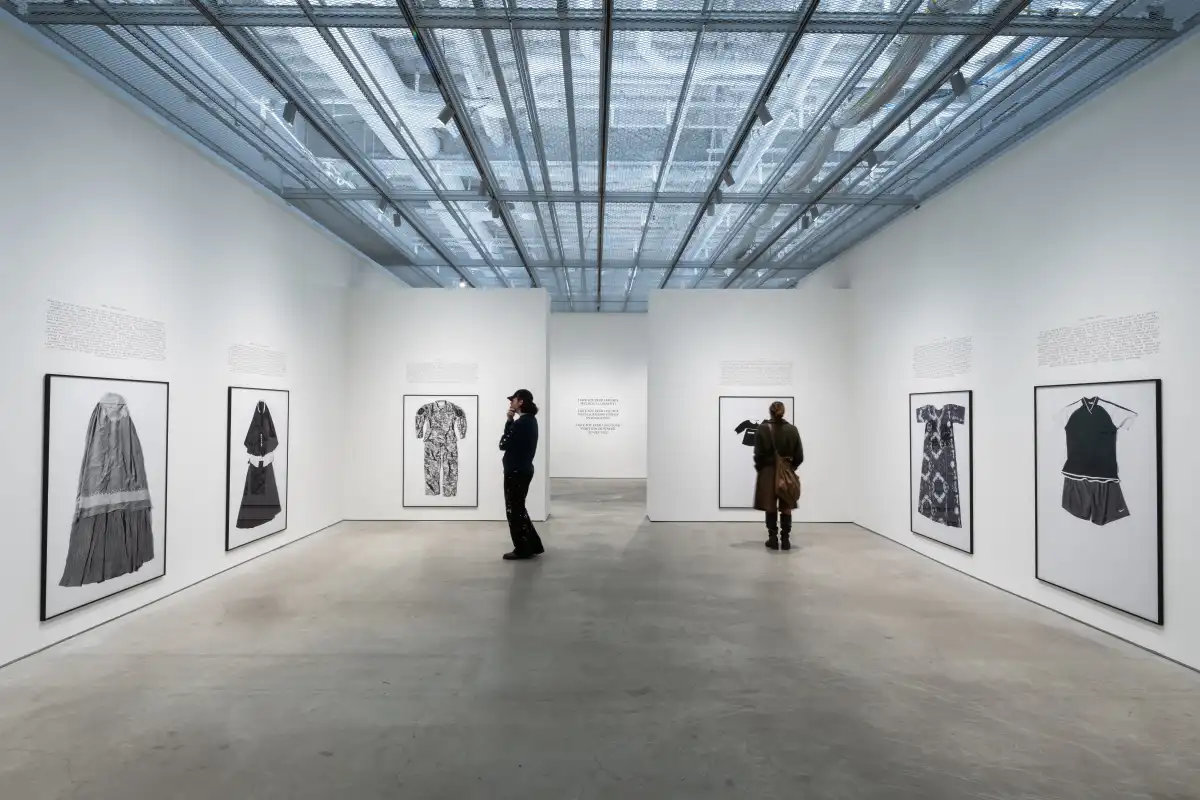
I was staggering when I reached the sign at the International Center of Photography that read “You have reached the end.” I collapsed onto a bench and sobbed, and although the grief was immediate, the relief has taken longer to reckon with. I could leave Laia Abril’s exhibition and return to a world in which those same cruelties, encountered in isolation, could still pass for exceptions. Abril shows how rape becomes systemic when families, churches, and courts make a woman answer for the violence done to her, giving those who violate her reason to expect impunity.
On Rape and Institutional Failure opens with near-life-size photographs of a nun’s habit, an Army uniform, and a wedding dress, each accompanied by testimony. I was struck by the dress and drawn to Veeda’s account of being forced to marry at thirteen. Years later, her fiancé made her relinquish her job on the grounds that she was “sparking men’s sexual desires around him.” In that marriage, she says, she spent six years confined to her own home.
At thirteen, my chief preoccupations were getting the latest issue of Seventeen and shopping at Express. I was free to take pleasure in how I appeared in the world. It had never occurred to me that this pleasure could be entered into evidence against me.
The dress introduces Alina, a twenty-one-year-old student in Kyrgyzstan who aspired to become a fashion designer. Her sister had escaped an abduction, and Alina went home for the holidays because she feared staying alone at university. When she herself was abducted, her mother wanted to bring her home, while her grandmother, mindful of the talk after her sister’s escape, entreated her to stay. “My grandmother asked me not to disgrace my family,” Alina recalls, before adding, “So I did.”

More than 3,000 small portraits of Catholic clergy accused, prosecuted, or convicted of sexual abuse recede into a dark field. Abril draws on databases compiled by survivors, an accounting the Church should have undertaken itself. In Rape Chat, a collage of group messages in vinyl, Abril includes WhatsApp exchanges among the men convicted in Spain’s La Manada case. I kept thinking about the labor it took survivors to make a record of abuse and how freely the men made a record of their own in the company of friends.
A map traces the distinction Deuteronomy draws between town and countryside. A betrothed woman could be put to death for failing to cry out in town, while in the countryside the law allowed that nobody might have heard her. In La Manada, the defense adduced an eighteen-year-old woman’s stillness in the men’s footage as evidence of consent. Spain’s Supreme Court convicted all five of rape in 2019. Across those centuries, what endures is the presumption that a woman in terror owes the authorities a performance they can recognize. The words Abril assembles gather force alongside others from scripture, interviews, and court records.
“Because she did not cry out though she was in the city.”
“Why couldn’t you just keep your knees together?”
“SEX AND PAIN SOMETIMES GO TOGETHER.”
“If it’s a legitimate rape, the female body has ways to try to shut that whole thing down.”
“She wanted to have it.”
“When you’re a star, they let you do it.”

Judge Robin Camp spoke the lines about knees and pain. Abril displays the latter at ICP and exhibited former congressman Todd Akin’s remarks in Berlin. Quentin Tarantino later apologized for defending Roman Polanski, who pleaded guilty to unlawful sex with a thirteen-year-old. The ruling on view from E. Jean Carroll’s civil case quotes Donald Trump’s remarks from the Access Hollywood tape and his sworn deposition.
In her later marriage, Veeda says, her husband beat her each time she asked for a divorce. I keep returning to that detail, and to the fact that Alina’s grandmother understood precisely where the disgrace would fall if her granddaughter came home. There is a terrible intelligence in that calculation. A family can foresee how cruelly the world will punish a girl who leaves and, in the name of preserving her place in it, enforce the terms of her captivity.
Go see Abril’s exhibition, and brace yourself for the relief you may feel when you reach the end. I could rise from that bench and leave the moment I knew I could bear no more. What I have carried with me is the knowledge that a woman can be just as certain she cannot bear another day, and that those vested with the power to protect her can still decide that she must.
Curated by Sara Ickow, On Rape and Institutional Failure is on view at the International Center of Photography, 84 Ludlow Street, New York, through January 11, 2027.