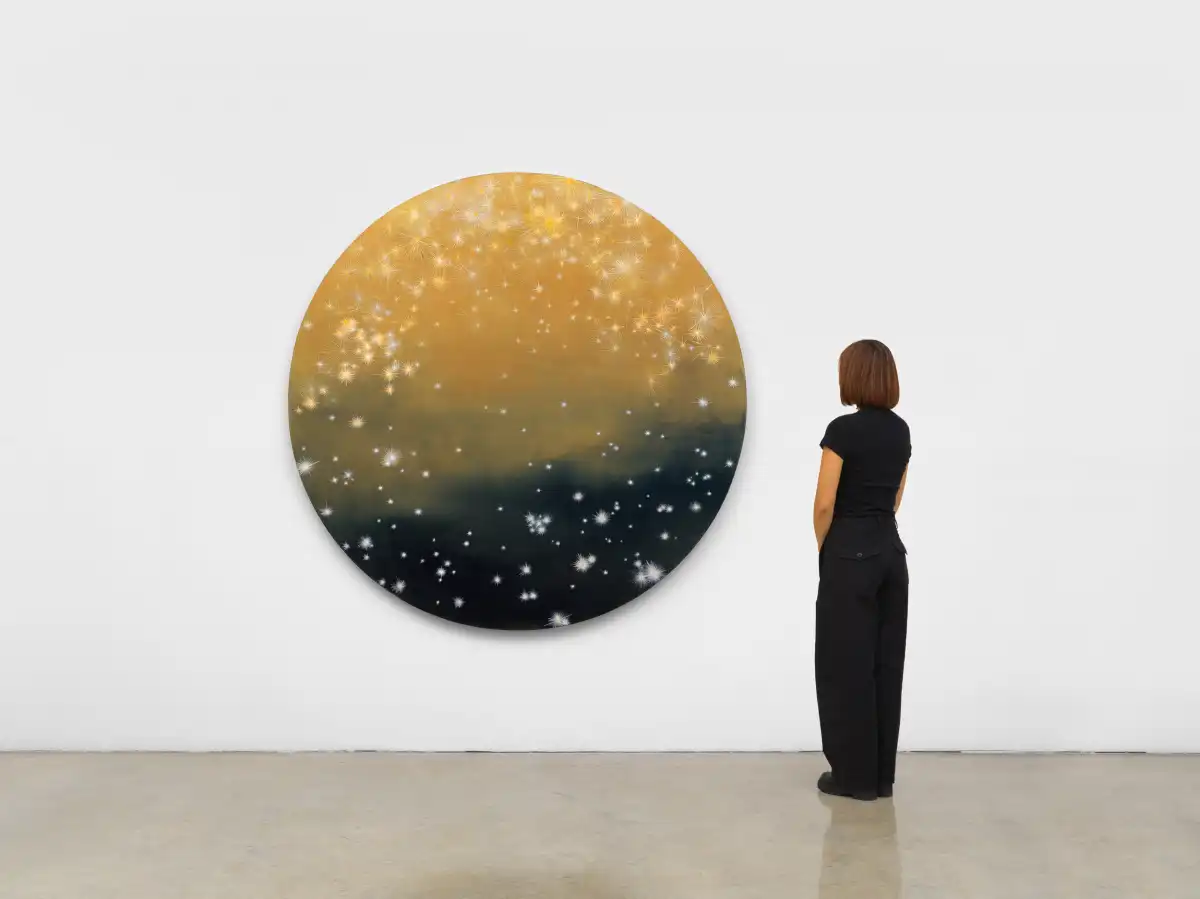
Cinto’s The Path to Stars brings the heavens close enough to enter. Lundqvist’s spare oil paintings find the complexity of living in the small distances people keep.
Dawn arrives in Sandra Cinto’s Aurora with the stars still in it. Gold gathers at the top of a circular canvas more than six feet across, fading through tarnished green into midnight blue. Fine white rays persist even in the brightest passages. It takes a moment, perhaps, to see how much of the night Cinto has let the morning keep.
A dark blue tondo, Nocturne, marks the entrance to The Path to Stars, Cinto’s twelfth solo show with the gallery. Farther in, the round canvases have the poise of celestial bodies in orbit, and the São Paulo-based artist carries their colors onto the walls. The amber of midday is visible within steps of dusk. There is something quietly transcendent about finding the sky at eye level, all around you, and sensing that you have a place in it.

The two biombos, or folding screens, bring that ethereal atmosphere out into the room. Their intricate gold faces recall Ogata Kōrin’s early eighteenth-century Irises at Yatsuhashi, where blue flowers and an angular bridge seem to float. Come around either screen and the brushwork loosens across blue. It takes an ordinary turn of the body to see that both skies have been there all along.
In 2008, for The Difficult Journey – After Géricault, Cinto sent thousands of folded paper boats across Bonakdar’s floor and drew in silver over reproductions of Théodore Géricault’s The Raft of the Medusa. In Géricault’s canvas, exhibited at the Salon of 1819, the prospect of rescue is a speck on the horizon. Some of that urgency survives in Cinto’s skies. A person can spend a long time looking into the dark for a light that small.
Bonakdar’s gallery opened on Prince Street in 1994 and moved to West 21st Street four years later, as dealers were taking over Chelsea’s garages and warehouses. In Constructed Happiness, her 1999 solo debut outside Brazil, Cinto let a single hue travel across walls and sculptures in three rooms. It could suggest hope, she said, as readily as “hunger, venom, delirium and death.” The gallery doubled its footprint in 2006. There is a certain confidence, two decades on, in how much white wall Bonakdar leaves around Lundqvist’s small oil panels in the skylit gallery.

The Swedish painter made her New York debut here in 2002, when a boy pulling a cart could already suggest a life in progress. She returns for her fourth solo show, her first in nearly a decade, with the same economy. A straight horizon, a muted field of color and a few objects are enough to begin. In all that negative space, the distance between two people can tell you as much as their expressions do.
In Duccio’s The Calling of the Apostles Peter and Andrew, a panel from the Maestà completed for Siena Cathedral in 1311, Christ calls to two fishermen while their net is still full. There’s a tenderness in the thought that a life might change while both hands are occupied with the old one. In Lundqvist’s Axe and Spade, two men flank a row of saplings. One seems ready to plant, while the other could undo the day’s work with his axe. The two stand with the same air of innocence.

There is a dollhouse intimacy to Lundqvist’s scale. You can take in the whole arrangement at once and feel, for a moment, that the whole story is in view. Her recurring silhouettes bring to mind Malvina Reynolds’s “Little Boxes,” where people’s lives start to sound as alike as their houses look. Lundqvist gives the eye plenty of open ground in which to reconsider that first impression. Two people can stand side by side and experience the same moment quite differently.
In Two Girls, one of the barefoot figures holds a white flower, its head bowed. Another bloom lies to their left. It may simply have fallen. One can also imagine a gift offered and quietly put down. Most of the nineteen-inch square is slate-blue sky, yet the whole picture seems to lean toward that scrap of white. The girls’ sleeves nearly touch. Either girl could reach the flower in a step or two. They might stand there a long time, each waiting for the other to move.
The exhibitions are on view through December 18, 2026, at Tanya Bonakdar Gallery, 521 West 21st Street, New York.