The city’s five pension funds — which cover city employees and currently provide benefits to some 160,000 retirees — climbed by about 23% in their last two fiscal years, as tech stocks and artificial intelligence-related investments skyrocketed. As a result, the city anticipated that its pension fund contributions could decline by about $8 billion over the next five years — while still meeting its obligations to retired city workers.
It’s a similar story for the state’s pension funds, which grew by about 17% over its last two fiscal years. They cover all state and municipal workers outside of New York City and currently make payments to more than 500,000 retirees.
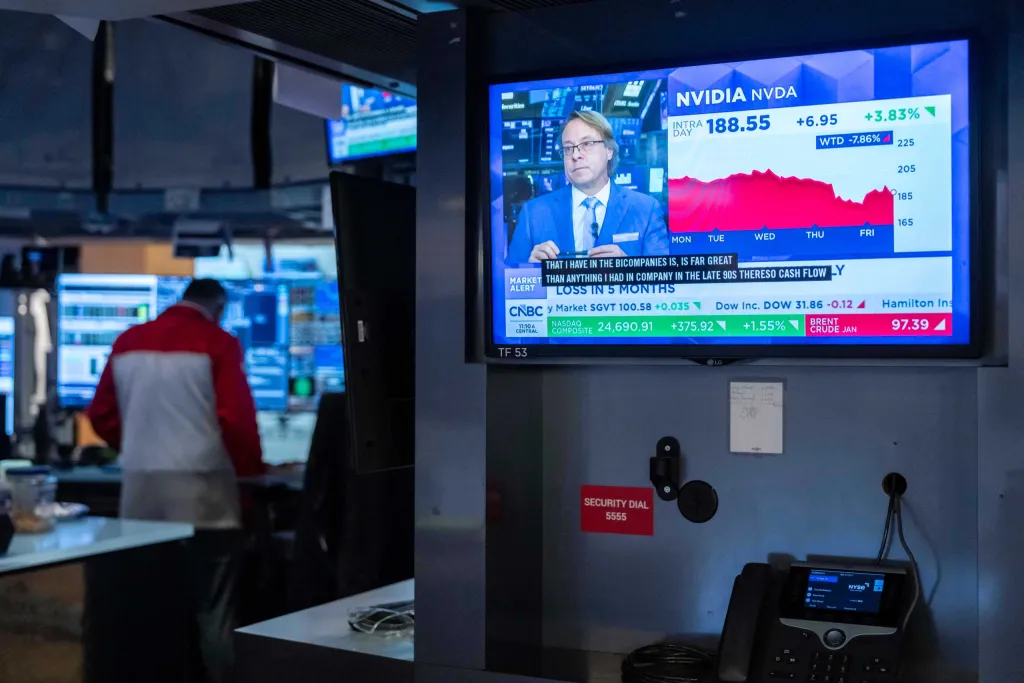
But with the sharp drop in tech stocks last week and growing fears that the unprecedented surge in AI investments will not pay off, both the city and state now face the possibility of sharp declines in pension fund values.
And that would require them to boost the amount they direct to pension funds each year to meet their commitments.
That, in turn, could crowd out other budget priorities — like expanded childcare or new investments in housing.
“AI is touching us everywhere in the pension funds,” City Comptroller Mark Levine told The City Reporter. “It is a massive component of the S&P 500 and Nasdaq. Our private equity investments are heavily in AI-related companies. We have gone big into private credit. And who is it being lent out to? AI.”
Markets plunged last week after the midterm elections, in part because winning Democratic candidates have pledged to slow the construction of data centers, without which the largest AI companies won’t be able to achieve the kind of growth they have promised investors.
The benchmark S&P 500 fell almost 3% for the week. The Nasdaq composite index declined 10% from its previous peak on Thursday, a drop called a correction, before slightly recovering on Friday to end the week down 6%. The Wall Street Journal reported that Anthropic, which is expected to launch its initial public offering before Thanksgiving, has been told by potential investors that it would have to reduce its expected valuation by at least 25%.
The city’s pension funds control $326 billion and the state’s funds are now at $310 billion, making them the third- and fourth-largest public pension funds in the country. The investment strategies for both are similar.
About a third of the assets are invested in U.S. stocks, with most of that in index funds that simply track key measures of the market.
International stocks — which have soared in the last year, primarily because of huge gains among South Korean companies providing chips for AI — bring the total equity investments up to 40%. Those gains are now endangered as well by an AI bubble bursting.
The index strategy, while regarded as the most prudent form of investing for individuals and pension funds, means the city has huge stakes in AI-centered companies, including chipmakers like Nvidia, Elon Musk’s SpaceX and older tech companies pushing aggressively into AI, like Meta (Facebook), Alphabet (Google) and Microsoft.
Bonds account for about a quarter of all funds, and AI companies have been issuing billions in corporate bonds this year. AI is also a growing part of stakes in real estate, private equity, pools of capital that are used to buy, fix up and sell companies, and private credit, a relatively new area in which firms lend money instead of a bank. So the city and state pensions funds’ investments outside of stocks also bring wide exposure to an AI bubble.
The city’s pension funds will not immediately buy shares in Anthropic if it goes public this month, the comptroller’s office says. But it will own Anthropic shares once the company is added to the Russell 3000 index, which tracks the 3,000 largest publicly held companies in the country and is expected to add Anthropic almost immediately. It will own more shares if, as expected, Anthropic is added to the S&P 500 about a year after its initial public offering.
“We don’t want to be overconcentrated in AI,” Levine said. He recently decided not to invest in a private-equity deal involving an AI company even though the proposal met the fund’s investment standards.
State Comptroller Tom DiNapoli, who decisively won his fourth term last week and is the sole trustee and makes all investment decisions for the state pension funds, was not available to comment last week.
Levine’s office is beginning a major reevaluation of the pension funds’ investments, something the office conducts every three to five years. Exposure to AI will be one of the top priorities, Levine notes, with the results expected within five months.
In the meantime, there is a role for AI in the city comptroller’s office.
“AI will help us by giving us new tools to assess risk,” he said.
Our nonprofit newsroom relies on donations from readers to sustain our local reporting and keep it free for all New Yorkers. Donate to THE CITY today.
The post New York’s Pension Funds Soared in the AI Boom — and Could Crash With the AI Bubble appeared first on The City Reporter.