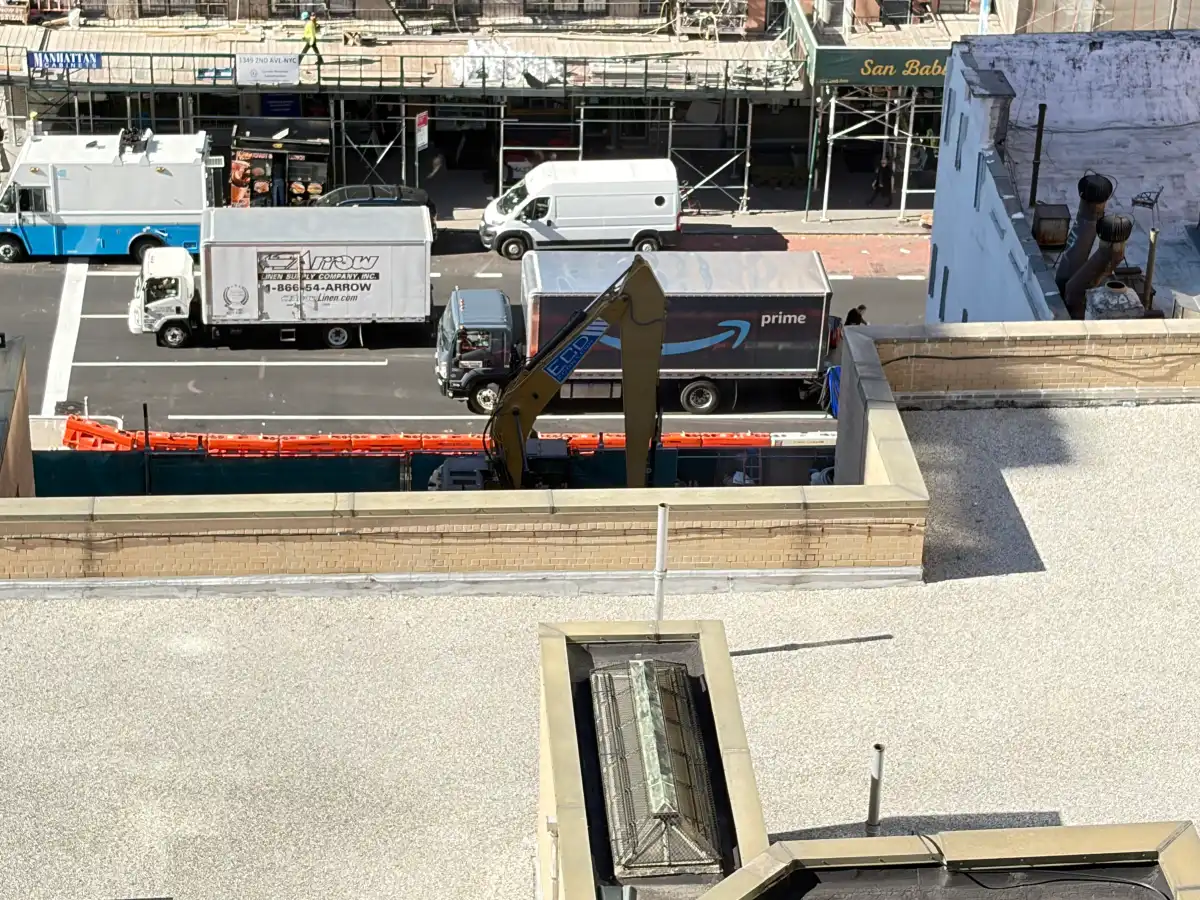
In the city that never sleeps, at least not as long as many would like, Erica Bersin doesn’t have to use an alarm clock to wake up. The problem for the Upper East Side resident is that nearby construction doesn’t just get her out of bed.
Construction crews routinely provide her with a 7 a.m. weekday wake-up call, and then keep working throughout the day – lately working until as late as 10 p.m. on weeknights and on weekends.
“The noise and vibrations are unbearable,” Bersin said. “I live with multiple sclerosis and my health has been negatively impacted.”
While noise is normal in New York City, Bersin lives within feet of three ongoing construction projects that have upset her neighbors, providing signs of a potentially bigger problem.
“I’m extremely familiar with my 7 a.m. wake up call, the start of the drilling every day,” said Community Board 8 Chair and 72nd Street Neighborhood Association President Valerie Mason. “The heaviest drilling seems from 7 and 10 a.m.”
Construction is going on at 301 East 71st St., 242 East 71st St. and 252 East 72nd St. as part of a building boom leading to another “boom.”
“The agencies who sign off on construction should not allow three corners in the same block to do work,” continued Bersin, an East 71st Street resident. “When it’s hardcore drilling, my furniture vibrates. You can feel it.”

Turning up the volume
In New York, noise comes with the territory, as does construction. But while builders say working longer, earlier and later allows them to finish sooner, many residents of nearby projects say they get no respite from the roar.
“It’s pick your poison. Do you want us to do this for two months or four months?” Mason said. “If we get the variance and work some Saturdays, we’re out of your hair or ears sooner.”
Mason said nearby doctor’s offices face their own barrage of noise. “Their whole building is shaking,” Mason said. “They are having trouble hearing the heartbeats of their patients, because the drilling is so loud.”
Bersin believes proximity to projects is a problem, creating a crescendo that sometimes drives residents from their homes.
“I’m not saying don’t put the buildings up. There has to be some deference to the people living here,” Bersin said. “I have to sit with noise-canceling headphones as long as they’re working. And it still doesn’t completely muffle it. I can still feel the vibrations. My next-door neighbor has a newborn baby. It’s not fair to the existing neighborhood.”

Loud and allowed
Department of Buildings spokesman David Maggiotto said construction is legally allowed in New York City weekdays 7 a.m. to 6 p.m. Contractors can request After Hours Variance (AHV) permits, often issued until 10 p.m. and/or weekends.
But as Mason pointed out, the permits are “liberally granted.”
“We’ve had situations in other buildings where they literally get an AHV every single weekend,” she told amNewYork.
Mason said the ongoing Memorial Sloan Kettering Upper East Side reconstruction project recently secured “Saturday work variances for almost an entire year.”
The DOB provides oversight over AHV permit applications and does after-hours inspections where permits were issued with no limit on permits in one area.
“The Department evaluates and regulates each site independently in accordance with applicable laws, regulations, zoning requirements, and building safety standards,” Maggiotto said.
A spokesperson for New York City Council Speaker Julie Menin, who also represents the Upper East Side, said after being contacted regarding these three sites, her office contacted “enforcement agencies to ensure that the projects are kept compliant with all local codes and ordinances.”
She “escalated noise complaints” with the New York City Department of Environmental Protection and Department of Buildings, requesting reviews of after-hours permits and bringing inspectors back to the sites.
“My office takes quality-of-life issues seriously,” Menin said in a written statement, “and will continue to be our community’s first advocate in holding our government partners to the same standard.”

All about AHVs
There are five reasons AHVs can be issued by the DOB, including four that appear strict and one that leaves a lot of latitude.
The permits can be granted for emergency work “involving a threat to public safety,” or public safety if work can’t be done during other hours “because of traffic congestion,” or worker or public safety.
City construction projects can get after-hours permits if they’re judicially mandated, subject to consent orders, or necessary to the “public interest,” such as sewers, sanitation, and transportation.
It is possible to get variances for “construction activities with minimal noise impact” along with specific “mitigation” activities.
The final reason allows permits due to claims of “undue hardship” from site characteristics, unforeseen conditions, “scheduling commitments and/or financial considerations.”
There must be an “alternative noise mitigation plan” specifying hours, activities, and devices, including additional mitigation measures, above and beyond those measures otherwise required.”
Rules require applicants “to significantly limit noise emissions from the site of such after-hours work.”
“There’s a difference between the regulations and how you should be operating when the work is being done in a residential location,” Bersin said.

Noise mitigation questions
Builders at 301 East 71st St. obtained permits for weeknights 6 p.m.-10 p.m. (allowing work 7 A.M. to 10 P.M.) and Saturdays 9 a.m.- 5 p.m.
The basis was “undue hardship” for their 130,000 square foot building, including affordable housing units, based on a “tight schedule” so they can “finish in a timely manner and return the street to normal operation.”
The permit applicant said, “without the AHV, the job will be at great risk of financial hardship and prolonged work.”
The DEP alternative noise mitigation plan notes nearby schools and a hospital, resulting in “significant foot traffic outside the site during business hours.”
Noise mitigation measures include many seemingly standard measures, such as containing activities within the job site, properly maintaining and lubricating machinery, and not leaving machines idling when not used.
They also cite a plywood construction fence draped with blankets to act as a “sound barrier,” on-site meetings to “minimize unnecessary noise,” and mufflers and baffles as available.
A note on the permit that expires Nov. 22, along with approval, indicates it is “recommended to do quiet work” after hours, but not required.

Dial 311 and wait
If residents believe there are safety or compliance issues with AHV permits, the DOB encourages them “to call 311 so that the appropriate agency can respond with an inspection,” according to Maggiotto.
“The DOB has an enforcement unit that responds to after-hours construction complaints on nights and weekends,” Maggiotto said, noting 911 is best for emergencies.
Bersin said she called and inspectors arrived hours later when there was “nothing going on by then.”
“You not only have noise from one site. You have two sites across the street from each other,” Mason said. “If you’re in your apartment, you may not even know where the noise is coming from.”
Bersin said Menin’s office recently told her “there is nothing more they can do because the sites are operating within the law(s).”
Menin, who is married to developer Bruce A. Menin, co-founder of Crescent Heights, said her office is doing what they can.
But one of the biggest issues for new construction in Manhattan lies well below the surface. The Earth Island Journal discusses “380-million-year-old Manhattan schist” or the “hard, durable rock able to support the weight of towering buildings.” Breaching this bedrock to set the foundation for the city’s tallest buildings is far from easy, or quiet.
“It makes the drilling even worse,” Mason said. “It’s like a perfect storm of circumstance.”
Mason said that, with as-of-right construction, builders do not need to interact with residents, while those behind construction projects that require zoning code variances must have community advisory boards to address related concerns.
“There should be requirements that the person building interacts with neighbors,” Mason said.
Some buildings seeking variances install decibel meters, going beyond sending inspectors. But construction brings issues beyond noise, such as pedestrians directed by workers, including some who directed Mason into a bike lane.
“I don’t blame them. They’re not trained crossing guards,” Mason said. “Someone almost got hit by an e-bike as a result.”
Maggiotto said if the agency believes builders are operating within current law, there’s not much they can do.
“The process of changing how AHVs are permitted and enforced would likely need to start with amending the Code through legislation passed by the City Council,” he said.
Bersin worries construction could lead to health problems beyond noise, but says a sound solution would go a long way.
“I’m not saying we don’t need housing. I’m saying they need to be more cognizant of people who live in the neighborhood,” Bersin said. “I’m not NIMBY. I’m not somebody who doesn’t think we need more housing. Be considerate of people who already live in the spaces.”