In 2023, after several e-bike battery fires erupted inside New York City Housing Authority apartments, including a blaze that killed a 5-year-old girl and a 36-year-old woman, NYCHA considered banning the devices entirely from authority property.
But opposition emerged from those arguing that some NYCHA residents rely on e-bikes to make a living, so NYCHA compromised, restricting households to charging only one battery at a time, requiring that batteries be safety-certified and prohibiting the charging of batteries in front of any entrance door or anyplace that could block escape in the event of a fire.
The compromise appears to have made little difference.
Since the protocol started in 2024, the number of e-bike battery fires inside NYCHA properties has risen, with 13 that year increasing to 22 so far in 2026. All told there have been 53 battery fires in NYCHA since the rule went into effect.

That includes Monday’s deadly fire at the Patterson Houses in The Bronx that killed an 11-year-old boy and critically injured four family members, as well as a fire in August at the Albany Houses in Crown Heights, Brooklyn, where an 18-year-old perished.
In both cases, the circumstances that triggered the deadly fires indicate potential violations of NYCHA’s rule: the batteries were being charged in locations that fire officials said blocked escape — in the Bronx fire it was in the kitchen, blocking the way to the exit door; in the Brooklyn blaze it was next to the entry door.
And NYCHA requires that charging take place when at least one resident over 18 is awake. In the Bronx case, the fire erupted around one in the morning.
This week’s fire in The Bronx raised questions about how much effort NYCHA makes to enforce the e-bike battery charging rule. Charging a battery in a manner that violates the charging rule is a violation of the household’s lease. With 53 battery fires since the rule went into effect, NYCHA acknowledged to The City Reporter Thursday that there have been just three terminations of tenancy started for non-compliance with the policy.
It’s not clear how aggressively NYCHA monitors compliance. Compliance with the battery-charging rule is not included on NYCHA’s annual apartment inspection form, nor is it part of the form staffers fill out when performing interim checks known as “Five Alive,” a five-point inspection that occurs whenever an employee enters an apartment to perform maintenance or repairs.
Instead, NYCHA said, employees are instructed to verbally report non-compliant battery charging to a supervisor who will then discuss the violation and remedy with the tenant.
The Patterson Houses apartment where the battery exploded this week had received a “Five Alive” inspection seven months earlier in March. NYCHA said the staff did not observe improper battery charging during the inspection.
On Wednesday, speaking outside the site of the Patterson Houses fire, Housing Authority CEO Lisa Bova-Hiatt acknowledged that charging a battery at an entryway “is a lease violation, but obviously NYCHA’s main goal as a public housing authority is to keep people housed. We need individuals to listen and follow the policy, and that’s where we are.”
She also noted that NYCHA will provide relocation services to the affected family and perform required repairs in the apartment and any other apartments or common areas affected by the fire.
Housing Authority officials emphasized the lease application mailed to each household annually contains the FDNY’s Fire and Emergency Preparedness bulletin on the proper way to safely charge lithium-ion batteries, and the authority’s Resident Handbook contains an updated e-micromobility policy as well.
‘Thermal Runaway’

Fire Commissioner Lillian Bonsignore noted NYCHA’s “specific curriculum on battery guidance,” and encouraged “all New Yorkers to follow the best practices in keeping everyone safe. Lithium-ion battery fires are extremely dangerous because they spread fast and ferociously. The battery cells go into thermal runaway, which makes a small fire turn into a very big fire very, very quickly.”
Bonsignore pointed out that the number of e-bike battery fires citywide has risen steadily since the department began tracking them in 2019, particularly in the last few years. Last year there were 292 with one fatality, so far this year there have been 401 — with six fatalities.
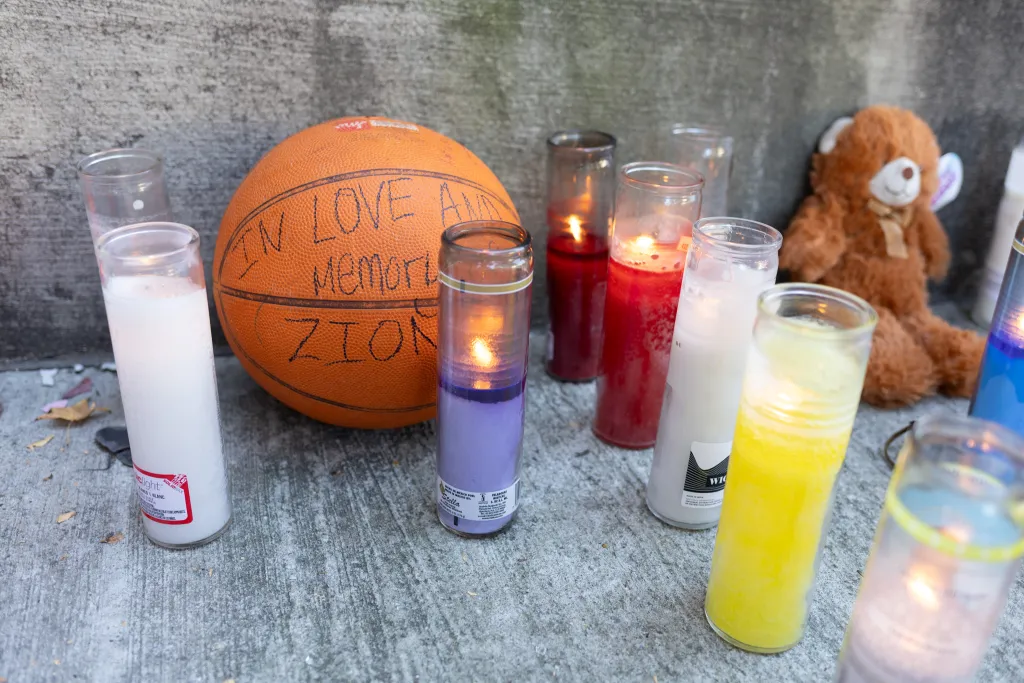
On Thursday Kristina Diaz, who lives next door to the apartment where the fire broke out, said she was in shock at what had happened, noting that besides the death of the 11-year-old, Zion Maine, four of his family members remained hospitalized in critical condition.
“Oh God. The whole family. They was polite. They was friendly,” she recalled. “Every morning they came out, the boy’s first words were, ‘Good morning King. Good morning Queen.’ Very respectful.”
Ben Fractenberg contributed reporting.
Our nonprofit newsroom relies on donations from readers to sustain our local reporting and keep it free for all New Yorkers. Donate to THE CITY today.
The post E-Bike Battery Fires On The Rise at NYCHA, Leaving Death in Their Wake appeared first on The City Reporter.