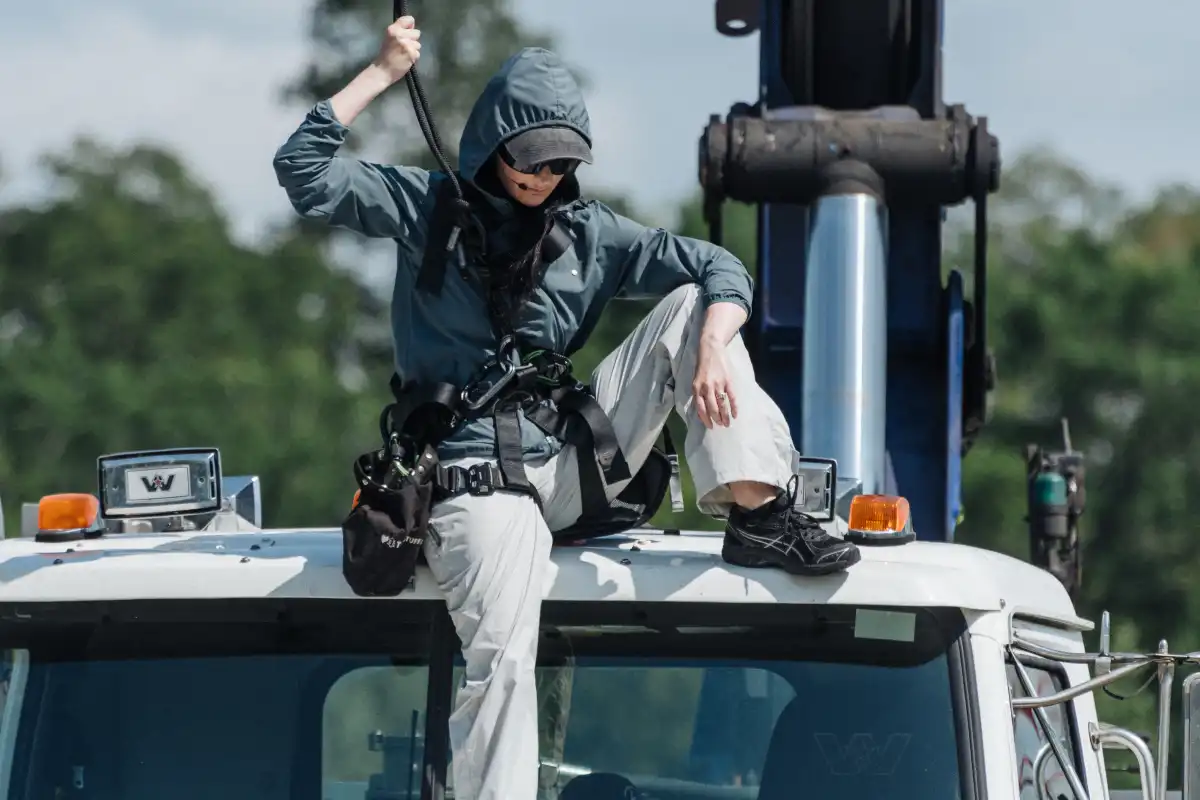
Performance artist Kinlaw has taken a deeply personal message about healthcare, aging and family care 150 feet above Times Square with FALL RISK, a one-night performance that placed the artist’s own body at the center of the issue.
Presented by Times Square Arts, the performance occurred on Oct. 13 at 8 p.m. in Duffy Square, between West 46th and West 47th streets. Kinlaw was lifted high above the plaza by a crane while speaking into a microphone about the struggle to get care for aging and disabled family members.
“I’ll be suspended 150 feet over Times Square, talking about what it takes and what it has taken to get medical care for my family,” Kinlaw said. “It’s about, essentially, American healthcare, getting older and who can afford to do either of those things.”

The work was first performed at Art Omi in June 2025. The Times Square version marked only the second presentation of FALL RISK and its most public setting yet.
Kinlaw, a New York-based performance artist and composer, is known for physically demanding work in unusual spaces. Past performances have included riding through the Los Angeles River while strapped to a pickup truck and climbing car lifts inside a New York City parking garage.
But Kinlaw does not describe FALL RISK as a stunt.
“There are people who work in stunts who are far more professional at doing these kinds of things than I am,” Kinlaw said. “I am not a stunt artist and I’m not really calling this a stunt.”
Instead, the physical risk is tied directly to the message. Kinlaw said the performance reflects the dependence that can come with aging, especially when people need help with basic tasks such as walking, eating or using the bathroom.
“For me, I’m putting myself in a situation where I also am dependent on the help of others,” Kinlaw said. “I’m dependent on the skill sets of others and the safety provided by other people.”
The performance grew out of Kinlaw’s experience helping care for aging parents while trying to navigate insurance and financial systems. Kinlaw said the process showed how difficult it can be for families to get even basic care.
“My job is to just be as direct as I can,” Kinlaw said. “All that I’m doing is talking about what I’ve seen.”
Times Square was chosen on purpose. Kinlaw described the area as a place filled with money, advertising and excess as a sharp contrast to families struggling to pay for healthcare and daily needs.
“It’s a center of excess and a center of circulation of money and advertisement,” Kinlaw said. “I think it’s important to stick something like this in the middle of a center of excess and wealth.”
There is also a historical connection to the location. Nearly a century ago, Harry Houdini suspended himself from a crane in Times Square while attempting to escape from a straitjacket. Kinlaw sees FALL RISK as connected to that history, but with a different purpose.
“That was, in a sense, focused on escape,” Kinlaw said. “Mine is focused on the realities of being present and here and enduring through it.”

The Times Square performance also comes during a painful period in Kinlaw’s life. During the interview, Kinlaw said her father had died about a month earlier.
“I’m still in grief,” Kinlaw said. “It’s just sad. I’m still in shock.”
That loss has changed the meaning and text of FALL RISK since its first presentation at Art Omi.
Kinlaw said the public setting matters because people walking through Times Square may have no idea what the performance is when they first see it.
“If those passing through hear what I’m saying, then that’s great,” Kinlaw said. “And that’s something Times Square can provide that an art space doesn’t necessarily.”
Above all, Kinlaw wants the work to draw attention to a healthcare system that can be difficult to navigate even for families with someone fighting on their behalf.
“Not everybody has that. Not everyone has an advocate,” Kinlaw said. “And even when you do have an advocate, it feels impossible to navigate.”