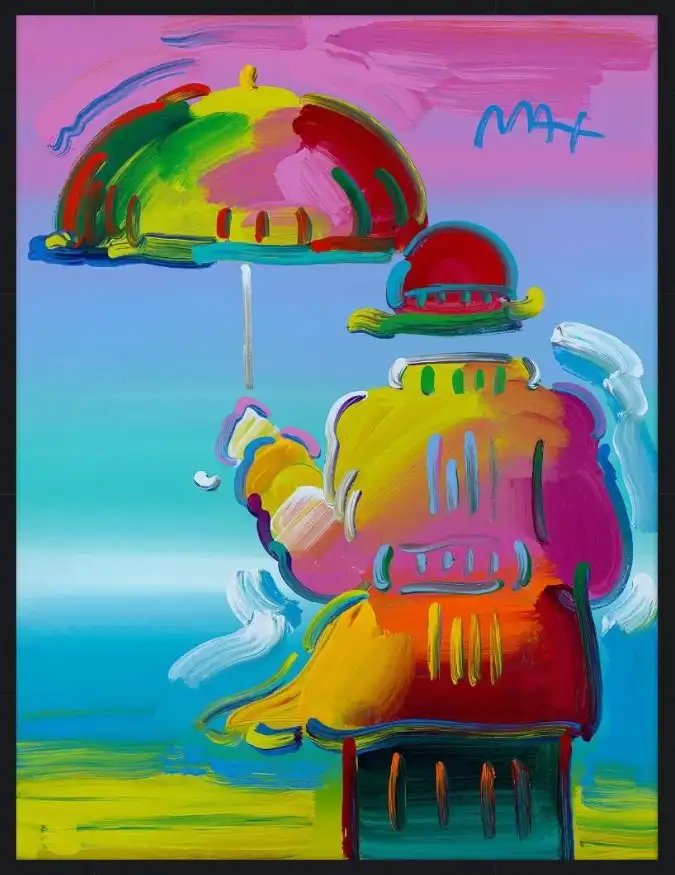
Prestige may be borrowed for an opening night. Authority, however, cannot. It accrues through the artists one stands beside, the collections assembled before fashion catches up and the public trust earned across decades. Park West Gallery entered its new SoHo chapter at 468 West Broadway with precisely that weight: a Peter Max legacy retrospective placed in explosive conversation with Picasso’s complete 347 Series. What moves me most about the pairing is not its obvious star power, although one could hardly request more. It is the deeper, almost uncanny logic connecting two men who understood that an image could escape the studio, multiply and enter the bloodstream of an era.
The chronology, quite remarkably, reads like curatorial fate. In 1968, an eighty-six-year-old Picasso produced 347 prints in fewer than seven months, working with master printers Aldo and Piero Crommelynck while Peter Max’s cosmic vision was sweeping through American culture. By 1969, Max had appeared on the cover of Life, and Albert Scaglione—an engineer whose earlier career included work connected to the Apollo program—left academia to establish Park West. A man who had helped advance machinery toward the moon founded a gallery just as one artist was dismantling Western pictorial history and another was teaching the public to dream in celestial color. Subtle, it was not. Magnificent, it remains.

Picasso’s undertaking, of course, is the darker and more libidinous half of the exchange. Created between March and October 1968, the sequence teems with musketeers, matadors, acrobats, prostitutes, painters, voyeurs and magnificently undisciplined ghosts from the canon. Raphael and La Fornarina reappear; Rembrandt, Velázquez and Goya seem to hover nearby. Etching, engraving, drypoint and aquatint become instruments of appetite, anxiety and recollection. The old revolutionary is not calmly reviewing his accomplishments. He is raiding civilization’s attic, trying on its costumes and racing mortality through every room.
Seen individually, these sheets can feel episodic—erotic here, comic there, elsewhere unexpectedly tender or grotesque. Reunited, however, they acquire the velocity of a mind refusing conclusion. Art history becomes theater; memory sheds its manners; desire keeps interrupting the funeral. Late style is so often expected to arrive serene, chastened and tastefully aware of the approaching curtain. Picasso offers no such courtesy. His copper plates insist that age need not purify a person of contradiction, scholarship or lust. Legacy may wait outside until the work is finished.

Across this historical divide, Peter Max answers with an entirely different emotional proposition. His imagery emerged from classical discipline, migration, spiritual curiosity, commercial ingenuity and an almost radical belief in radiance. Having fled Nazi Germany as an infant and crossed continents before reaching New York, Max understood darkness far too intimately to mistake optimism for naïveté. His suns, profiles, sages, flowers, flags and incandescent heavens were not frivolous withdrawals from reality. They were declarations that history’s brutality would not be granted absolute control over the visual field.
Just as importantly, Max refused the notion that significance required scarcity. Posters, serigraphs, magazine covers, postage stamps, airplanes and monumental public commissions carried his vocabulary beyond the white cube. Picasso used the reproducible print to revisit the old masters and distribute private obsessions; Max embraced multiplication as cultural transmission, sending color into homes that might never have considered themselves part of the art world. One looked backward through centuries of European painting and tore at its architecture. The other looked outward—toward music, space travel, ecological consciousness and the democratic possibilities of popular imagery.

Park West possesses unusual standing within both stories. Its relationship with Max extended across decades, making the gallery his largest and longest-running dealer; following his passing in September, this retrospective carries the gravity of sustained stewardship rather than borrowed proximity. The presence of his son Adam Max, alongside curator and art historian Dr. Charles A. Riley II, further anchors the presentation in family, scholarship and firsthand knowledge. Meanwhile, Park West has acquired two complete sets of Picasso’s 347 Series since 1999, preserving access to an achievement ordinarily dispersed across institutions, auction rooms and private holdings.
That commitment gives the grand opening its real intellectual force. Park West is not furnishing a new address with two famous names; it is revealing the long architecture of its own connoisseurship. Since 1969, the company has introduced art collecting to more than three million clients, building extraordinary reach without surrendering the seriousness of historical material. Scale, so frequently treated with suspicion in cultured circles, becomes meaningful when it is used to widen encounter. Accessibility need not flatten scholarship. Popularity does not invalidate profundity. Sometimes the crowd has arrived because the work continues to matter.

SoHo, with its manufacturing past and artistic mythology, provides an unusually fitting stage. Here, industry once became culture; lofts became studios; experimentation became history, then real estate, then legend. Park West now enters that lineage with two distinct revolutions in seeing—one cut into copper, the other released through chromatic abundance.
Ultimately, Picasso broke the image open; Peter Max filled the breach with color. After more than half a century carrying art toward the public, Park West has built the room where those transformations can finally answer one another—and earned the authority to keep their extraordinary conversation alive.
For more information, visit parkwestgallery.com.