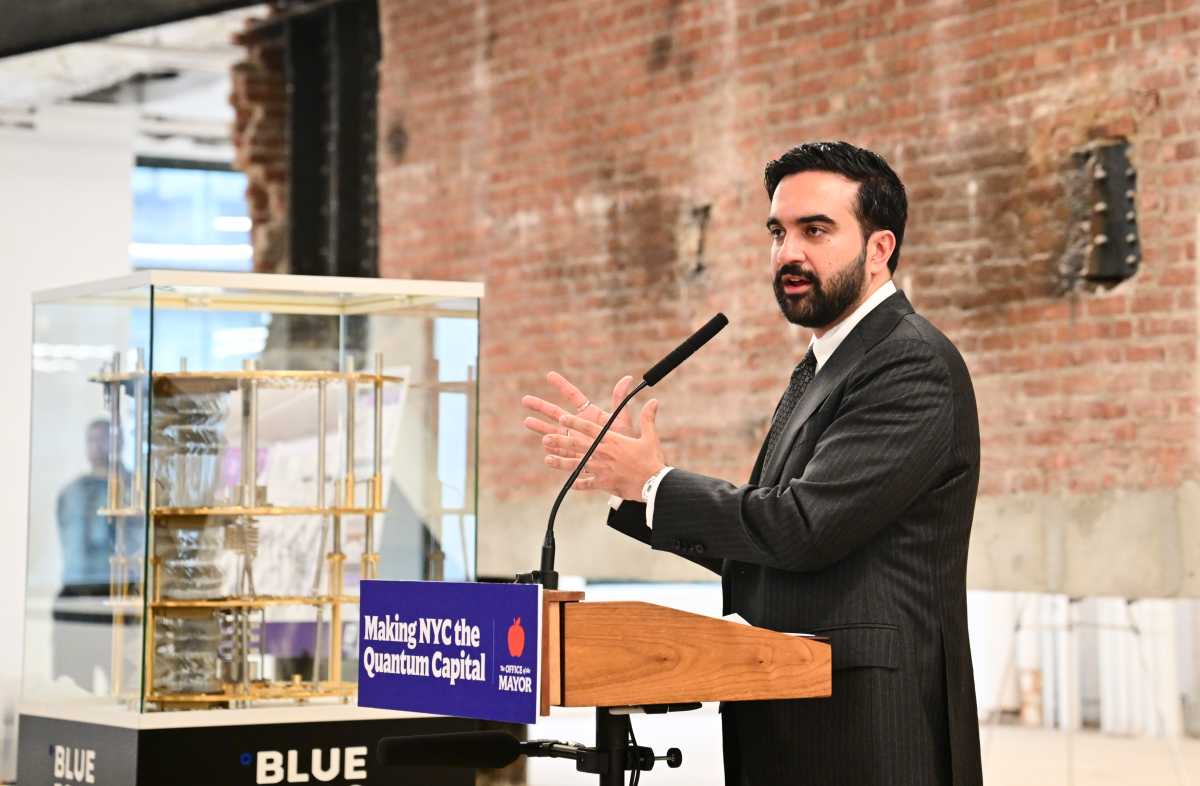
Mayor Zohran Mamdani announced on Wednesday a nearly $30 million investment in a new quantum technology lab at New York University under an agreement that will give the city a share of revenue from inventions developed using publicly funded equipment.
The deal gives the city 15% of revenue received by NYU’s central administration from technologies developed using city-funded equipment at the facility, known as QFab. City officials described the arrangement as a first for New York City, which has previously taken equity stakes in smaller projects but not a share of intellectual property revenue.
The lab, expected to open in 2030 at 770 Broadway in Manhattan, is backed by roughly $284 million in city and university funding. NYU officials project it will help generate approximately 2,000 permanent jobs and support more than 100 companies.
NYU President Linda Mills said the university is committing $255 million to the project, including $100 million in capital spending and $155 million in operating costs over the next decade. The city’s contribution is a nearly $29 million capital investment through the New York City Economic Development Corporation.
The arrangement could allow the city to collect licensing fees, royalties, and other proceeds if inventions developed using city-funded equipment are successfully commercialized. Any financial return would depend on whether those technologies generate revenue.
“So often, public subsidy is just put forward as an incentive without a question of whether the city should also be a part of the revenue that it often creates,” Mamdani told reporters.
The agreement also provides three seats on QFab’s executive advisory board, with representation from NYCEDC and two City University of New York colleges, Borough of Manhattan Community College and City Tech.
The administration said it hopes to use that representation to encourage research into sustainable technology, medical advances and more efficient energy systems.
Asked whether such arrangements could become a requirement for future city-funded projects, Mamdani did not commit to making them mandatory but said the agreement reflected the approach his administration hopes to pursue elsewhere.
“This is a model that we have been very excited about since the first day we’ve been in office,” he said.
The 23,000-square-foot facility will provide researchers, students and companies with specialized equipment to build and test quantum devices. The emerging technology uses principles of quantum mechanics to develop new computing, communications and sensing systems, with potential applications in medicine, energy and other industries.
The project will also provide training opportunities for CUNY and New York City public school students, including internships, summer workshops and certificate programs.
Juan de Pablo, executive dean of NYU’s Tandon School of Engineering, said more than 3,000 CUNY students are expected to benefit from the initiative. The programs will initially involve BMCC and City Tech, with the university hoping to expand participation across the CUNY system.