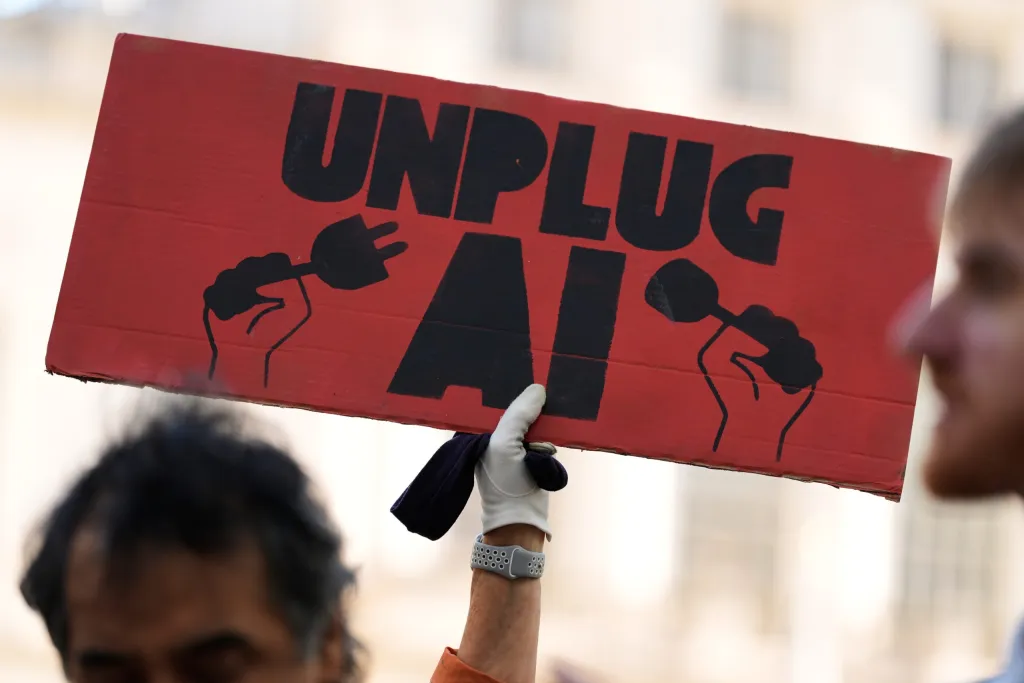
Representatives for some of the country’s AI giants were on the digital hot seat Monday, answering sometimes hostile questions from the City Council about artificial intelligence hacking the government, leaking data, misleading consumers and fomenting extremism.
Representatives for OpenAI, Anthropic, Google and Meta all testified at the hours-long hearing, while the Elon Musk-owned SpaceXAI ignored the Council’s requests, even after receiving a subpoena.
Speaker Julie Menin says she’ll see the multibillionaire’s company in court.
At a press conference ahead of the hearing, Menin said SpaceXAI had replied to the subpoena “with a letter indicating that they want to work with us.”

“To be clear, the only response to the subpoena should be that they should be here today to testify,” she added. “They are opting not to do that, so we are pursuing legal action.”
The City Council would have to file a lawsuit or special proceeding in state court to compel testimony from leaders of the $3.2 trillion company. SpaceXAI did not respond to The City Reporter’s request for comment.
Lawmakers grilled representatives for the other four companies — all of whom testified remotely via video call — in an hourslong hearing with oral testimony from an anticipated 69 witnesses spanning 14 panels, including Mamdani administration officials and industry whistleblowers. The Council also weighed 10 new bills and resolutions aimed at reining in the industry.
Path to ‘Extinction’?
The first to testify were AI company whistleblowers including engineer Jacob Coxon, who announced his resignation from Anthropic last month in a social media thread warning about the dangers of AI. In a post that’s been viewed more than 174 million times, he described the potential risks of unregulated super AI.
“On the current path, I think it is more likely than not that humanity loses control to these AIs and it can end in human extinction,” he told the Council.
MORE: Why New York City Has Become an AI Mecca

Representatives from Google, Meta, OpenAI, and Anthropic followed. They ducked most direct questions on the potential perils of AI.
“You are coming to a hearing today to testify about the dangers and risks of artificial intelligence,” Councilmember Shekar Krishnan said after asking about threats to the city pension systems, with the influence of AI in the stock market where pensions are invested.
None of the panelists could directly answer his questions, citing only the way some businesses benefit from AI.
“The fact that either you don’t have answers to this or you all are citing general statements about the performance of publicly-traded companies does not answer the question about a specific issue that puts many Americans at risk,” Krishnan said.
Council’s Limited Powers
Menin touted the hearing as the first opportunity by a legislative body anywhere on the globe to compel answers from leaders of the most prominent AI companies on the technology’s potential risks to the public. She made the extraordinary move to convene the entire City Council, rather than a specific committee, to question industry leaders.
But the City Council is limited in its ability to rein in the industry or even an individual company. Crucially, the Council does not have the power to grant the broad government oversight and industry-wide regulations that tech CEOs have warned are necessary. President Donald Trump dismissed their pleas to limit the technology as a “conspiracy” and later signed an accord with those same industry leaders where they agreed to self-police AI development.
MORE: NYC Already Battling AI Attacks, Comptroller Says
The bills introduced by city lawmakers largely concern stepping up the Mamdani administration’s AI readiness to prevent attacks from rogue agents, which one citywide official declared has already happened.
Sarah Milstein, a top official at the city’s Office of Technology and Innovation, told lawmakers that the agency is confident in its ability to defend the city’s systems from malicious attacks, but that the agency has no regulatory power over the private sector or consumer products.

Meanwhile, the city’s AI czar, Jiahao Chen, quietly resigned in September, City & State reported last week.
The Council only began questioning Mamdani administration officials — the third of 14 panels planned for the day — around 4:30 p.m., five hours after the hearing began. More than 60 other industry experts were waiting to speak, in addition to an unknown number of members of the public.
Our nonprofit newsroom relies on donations from readers to sustain our local reporting and keep it free for all New Yorkers. Donate to THE CITY today.
The post NYC Council Grills AI Leaders and Whistleblowers in Marathon Hearing appeared first on The City Reporter.