New York knows how to dress remembrance. Sometimes it arrives in evening clothes, accompanied by caviar, champagne and the assurance of people accustomed to turning private devotion into public good. On September 16, Elizabeth Segerstrom and Barbara Tober underwrote the opening concert of the New York Philharmonic’s subscription season in honor of their late husbands, Henry Segerstrom and Donald Tober. The prestige was unmistakable; the intimacy, however, became the night’s truer currency.
Henry and Donald were good men in the most consequential sense: they understood that success acquires meaning through what it protects. Segerstrom helped transform Orange County into a cultural destination; Tober supported institutions across New York, including Lincoln Center, Juilliard, the Met and the Museum of Arts and Design. Their legacies remain visible in stages and civic life. Yet the occasion also illuminated the formidable women who loved them and refused to allow grief to become inert.
“Donald is in my bones,” Barbara said, recalling the hours they spent discussing who they were and why they had chosen one another. “When you lose someone, hug them spiritually and keep them all around you as much as you can.” Elizabeth remembered Henry’s belief that the arts belonged at the center of everything and credited Barbara with teaching her to find joy within sorrow.
That idea—mourning converted into motion—made Gustavo Dudamel’s inaugural program as Music & Artistic Director feel uncannily precise. I have attended many concerts under Dudamel, yet he continues to take me by surprise. He does not simply conduct; he releases the orchestra’s deepest instincts, drawing force and exquisite delicacy from musicians already at the summit of their form.

John Adams’s On the Transmigration of Souls began almost imperceptibly. At first, I heard what sounded like an old air-conditioning system awakening somewhere inside David Geffen Hall. I glanced inquisitively to my left, wondering whether anyone else had noticed. A distant explosion arrived, with heels scampering across concrete in its wake. Then came one siren, soon several, and the unmistakable sound of a city beginning to comprehend the incomprehensible.
I took a deep breath. Slowly, almost mercifully, the New York Philharmonic Chorus and Brooklyn Youth Chorus entered with fragments taken from missing-person posters and memorials. Names of those lost emerged through the darkness, spoken by friends and relatives, while the ensemble gathered beneath them. Only then did I understand: we were not hearing a conventional interpretation of September 11. It felt as though the attack’s soundscape were unfolding around us in real time—machinery, panic, searching, love.
Tears formed before I could negotiate with them. Adams described the composition not as a requiem, but as a “memory space,” and Dudamel guarded it with extraordinary restraint. He never permitted anguish to become spectacle. Instead, brass, strings, testimony and children’s voices carried the heaviness with meticulous precision, allowing thousands of private losses to become a shared act of witness. The grief could not be resolved. For those devastating minutes, however, it could be held.
Zosha Di Castri’s world premiere, Invisible House, extended the meditation toward ancestry and displacement. Inspired by her Ukrainian great-grandfather’s memoirs, folk melodies and Ilya Kaminsky’s poetry, the work moved from warning and wildness toward communal rhythm, intimacy and prayer. Art became an unseen shelter built across generations—a path toward a home history had rendered unreachable.

Following intermission, Prokofiev’s Symphony No. 5 brought levity, sunshine and brilliance without pretending the shadows had disappeared. Written in 1944 as war consumed Europe, it celebrated the grandeur of the human spirit. Under Dudamel, nobility gave way to wicked buoyancy, lyricism and an exuberant finale. Light entered the hall, although it had earned its arrival.
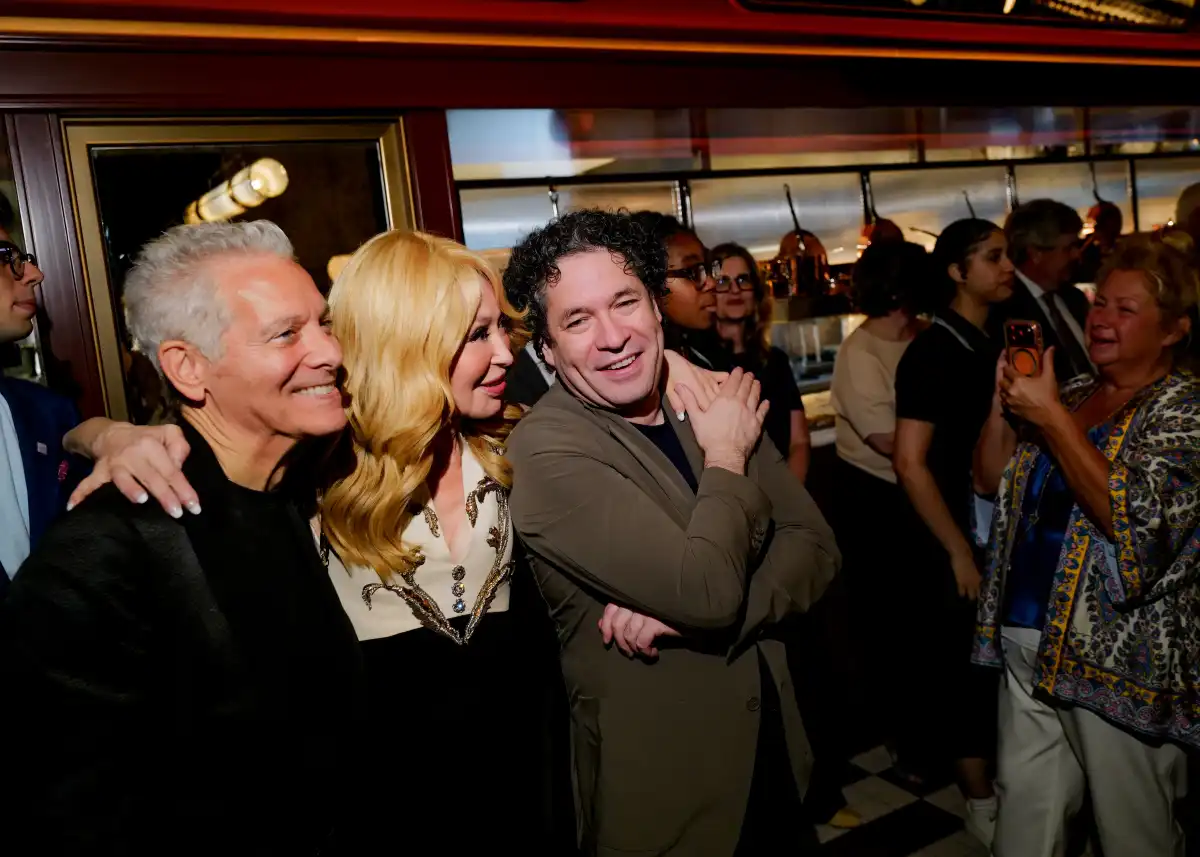
The celebration then crossed Broadway to Daniel Boulud’s new Brasserie Boulud, opened specially ahead of its official debut. A stone’s throw from the Philharmonic, the Rockwell Group–designed restaurant possesses a gorgeous central bar and the immediate magnetism of what may become the hottest pre- and post-concert address in town.
Some 160 friends—including Mikhail Baryshnikov, Candace Bushnell, Peter Marino, Michael Feinstein, Francine LeFrak, Susan Jaffe and Christopher Wheeldon—mingled over delicious morsels, caviar and raised glasses. The final surprise came from the Young People’s Chorus of New York City, accompanied by violinist Nick Kendall, singing “You Will Be Found” from Dear Evan Hansen.
After a concert that began with the names of people who could not be found, the title carried almost unbearable resonance. Perhaps this is what Barbara meant by hugging someone spiritually: build the hall, fund the music, gather the friends and keep beloved names moving through the world. Their wives gave Donald Tober and Henry Segerstrom more than a tribute. They gave them an orchestra, a table and young voices promising that love, translated into art and service, need not disappear.
