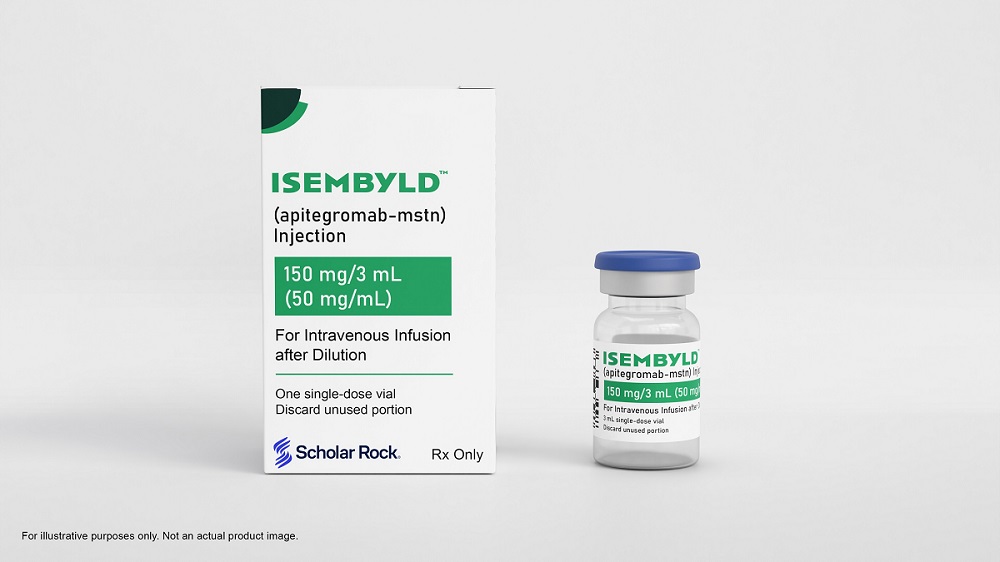
The spinal muscular atrophy (SMA) therapies that have reached patients in the past decade target its genetic underpinnings. While that’s appropriate for an inherited disorder, the approach does not directly address muscle where symptoms show. A Scholar Rock drug specifically designed to target muscle tissue now has FDA approval, making it the first therapy of this type for the rare muscle-wasting disease.
The regulatory decision for the drug, apitegromab, covers adults as well as children age 2 and older, the agency announced after Friday’s market close. These patients must already be receiving one of the two currently available chronic therapies for SMA. The first vials of Scholar Rock’s intravenously infused therapy will reach the market in coming days, executives said during a Monday morning conference call. This drug, the Cambridge, Massachusetts-based biotech’s first commercial product, will carry the brand name Isembyld.
In SMA, mutations to the SMN1 gene leave patients with shortage of a protein needed for the function and health of motor neurons. Patients subsequently develop progressively worsening muscle weakness that affects the ability to walk, move, and even breathe. The loss of muscle function eventually becomes fatal.
A “backup gene,” SMN2, provides instructions for making a version of the protein that SMA patients need. Spinraza, an antisense nucleotide marketed by Biogen, and Evrysdi, an oral small molecule from Roche, are FDA approved medicines that get SMN2 to code for the correct version of the key protein, making up for the protein that SMA patients lack. Novartis’s Zolgensma offers a one-time treatment that delivers a functioning version of SMN1 gene. But this gene therapy may only be administered to SMA patients younger than age 2. While the Biogen and Roche SMA drugs help older patients, many of them, particularly those with advanced disease, continue to show diminishing muscle function.
The body regulates muscle growth with myostatin, a protein that acts like a brake on skeletal muscle growth. Isemblyd is a monoclonal antibody designed to block activation of this protein. Scholar Rock evaluated its drug in a Phase 3 clinical trial that compared the study drug in patients who had already been treated with an SMN2-targeted therapy. Results at one year showed clinically meaningful improvement according to a scale used to assess motor function in SMA patients. By comparison, patients who received an SMN2-targeted therapy alone showed a loss of motor function.
“I think there’s greater appreciation that the body’s natural negative regulator for muscle growth is probably not something that is particularly helpful for patients with SMA,” CEO David Hallal said during the call. “Now we have the first and only muscle-targeted therapy ever approved by the FDA for patients with SMA. We’re excited that patients can now benefit from both increased SMN protein production as well as safe and effective inhibition of myostatin.”
The study drug was generally well tolerated in clinical testing. The most common adverse events reported included upper respiratory tract infections, vomiting, and cough. The label also includes a warning of serious fractures. Scholar Rock President of R&D Akshay Vaishnaw said fractures in the trial were well within the incidence rates for this patient population. Also, all patients who had fractures stayed on the study drug and their injuries resolved. None of these patients stopped taking the drug. Detailed Phase 3 results were published last year in The Lancet Neurology.
Scholar Rock estimates that 6,600 SMA patients in the U.S. are eligible for Isembyld under the current label. Additional clinical research is underway that could expand the product’s label. A Phase 2 study is evaluating the SMA drug in infants and toddlers younger than 2. A separate mid-stage study is testing the myostatin inhibitor in facioscapulohumeral muscular dystrophy. The company is also developing a subcutaneously injected version of the antibody drug for SMA.
The Scholar Rock drug might find an additional place in obesity, where loss of muscle mass is a known adverse effect of currently available medications. Last year, the company reported preliminary data from a Phase 2 trial that evaluated the drug in combination with Eli Lilly’s blockbuster obesity drug Zepbound. While the combination still led to loss of muscle mass, that loss was less than what was shown in the Zepbound-only arm. Scholar Rock has since said it would look for a partner to further evaluate the antibody in combination with GLP-1 obesity drugs.
Nearly a year ago, the FDA turned down Scholar Rock’s application for its SMA drug due to problems at a third-party manufacturing facility owned by Novo Nordisk. Scholar Rock removed that facility from its application and made arrangements for commercial supply to come from another site.
Isembyld is administered as an intravenous infusion every four weeks. Scholar Rock set a $11,659 wholesale price for a single vial of the drug, whose dosing is determined by a patient’s age and weight. The company estimates the annual net price, taking into account patient compliance as well as payer rebates and discounts, will be about $310,000.
Prior to Isembyld’s approval, Leerink Partners modeled the drug achieving $1.4 billion in peak U.S. sales in 2040 and $1.35 billion in peak sales by 2036 in the rest of the world, assuming a 2027 launch. Hallal said the company is not specifying a timeline for a regulatory submission in Europe. In an August research note, Leerink analyst Basma Radwan said obesity is not included in the bank’s valuation of the drug. Acknowledging that the Phase 2 study provided supportive evidence of muscle preservation, she said the commercial viability of the drug’s approach in obesity remains uncertain.
As of the end of June, Scholar Rock reported its cash position was $492 million. FDA approval of Isembyld came with a rare pediatric disease priority review voucher. While Scholar Rock may use the voucher to speed up regulatory review of another eligible rare disease drug, Chief Financial Officer Vikas Sinha said the company plans to sell it. Recent voucher sales have reached close to $200 million.
Photo by Scholar Rock
