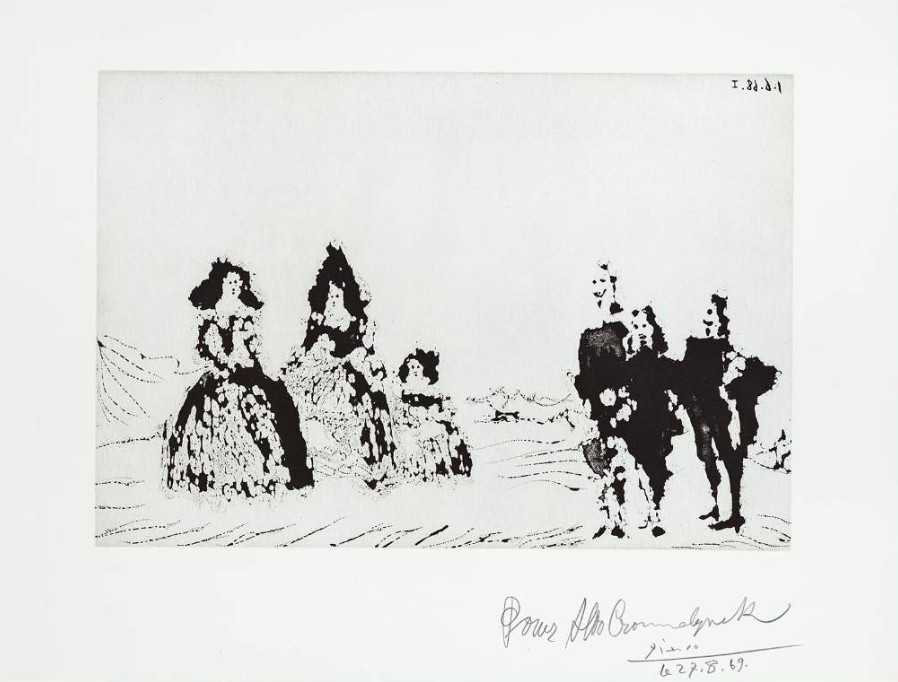
At eighty-six, Pablo Picasso had no interest in behaving like an elder statesman. He preferred the copper plate, the circus, the brothel, the museum, the television set and, whenever available, a magnificently indecent joke.
Rather astonishingly, between March 16 and October 5, 1968, he produced 347 etchings, engravings, drypoints and aquatints in fewer than seven months. Park West Gallery is now displaying the complete sequence, allowing us to experience the velocity of his imagination. One sheet offers an anecdote; all 347 become an autobiography at the speed of appetite.
That distinction, crucially, matters. Markets and geography often scatter a series until its rhythm becomes impossible to hear. Once reunited, however, these prints behave less like objects than scenes in an unruly novel. Characters enter, vanish, return in costume and occasionally climb into bed with art history. Picasso called the process his way of “writing fiction,” although the fiction is crowded with his memories, anxieties and disguises.
Beyond the studio walls, 1968 was convulsing. Students built barricades, workers launched mass strikes and Vietnam entered American homes through television. Meanwhile, in Mougins, Picasso staged his own rebellion against time, attacking copper with needles, acid, scraper and ink while younger radicals questioned the art object. More intimately, the outpouring followed the death of Jaume Sabartés, his friend and longtime secretary. Grief seldom appears here wearing black; instead, it disguises itself as acceleration.
Here, deliciously enough, lies the reversal. Picasso had spent his youth detonating inherited perspective; now, nearing eighty-seven, he raided the canon he once helped destabilize. Rembrandt, El Greco, Velázquez, Goya, Ingres, Delacroix and Manet wander through the plates like guests at a party whose host has hidden the silverware. Raphael appears with La Fornarina, while Popes, painters and voyeurs peer into the bedroom. Reverence was welcome. Respectability was denied entry.

From there, the cast becomes gloriously strange: musketeers, matadors, acrobats, prostitutes, majas, dwarfs, owls and Celestina, procuress of Spanish literature, watching from the margins with the intelligence of someone who has seen every foolishness. Jacqueline Roque becomes an acrobat. A figure identified as Charles de Gaulle loses his trousers. Television wrestling mutates into classical combat. Nothing remains safely within its century.
For all that theatrical mischief, the technical achievement is formidable. Working with master printers Aldo and Piero Crommelynck near his home, Picasso moved among etching, engraving, drypoint, aquatint and sugar lift with insolent fluency. These are not reproductions, but original works conceived upon copper, where each acid-bitten line carries intention. Since the plate reverses its image, spontaneity must negotiate chemistry, pressure and mirrored thought.
Quite wonderfully, that resistance became fuel. Fine contours thicken into velvety darkness; empty paper becomes light, flesh or theatrical silence. The eye travels from whisper to assault, elegance to obscenity, Renaissance quotation to cartoonish slapstick. Picasso was not polishing a monument to himself. He was permitting erudition and libido to brawl in public.
When published by Galerie Louise Leiris in 1969, the project entered public view and immediately caused a scene. Twenty especially explicit plates were excluded or sectioned off in some early exhibitions. Picasso had summoned the Renaissance into the bedroom, placed Michelangelo beneath the bed and invited the Pope to watch; institutional discretion never stood much of a chance.
Even so, an honest reading must resist turning every provocation into proof of genius. The eroticism can be comic, tender, ravenous and deeply uncomfortable. Women repeatedly become models, courtesans and stages upon which male desire performs itself. The gaze is hardly innocent; neither is the aging artist, who appears as watcher, buffoon or grotesque master. Rather than resolve Picasso’s contradictions, these images expose them.

Perhaps, then, this is why the cycle remains so alive. Late style is expected to deliver serenity or wisdom arranged attractively near death. Picasso offers no civilized conclusion. He gives us an avalanche of memory, bodies, jokes, embarrassment and almost frightening vitality. Mortality enters not as a solemn skull upon the table, but as the reason to work faster.
Only within Park West Gallery’s complete installation does that accumulation become fully visible. By the hundredth image, repetition turns hypnotic; by the two-hundredth, quotation becomes possession; by the final plate, the undertaking feels less like a retrospective than an attempted escape from chronology. Picasso is not simply revisiting the canon. He is climbing inside it, rearranging the furniture and leaving several scandalized ancestors under the bed.
Ultimately, all 347 reveal creation before legacy tidied it up: messy, learned, lustful, audacious and very funny. Some artists conclude with a dignified bow. Picasso, mercifully, left the Pope in the bedroom, Michelangelo beneath the bed and history gasping in the hallway.
Park West Gallery has assembled every piece of evidence.
Experience the complete series at parkwestgallery.com.