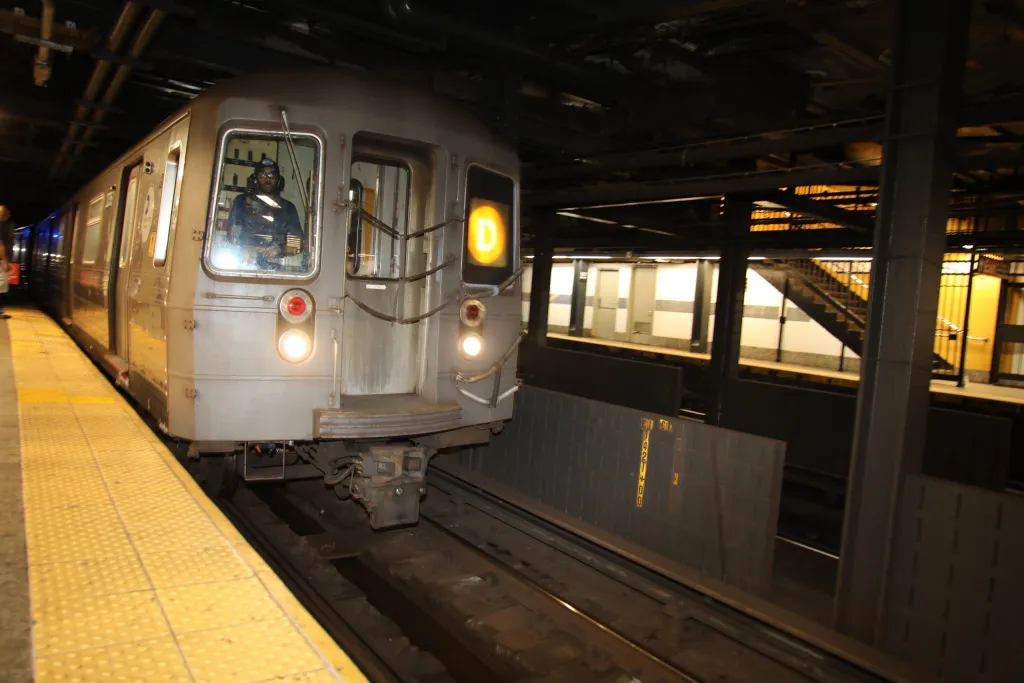
The death of a rookie transit worker who was struck by a New York City subway train last week transported Jeffrey Fleming back to the most terrifying moment of his career.
Nearly a decade ago, he survived being hit by a G train that pinned him against a Brooklyn subway tunnel wall and killed his co-worker Louis Gray after the two men had been placing warning lights along a curved section of the tracks. That deadly incident got the MTA dinged by the National Transportation Safety Board for lapses in protecting its workers.

Fleming said “not a day goes by” without being reminded of what happened early on Nov. 3, 2016, while he and Gray worked between the Church Avenue and Fort Hamilton Parkway stations on the F and G lines. But the 59-year-old grandfather said the death of Moet McCullum, who was hit by a southbound D train late Thursday while working alongside other crew members to set up track-level flags by the 161st Street–Yankee Stadium stop, is especially painful.
“It’s like it happened all over again,” the retired construction flagger told The City Reporter. “You think that after all these years, they would have figured something out for it not to happen again.”
McCullum, a 41-year-old mother of three, is the first worker to die on the tracks since November 2023 when Hilarion Joseph was killed while on flagging duties south of the 34th Street–Herald Square stop in Manhattan.
Joseph’s death resulted in the Federal Transit Administration later citing what it called an “escalating pattern” of safety failures at New York City Transit, including a 58% increase since 2022 in the number of “near-miss events” involving transit workers. The MTA appealed those findings.
Citing ongoing investigations into McCullum’s case, the MTA declined to comment beyond remarks made Friday by Demetrius Crichlow, president of NYC Transit, during a news conference at the Brooklyn headquarters of Transport Workers Union Local 100, which represents subway and bus workers.

“We stand together with the union and the investigative agencies to ensure that … the root cause is found and we do what’s necessary to protect our employees and the millions of people that we serve,” Crichlow said.
The NTSB, NYC Transit and TWU Local 100 are all investigating the incident.
‘I Started Running’
For Fleming, the latest fatality also served as a brutal reminder of the risks that accompany flagging, a critical safety practice that relies on the use of lights and flags to warn train crews and track workers.
“You have to be fully alert,” he said. “Fully alert.”
Recalling his 2016 brush with death, which left him with multiple shattered ribs, Fleming said he heard “nothing” before the train made contact with him and Gray within “like 10, 15 seconds.”
“Something told me to look to my right, and I looked to my right and I see my co-worker running, and I was like, ‘What is he running for?’” Fleming said. “So then I started running.”
Officials said McCullum, who usually served as a subway conductor, was working as a flagger when she was struck by the train. An internal MTA account of the incident obtained by The City Reporter notes others in the crew on the tracks felt the wind, heard a train coming around a curve and saw headlights before clearing out of its path.
McCullum “froze,” according to the preliminary incident rundown.

John Chiarello, TWU Local 100 president, said the fallout from McCullum’s passing has been “total devastation.”
“She didn’t come to work that day to be killed by a train, you know?” he added Friday. “And then the person operating the train certainly didn’t think that they would come and kill one of their fellow workers.”
The internal account of the incident said the operator of the D train that struck McCullum “proceeded at normal speed” while heading south from the 167th Street station even after being warned at that stop about workers in the area. It also points out the train operator “did not see any lights” before heading toward 161st Street–Yankee Stadium.
The victim’s brother-in-law told the Daily News he was troubled by those initial accounts.
“When you’re going through the tunnel and you know there’s flaggers, slow down,” Thomas Tyrell, who is married to the victim’s twin sister — also an MTA subway conductor — told the newspaper. “You’re supposed to be driving slow.”
Transit Workers Face ‘the Unexpected’ on the Job
In the wake of the 2016 incident that killed Gray and severely injured Fleming, the NTSB recommended NYC Transit’s flagging protections be revised to prohibit trains from moving “at greater than restricted speed” while flagging protection is being established.
The federal board also said NYC Transit’s rail control center should communicate a flagger’s location to train dispatchers, train operators and tower operators.
Fleming said transit workers are well-versed in how to stay safe on live subway tracks through measures including stepping into niches and subway-bench walls designed to provide refuge from passing trains.
“But when you got a big train coming on you, all that safety stuff is out the window,” said Fleming, who worked as a station cleaner and conductor before becoming a construction flagger. “You’re not going to remember nothing of what to do, you’re just trying to outrun that train.”
“You’ve got to expect the unexpected,” he added. “And that night, that was the unexpected.”
Fleming said he hopes to eventually connect with McCullum’s loved ones to share in their grief.
“I feel their pain,” he said. “And I send condolences out to them.”
Our nonprofit newsroom relies on donations from readers to sustain our local reporting and keep it free for all New Yorkers. Donate to THE CITY today.
The post ‘Like It Happened All Over Again’: MTA Worker’s Death on Tracks Highlights Job Dangers appeared first on The City Reporter.
