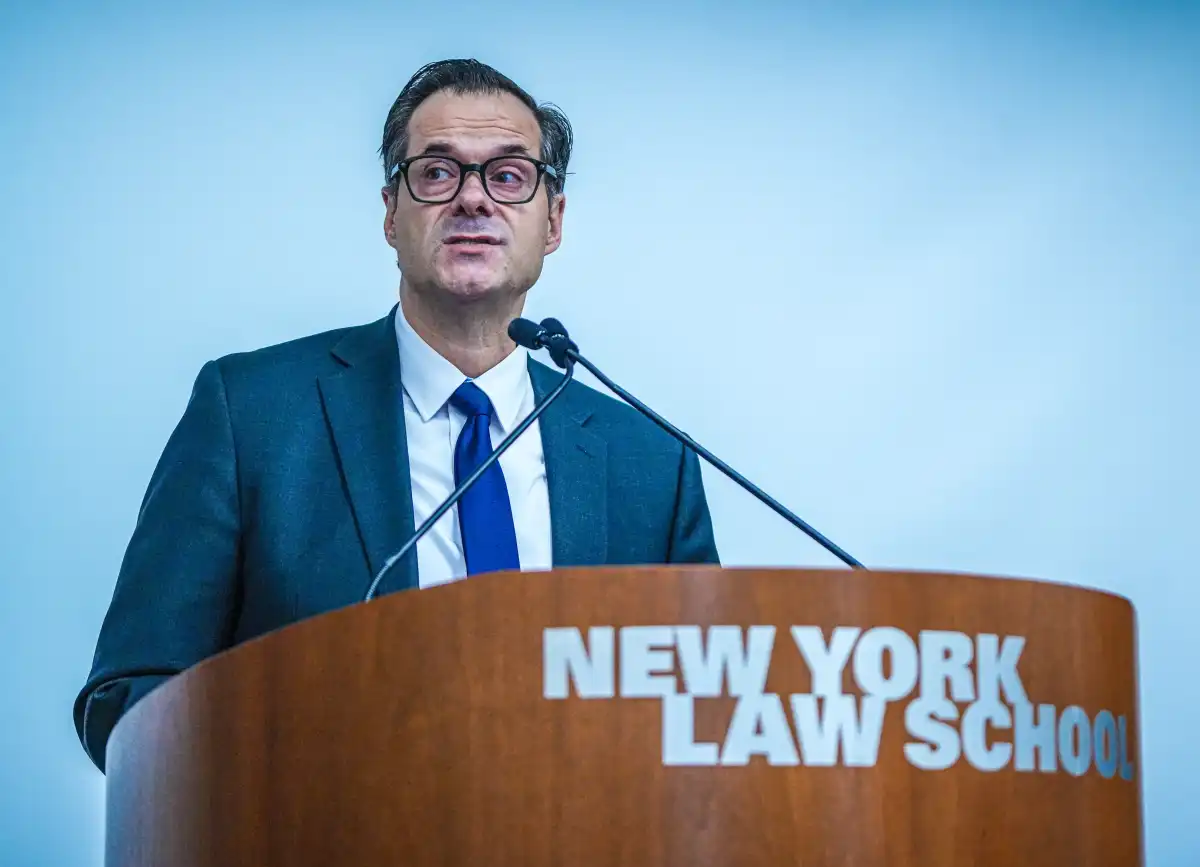
The New York Law School spent the eve of the 25th anniversary of 9/11 remembering what it took — both from its own students and faculty and the city at large — to rebuild after the Twin Towers collapsed during the terror attack that took nearly 3,000 lives, including four of the school’s former students.
“It’s hard to believe so much time has already passed, but for many, including myself, it still feels like it happened yesterday,” said Dean Anthony Crowell, who served in the city’s Law Department on Sept. 11, 2001. “Our law school community and our surrounding Tribeca neighborhood, like the rest of Lower Manhattan, directly felt the impact of the attacks that day and for months and years afterwards.”
The law school, which was located just steps away from the towers on the corner of Church and Worth Streets, was in a part of the city which had been damaged so badly it had to shut its doors for classes for two weeks after the attack. Its students, however, took the opportunity to open themselves up to the community, with many stepping up to serve Lower Manhattan in its efforts to rebuild, Crowell said.
“Many of our students worked on the recovery as first responders while continuing to attend law school,” Crowell said during the school’s commemorative event Thursday. “Many of our students at the time were law enforcement officers, in the NYPD, in the FDNY, people who were nurses and teachers, all significant public service roles, helping to manage the aftermath, but also trying to pursue their studies.”
“It allowed us to ask, what is the opportunity for the law school to serve? What is the opportunity for our students to understand not only what happened, but what was the lawyer’s response to that?” Crowell said. “Obviously, questions not only of economic development and rebuilding, but also broader questions of civil rights and social justice concerns, combating hate crimes, human rights issues, and the legal response and the academic programmatic response was really quite compelling.”
The law school’s current primary campus, on the corner of West Broadway and Leonard Street, was the first major construction project completed in Lower Manhattan after 9/11. It opened its doors in 2009.
In that campus building, Crowell introduced a panel discussion with Real Estate Board of New York President James Whelan, then-Port Authority Executive Director Chris Ward, Executive Director of the 9/11 Fund Carol Kellermann and Vice President of Tribeca Enterprises Nancy Lefkowitz on how the city found its way back after the attack at the law school Thursday, where lawyers, planners and artists spoke about the role they each played in the rebuilding process.
How New York Law School president responded to 9/11
Crowell, who was serving an assistant corporation counsel to the city during the time, had been – ironically, he said – working to establish the Office of Emergency Management and legal aspects of the city’s bioterrorism preparedness plan. He had walked across the World Trade Center Plaza to submit the final filings for ballot initiatives regarding the emergency management office the evening of Sept. 10.
“Despite all the policy and planning efforts, neither I nor anyone else ever thought we would be thrust into working on the largest-scale emergency response in this city’s history,” Crowell said. “Soon after the attacks, I was stationed at the Law Department’s desk at the emergency command center at Pier 92 on Hudson River, and we worked to establish a family assistance center at Pier 94 to offer a comprehensive set of legal and social services for impacted families.”
That work involved helping identify and provide support to the families who had lost loved ones in the attack and issue death certificates even when their remains could not always be found, an extremely difficult and devastating task, he said.
“This was immensely complex, logistically, legally, operationally, and of course, emotionally, at a scale that was unprecedented, with so many issues and stories to navigate,” Crowell said. “And, there was no better demonstration that lawyers are invaluable during times of immense crisis, not only helping to steer institutional responses, but also to help those who had lost nearly everything find a path to rebuilding their lives.”
The effort to rebuild Lower Manhattan

The panelists agreed that public sector lawyers working in the trenches of victim compensation programs and ex-Mayor Michael Bloomberg, who led the city through the years immediately after the attack, played a significant role in creating the environment and leadership necessary to move forward. However, Ward and Whelan emphasized the importance of private partnerships with the city and public entities in infusing the recovery efforts with enough capital to truly move them forward.
“The destruction, as it often does, brought a level of creativity in the private sector that filled this incredible void,” said Ward. “The creativity that comes out of the private sector just came downtown in a way that you can’t imagine.”
“This city was collectively, in our psychology, and the amount of energy, thoughtfulness, and participation. was pouring into those 60 acres downtown,” Ward added.
Major companies and corporations – like Goldman Sachs and Conde Nast – deciding to build headquarters in Lower Manhattan also helped build public confidence in the area and supported people and businesses returning to the area.
The power of community support also can’t be overstated, Kellermann said – The 9/11 fund received $500 million – equivalent to $1 billion today – in its first months of operating, which it used to fill the gaps of government assistance and support notable rebuilding efforts, including that of Manhattan Community College.
Artists, said Lefkowitz, who helped establish and lead the Tribeca Film Festival in the terror attack’s aftermath, also played a significant role in reestablishing confidence in the area. The idea of the film festival was to get people back to Lower Manhattan and feel like it was a place they could comfortably come to make memories.
“Going to the movies as a community, we can see our common humanity on screen,” Lefkowitz said. “It was important then, 25 years ago, when people didn’t know what to do or how to get together, to bring people together to laugh and to say it’s okay to laugh again.”

It was that and other actions of artists, Lefkowitz said, which played a pivotal role in getting private interests and the city residents trusting in rebuilding plans and helping push them along, coming to the area to spend time and money, which in turn fueled businesses to open and reopen with confidence people would work at and patronize them.
“That was the mission: bring people downtown, help small businesses that were suffering or closing,” she continued. “We wanted to bring people downtown to spend their money and to create new memories. It just speaks to the power of gathering and community.”
The response in the days, months and years following the attack, Crowell said, should serve as something to learn from and something to build from.
“While the attacks of September 11th and the many things that happened in this aftermath, including horrific hate crimes, represented humanity at its worst, it also brought out the best in countless people in New York and beyond,” Crowell said. “This is a moment to remember and to commemorate all that took place, and also as a time for us to think about where we can be, what we should be, where we will be the next 25 years as well.”