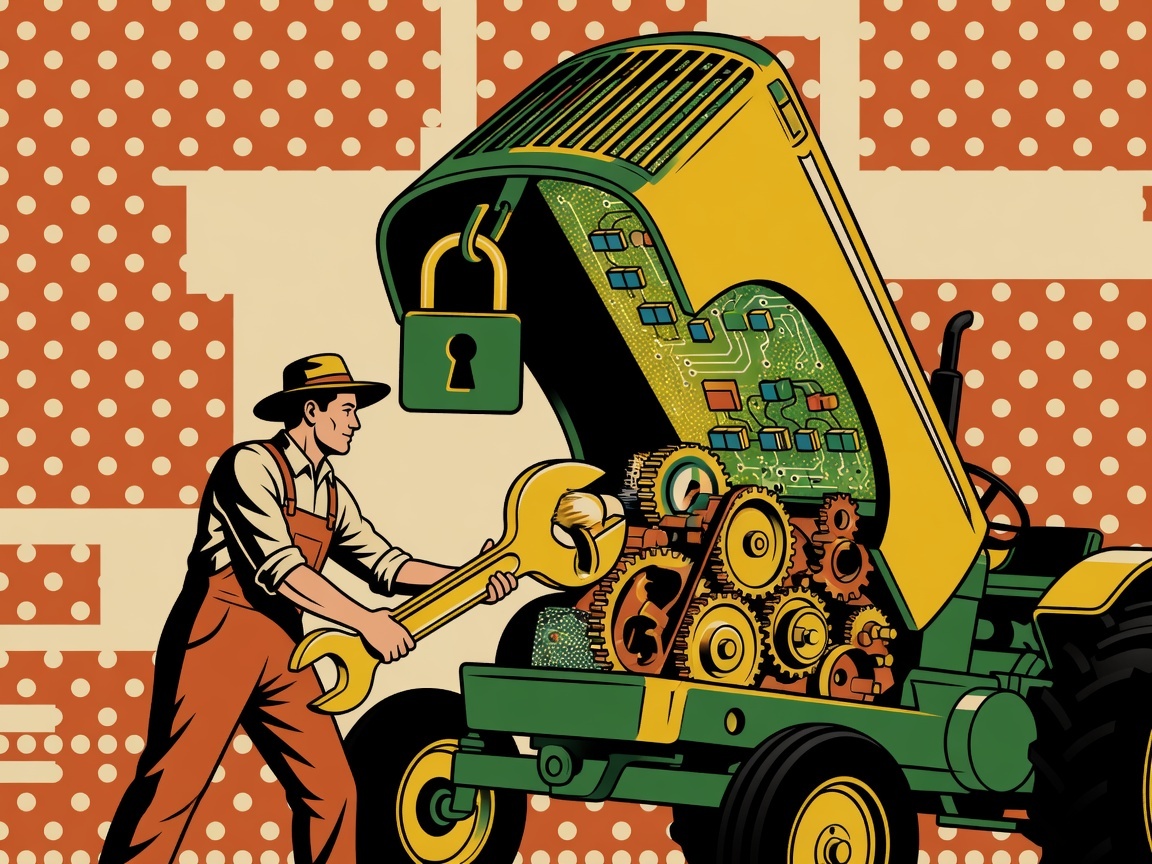
Farmers have won the right to repair—at least, if they own John Deere equipment. In July, the Federal Trade Commission (FTC) announced a settlement requiring Deere to give farmers and independent repair shops access to the software, manuals, and other resources needed to fix its products. The settlement sensibly balances consumers’ immediate interest in affordable repairs against the long-term need to protect innovators’ intellectual property.
Deere had previously reserved many of those resources for its licensed repair shops. Such control—especially over onboard software—is common in industries ranging from vehicles and medical devices to consumer electronics.
Critics contend that these restrictions allow manufacturers to “monopolize” repair aftermarkets. That concern has fueled right-to-repair campaigns and legislation across the country. In the early 2020s, the FTC promoted the right to repair as an anti-concentration policy that could spur competition. Advocates have also framed it as a matter of property rights: A farmer who buys a tractor owns it and should generally be free to repair it.
But the right to repair also implicates intellectual property. As one scholar argues, “While copyright and IP law protect firms to some degree, the broad extent of most proposed [right-to-repair] legislation across the states and federal government constitutes a threat to this protection.”
That concern deserves attention. One need not resolve the broader tension between intellectual property and economic competition to examine the more fundamental legal tension between intellectual property and property rights.
A Fix That Doesn’t Break IP
The FTC found a sensible compromise. Farmers who buy Deere tractors can exercise their property rights over the machines and their components. Deere keeps its intellectual property, including its trade secrets, while giving owners and independent shops access to the software and resources needed for repairs.
That balance protects what matters most to each side. Some activists treat intellectual property as little more than a corporate shield against competition. The FTC took it seriously, while drawing its boundaries so farmers could meaningfully exercise their own property rights. Farmers can now repair their machines when time matters most—during harvest, for example—without forcing Deere to surrender its intellectual property. The compromise fits comfortably within longstanding law.
The patent-exhaustion doctrine has long provided that selling a patented product exhausts the patentholder’s control over that particular item, allowing its owner to resell, repair, or alter it. Both common law and Supreme Court precedent, including Wilson v. Simpson, recognize that principle. The Deere settlement confirms that farmers enjoy those rights over the equipment they purchase. Deere, meanwhile, retains its underlying patents and may provide repair access on “fair and reasonable” terms.
This compromise was taking shape well before the settlement. When the FTC sued Deere, Andrew Ferguson—then an FTC commissioner and now its chairman—dissented, noting that “the parties are in active negotiations over a fix that, if brought to fruition, could provide meaningful relief to America’s farmers.” He was right. Deere had already expanded farmers’ repair options through a 2023 service program and was seeking guidance from federal agencies.
Against that backdrop, the settlement looks less like forced compliance than the formalization of an expected compromise. It places the right to repair on more consensual and predictable legal ground.
The Case Law Under the Hood
Courts mapped this terrain decades ago, distinguishing repairs that preserve a machine’s identity and useful life from reconstruction that effectively creates a new patented product.
In the 2008 case Quanta Computer Inc. v. LG Electronics Inc., the Supreme Court unanimously held that patent exhaustion applies to components that substantially embody a patented invention. The principle reaches beyond the tractor as a whole to the parts and software necessary for its ordinary use. Once a patentholder authorizes a sale, it cannot use patent law to retain control over how the buyer uses the product.
The Supreme Court addressed the competition side of the problem in Eastman Kodak Co. v. Image Technical Services Inc. in 1992. Kodak had refused to sell replacement parts to independent companies that serviced its equipment. The Court held that Kodak could face antitrust liability for using its control over those parts to exclude competitors from the repair market.
The clearest precursor to the Deere settlement is the Supreme Court’s 2017 decision in Impression Products Inc. v. Lexmark International Inc.. The Court ruled 8-1 that Lexmark could not sell its patented printer cartridges and then use patent law to restrict their reuse or resale.
Writing for the Court, Chief Justice John Roberts reaffirmed the exhaustion doctrine: “When a patentee chooses to sell an item, that product ‘is no longer within the limits of the monopoly’ and instead becomes the ‘private, individual property’ of the purchaser.” He added, “That smooth flow of commerce would sputter if companies that make the thousands of parts that go into a vehicle could keep their patent rights after the first sale.”
The same principle applies to Deere. Once farmers buy its equipment, Deere cannot use patent law to prevent them from using and maintaining it.
Repair Without Ruin
The FTC’s Deere settlement offers a workable right-to-repair model: Give consumers meaningful control over the products they buy without stripping innovators of their intellectual property. Whether courts and lawmakers follow remains to be seen. The best repair policy fixes access without breaking innovation.