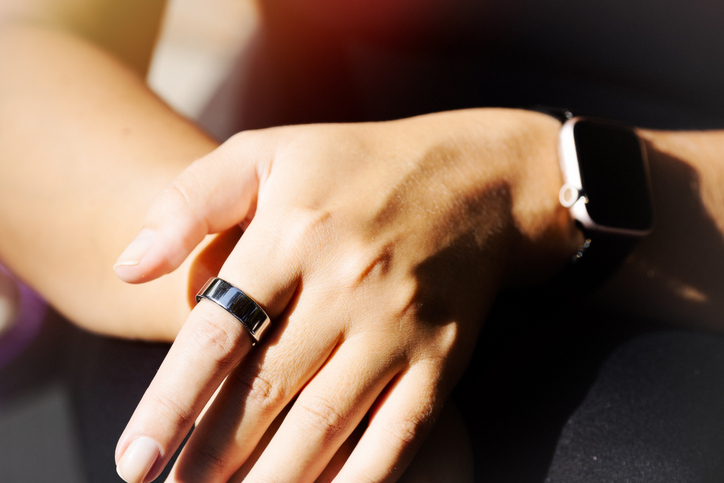
A class action lawsuit has been filed against Oura, alleging the company is falsely advertising its smart ring’s sleep tracking accuracy.
The lawsuit, filed in California federal court last week, claims Oura can’t back up its marketing figures, which boast up to 95% sleep stage tracking accuracy. It argues that Oura’s claims are unsupportable since its ring can’t measure the brain activity and eye movements that actual sleep staging requires.
Identifying sleep stages typically requires clinical equipment like scalp electrodes and eye sensors, but Oura’s finger-worn sensor relies instead on AI-generated estimates from proxy signals like heart rate and movement, the complaint stated. It cited a 2025 study published in Nature that found Oura rings achieved only about 53% sleep-stage accuracy across 45 nights of data.
The suit seeks an injunction against the alleged false advertising, plus monetary compensation for misled customers.
The complaint was brought by Madison Surber, a California resident who paid more than $500 for an Oura Ring 4 Gold in 2025. She says she relied on Oura’s marketing claims when making her purchase and would not have bought the ring, or would have paid less for it, had she known those claims were allegedly inaccurate. Surber is seeking to represent a broader class of consumers who purchased the rings under similar circumstances.
Oura has said it stands behind accuracy claims.
“Like other consumer sleep wearables, Oura Ring estimates sleep stages using multiple physiological signals, including heart rate, heart rate variability, movement, breathing patterns and temperature. There is well-documented, peer-reviewed independent scientific evidence that sleep stages are associated with distinct, measurable, reproducible changes in physiology, which is why these signals are reliably used to classify sleep stages,” an Oura spokesperson said in a statement sent to MedCity News.
In the statement, the spokesperson noted that the ring is not a medical device nor a substitute for a clinical sleep study.
They also added that Oura’s sleep-staging algorithm was developed using more than 1,200 nights of data and has been validated favorably against polysomnography in multiple independent, peer-reviewed studies.
“We’re committed to continuing to clearly communicate what Oura measures, what it estimates, and how members should use that information. We dispute the allegations and will defend against them in the appropriate legal forum,” the spokesperson wrote.
One consumer protection lawyer — Shawn Collins, an attorney at Stradling — said wearable companies typically validate accuracy claims like Oura’s by comparing their algorithms against polysomnography, the clinical gold standard, though each company’s proprietary algorithm produces different results.
He noted that Oura has gone on the offensive since the lawsuit was filed, publishing two blog posts defending its methodology. “
“Although Plaintiff does not explicitly allege this, they are implicitly alleging that Oura falsely claims that its ring is as accurate as the PSG method, which it does not do. To the contrary, Oura expressly disclaims on its website and various other places that its ring is not as accurate as the gold standard PSG study, which is probably why Oura claims 95% accuracy and not more,” Collins stated.
He added that the plaintiff appears to recognize this weakness, which is likely why the complaint focuses on the placement of Oura’s disclaimer — arguing it isn’t prominent or close enough to the 95% accuracy claim for consumers to see when deciding to buy the ring.
Collins thinks the case may hinge on substantiation rather than consumer perception.
“Can the health tech company’s wellness claims be substantiated with scientific and clinical rigor, via peer-reviewed clinical studies? Here, if Oura can substantiate its “95% sleep-staging accuracy” claim with peer-reviewed clinical studies, they are well prepared to defend themselves against this lawsuit,” he declared.
An expert in the health data space — Shashi Shankar, CEO of Novellia, a platform that helps patients consolidate medical records and share anonymized data with drugmakers — believes the dispute is fundamentally about trust rather than technical failure.
He said the main issue is the gap between what a device can measure and what that measurement actually means.
“Wearables are pretty good at surfacing signals — like sleep patterns, heart rate, activity — that prompt people to pay attention to their health. It’s helpful when my wearable tells me to walk more steps, to do a breathing exercise, or that my sleep has been pretty bad for the past week,” Shankar remarked. “Where wearables fall short today is anchoring those signals to a patient’s clinical reality — their history, their conditions, their outcomes.”
In his eyes, that’s less of a flaw and more of a scope problem — but he thinks being precise about that distinction is how this industry builds durable trust.
To Shankar, more inputs are always better. Wearables, sensor data, patient-reported experiences and medical records are all pieces of a larger picture, and these signals become evidence when they’re anchored to longitudinal patient data and real-world outcomes, he explained.
“Oura’s partnership with Eli Lilly points in the right direction. Pharmaceutical-grade validation tied to patient outcomes is a strong model that can get even stronger through tighter integration with clinical data, like medical records. That’s how wearable data earns clinical credibility,” Shankar stated.
The case remains in its early stages for now, but it’s already forcing a larger conversation about how much precision consumers should expect from their wearable-produced health data.
Photo: Alena Frolova, Getty Images