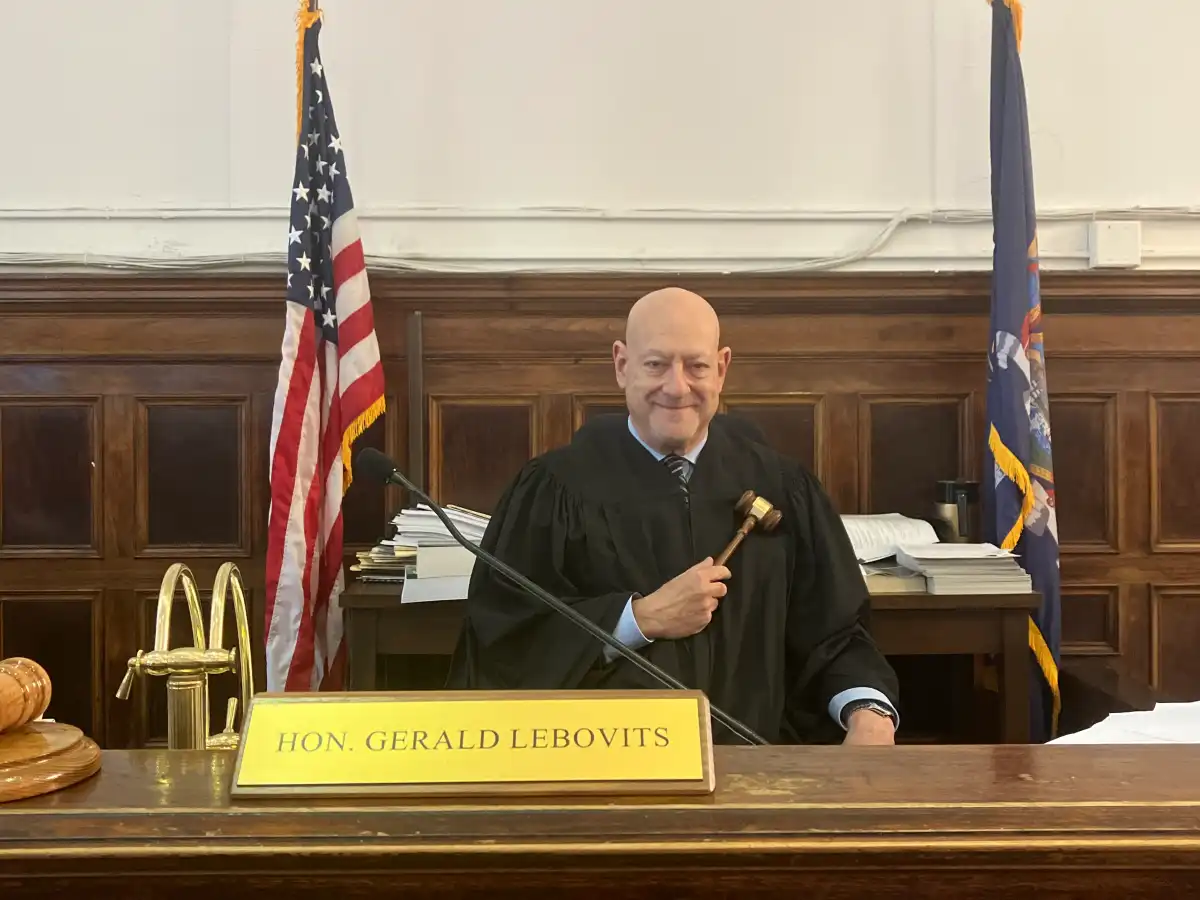
Manhattan Supreme Court Justice Gerald Lebovits has spent over four decades of his life in the courtroom. Even at 71, he’s far from slowing down: With about 1,800 cases on his docket – a slew of which deal with high-profile housing and celebrity matters – he’s also teaching at a handful of law schools, authoring multiple books on the current state of various fields of law and mentoring dozens of students who intern in his courtroom.
“It’s an honor and a privilege,” Lebovits said of working in the court system for so long.
Lebovits has about five years until the New York State Constitution forces him into retirement from the bench, which he’s sat on in various courtrooms across the city for the past 25 years. He’s presided over a number of landmark cases during those two and a half decades, perhaps most notably the Right to Shelter action brought under the Adams administration.
The legal action was brought by ex-Mayor Eric Adams in a bid to reduce New York City’s legal obligation to house the homeless in 2023 when roughly 250,000 migrants came to New York City, an influx partially caused by Republican governments in southern states sending people who crossed the border north. The Adams administration was seeking a declaration from the court saying the city didn’t have to shelter those people, and the Legal Aid Society, who opposed them, wanted the city’s responsibility to remain intact.
“Very quickly, on I asked the city, ‘Well, where do they live?’” Lebovits said. “And the city said, ‘Well, they don’t have a home.’ So I said, ‘Then they’re homeless. Now, what are we going to do about it?’”
No one thought that matter would settle, Lebovits said. But, under his supervision, it did, something he said was no small feat. It took every ounce of what he’s learned teaching law school and judicial courses for decades to help bring the parties to a place where they agreed, Lebovits said, along with both sides being open to working together.
“It took months and months of negotiating,” Lebovits said. “In the end, instead of me granting the application like the city wanted, saying, ‘City, you don’t have any obligations toward these quarter of a million people,’ we ended with the city being obligated to shelter all of those people for as long as it was [necessary].”
His nine-year tenure as a judge on the New York Housing Court – a place where reaching a settlement is particularly desirable – also equipped him with experience to aid both sides in coming to an agreement.
“Among the many things I learned in housing court was how to settle a case to the party’s satisfaction,” Lebovits said. “It’s an important art form, but I did it every day for nine years. I also teach negotiation strategy at Fordham and Columbia. I used all my skills and then some in the right to shelter case.”
Being part of notable legal matters is nothing new to Lebovits, who in some ways, has been in the news since the start of his career: A few months into his first job – a Legal Aid Society criminal defense attorney – he took to the picket line during the non-profit’s historic 10-week strike.
“Naturally, I had to join the picket line, I would not scab,” said Lebovits, who added that though he supported the strike, it was difficult since he cared so much about his clients and he’d just started the new job.
“It was peculiar. I didn’t know that lawyers could actually strike,” he continued with a small laugh. “I had a button that said I’d be on strike ‘As long as it takes.’ I was hoping that it wouldn’t take very long.”
Since then, he’s defended hundreds facing misdemeanor and felony charges during a roughly three and a half year tenure at Legal Aid, spent roughly 15 years as a law clerk to a criminal court judge who presided over dozens of murder trials where he learned – and, eventually, taught – the ropes of judicial opinion writing and legal analysis behind the bench, before embarking on his own judicial career.
Beyond the Right to Shelter case, notable cases Lebovits has overseen include those dealing with who should pay for the pollution of the Gowanus Canal, one of the city’s superfund sites, celebrity matters, and a case that split the BIC pen empire between the family who owned it. He also ruled earlier this year to dismiss the expulsions of Columbia students who’d been disciplined for protesting in support of Palestine in 2024.
It doesn’t matter to him how significant a case is in terms of public interest, though, Lebovits says: They’re all equally important.
“I have hundreds and hundreds and hundreds of cases,” Lebovits said. “Many are big, and many are small, and all are important. I have cases under $5,000, but I also have cases in the billions, and every, every case is critical.”
His self-professed love for the city’s small claims court, which helps people – who are typically representing themselves – work out every day disputes, like when a neighbor believes someone has stolen something of theirs or an airline’s lost someone’s bag, perhaps most clearly depicts that.
“Small claims was always my favorite assignment, and it will always be my favorite assignment,” Lebovits said. “In small claims, you’re hearing cases in which people got themselves into a situation, and they couldn’t resolve it on their own, so they wind up in court. I’s a special thing when you can resolve it to everyone’s satisfaction by settling, making everyone happy.”
“You have the opportunity to be the judge before whom you always wanted to appear: Neutral, fair, someone who listens to you and will make a decision one way or another. It’ll resolve your problem,” he continued.
Even prior to putting on the judicial robes, Lebovits spent years as a pro bono arbitrator in small claims court. That position is not a judge, but in many ways, serves the same function as one: In it, Lebovits would help mediate, settle and make rulings on daily disputes. He still pours time into the small claims community, continuing to write books on the law and occasionally adjudicate cases in the field.
“I got involved in small claims, it consumed me then, and it continues to consume me now,” Lebovits said. “You’re talking about doing justice for hundreds of thousands of people who might never have seen a judge before, and might never see a judge again. “You’re the face of justice for all these people who have these disputes that are very important to them.”
Lebovits was first appointed to the bench in 2001, where he served as a Housing Court judge until 2010. He was then elected to the New York Civil Court bench in 2011, and though he presided over a New York Criminal Court from 2011-2012, he’s been dealing primarily with civil matters since. He’s primarily sat on Manhattan benches, he said, though he’s heard cases in Staten Island and the Bronx and handled criminal arraignments in other boroughs as well.
“It’s like going all around the world,” the justice said of serving across the city.
Now an elected New York Supreme Court justice, he primarily deals with business, tax, personal injury, celebrity disputes and court corruption cases. Though he spent roughly the first two decades of his career in criminal courtrooms, Lebovits said he finds working on the civil side of things now incredibly rewarding.
“There are a limited number of issues in criminal law. It seems very expansive, but compared to civil, it’s a drop in the water,” Lebovits said. “There’s so much more to it. It’s much more complicated, much more difficult, and I’m very happy to hear these important civil justice cases. It’s a more vast area where you could make a difference.”
It’s clear his passion for the judiciary is strong – the way the state’s public pension system is set up, he’s essentially losing money by continuing to work at his age instead of retiring, he said. However, his role as a teacher, mentor and author of legal volumes might hold an even dearer place in his heart.
“It’s important for everyone to have a good teacher and a good mentor, someone who cares,” said Lebovits, who’s taught law at Columbia, St. John’s, New York University, Fordham and New York Law School. “Teaching is among the most important things to me, and I hope to be that mentor for a lot of people.”
And, despite being a septuagenarian, he’s not shying away from embracing new technology: Alongside authoring thick volumes on landlord-tenant law, small claims litigation and trial practices (many of which now boast editions in the double digits and fill multiple shelves in his office library), he’s also publishing papers on the use of artificial intelligence in the law.
It’s writing books and research articles and teaching others, Lebovits says, that has taught him the most.
“I feel very fortunate to have the opportunity to teach,” the justice said. “I learn a lot from teaching. I think that people who listen to lectures learn maybe at the 10% level, but if you have to teach the subject, you learn at the 90% level. The courses that I teach, in many ways, match what I do in court as a judge, so the more I teach, the better a judge I can be.”
He takes his role as a mentor seriously, staying in touch with – and in some cases, employing – his students, many of whom he’s become close friends with. His wife, fellow judge Margaret Chan, who works as an associate justice of the New York State Supreme Court, Appellate Division, First Department, even serves as a godmother to one of his students’ children.
Giving back to the profession like this also allows him to leave a legacy and have a lasting impact on the court system, he said, something he finds critically important.
“A lot of my students wind up teaching themselves, or working for the court system as law clerks and in other positions,” Lebovits said. “What I have taught them will be passed along to so many other people. If you teach somebody who becomes a law clerk or who becomes a judge, then your teachings magnify, and then you have, hopefully, a good legacy: your ideas are passed along to others.”
His students clearly enjoy receiving his ideas: He’s been elected Adjunct Teacher of the Year at Fordham University School of Law, selected to receive the “Most Beloved Professor” award by students at NYU Law School and elected Adjunct Professor of the Year at New York Law School and St. John’s University School of Law, where he also received the Dean’s Teaching Award.
Those awards are proudly on display in his office, alongside a variety of memorabilia, keepsakes and gifts he’s received from former students and interns, including a Funko Pop action figure of himself, crocheted flowers, group photos and a small statue of Chan, whom he said he considers when he has to make a difficult decision.
As he looks back on his long career – and forward to his remaining few years on the bench – spending his life in service of the law is something Lebovits said he’s eternally grateful for.
“I don’t know what else I would have done had I not become a lawyer,” Lebovits said. “I would be unemployed. I wouldn’t know what to do with my life.”