
SYRACUSE, N.Y. — During the first year and a half of her son’s life, Valerie Gregory did everything she could to help him thrive: She read to him, talked to him, showed up for wellness checks, and whenever possible took him to a weekly playgroup, where both mother and son had the chance to socialize with peers.
At one of these gatherings, organizers brought along a standardized developmental questionnaire that helps gauge if children are hitting rough milestones for their age, like making eye contact, sitting up and waving goodbye.
Despite regular visits to the pediatrician’s office, Gregory had never before seen the screener. What she ultimately learned caught her off guard.
“He was behind on walking, and he was way behind on speech,” she recalled.
Gregory credits that brief encounter — the screener took less than 20 minutes to complete — with leading to therapies for her son that gave him a much stronger start in school, and life. “I have told people, ‘Get checked out. It’s free, and they figure out things you might not realize,’” she said.
Twenty-five years ago, the American Academy of Pediatrics recommended that parents of young children complete developmental screeners at regular visits to the pediatrician — often a crucial first step in diagnosing a child’s disability or delay. But a generation later, implementation remains spotty, with just over 36 percent of parents of young children nationally reporting having filled out a screener in the previous 12 months, according to the latest National Survey of Children’s Health by the U.S. Department of Health and Human Services. New York lags behind most states, with about 28 percent of parents saying they had been screened recently. Only Nevada, Florida, Arkansas and Missouri come in lower.
The last set of federal survey results is from 2024. Many experts say it provides the most comprehensive state- and national-level data on screening rates, but some note that it can also underestimate screening numbers since some parents might not remember filling out a form or know what it was for. “If you ask pediatricians if they are screening, you might get a different number,” said Dr. Liz Isakson, executive director of Docs for Tots on Long Island, which advocates for children through age 5. (One 2020 study focused on pediatricians, for instance, found that nearly two-thirds of them reported doing some developmental screening.) “But I think parents are always right,” Dr. Isakson added. “If they are getting screened and don’t know it, that’s a problem.”
Related: Young children have unique needs and providing the right care can be a challenge. Our free early childhood education newsletter tracks the issues.
In an effort to boost screening rates, a growing number of communities are taking a new approach: bringing the tool outside of doctor’s offices to libraries, zoos, farmer’s markets and other gatherings where parents with young kids congregate, like Gregory’s son’s playgroup. In New York and 29 other states, much of this work is supported by Help Me Grow, a national network of local organizations that promotes healthy child development, including by making screenings more accessible. Help Me Grow operates in six different parts of New York state, from Long Island to the Finger Lakes communities and cities like Buffalo and Syracuse.
In Onondaga County, where Syracuse is located, the number of annual screenings documented by the group has jumped thirtyfold — from about 150 to more than 4,600 — since the campaign began in 2019, and organizers see greater parent engagement with children’s development.
“It’s been 25 years of us trying to mandate people to do it,” said Isakson, whose organization oversees Help Me Grow on Long Island. “Oftentimes the best way to get to change is to have people ask for it.”
Doctors routinely screen kids in all kinds of ways — measuring and weighing them, and testing their vision and hearing. But a 2006 American Academy of Pediatrics recommendation following the earlier statement was for a standardized developmental screener to be administered to caregivers when children are 9, 18 and 30 months old. The academy has issued recommendations for autism and social-emotional screens as well.
!function(){“use strict”;window.addEventListener(“message”,(function(a){if(void 0!==a.data[“datawrapper-height”]){var e=document.querySelectorAll(“iframe”);for(var t in a.data[“datawrapper-height”])for(var r,i=0;r=e[i];i++)if(r.contentWindow===a.source){var d=a.data[“datawrapper-height”][t]+”px”;r.style.height=d}}}))}();
There are different versions of the screeners, but a typical one might ask questions like (of an 18-month-old): Does your child say two or three words that represent different ideas together, such as ‘See dog,’ ‘Mommy come home,’ or ‘Kitty gone’? or: Does your child walk well and seldom fall?
A flag on a screener is not a diagnosis, and the hope is that families like Gregory’s will get further evaluation and follow up, whether through the medical or early intervention system. The latter provides federally mandated help for children with developmental delays and disabilities up to age 3. One study released earlier this year found that children in New York City who had received the services through age 3 outperformed similar peers on third grade reading and math tests.
When it comes to screenings, “it’s exceptionally important to do them early and often,” said Kate Ryan, who directs the Adirondack Birth to Three Alliance. Funding challenges are a big reason why pediatric clinics don’t, though: The electronic tablets that parents often use to complete the questionnaires cost money, as do trainings for staff in how to interpret and explain the results. And some physicians say it can be difficult to get reimbursed by insurance and Medicaid for the cost.
“Pediatric clinics often lose money on screening,” said Noelle Hause, senior manager of infant and early childhood mental health at the national child development advocacy organization Zero to Three. “We’re all wondering why we don’t identify conditions early — it’s not because it’s not recommended, it’s because it’s not getting reimbursed.”
Related: Parents of premature infants struggle to get the help their children are entitled to
New York officials recently acknowledged that the state needs to improve its numbers. The State Health Department this month issued a memo to pediatricians, social workers and other providers who work with young children citing the low screening rate. “We are missing critical opportunities to identify developmental concerns early, educate families about developmental milestones, support their children’s individual growth, and learn what to do if they have questions or concerns,” the memo stated.
It also announced a new campaign to address the issue, called “Be Their Biggest Champion.” Screening “might be happening more than is being reported,” said Vanessa Threatte, executive director of the New York Council on Children and Families, which is spearheading the campaign. “But if parents don’t understand it…there’s still a challenge there that needs attention.”
New York did not allow clinics to receive separate Medicaid payment for developmental screenings until a few years ago, one reason for the state’s lower participation rate, Dr. Isakson said. Even now, the payment rate, at less than $20 per screening, does not always offset clinics’ cost.
While provider participation has historically been the biggest obstacle to universal screening, experts say parent hesitancy and disconnect also play a role.
When parents have to seek out screenings proactively, the families that get them end up being disproportionately “those who are well resourced and know about child development and want reinforcement that their child is developing as hoped,” said Ryan. “You don’t see those who are in generational poverty and maybe have had negative experiences with child development.”
Even at pediatricians who routinely screen, parents from underrepresented groups can still face barriers. “You have, say, a parent with low literacy who can’t complete” the questionnaire, said Dr. Katharine Zuckerman, a professor and associate division head of general pediatrics at Oregon Health & Science University who researches disparities in access to screening and early intervention. Or, she said, you might have a parent “who speaks Armenian, and the survey isn’t available in Armenian.”
For immigrant families, especially, early childhood advocates worry that President Trump’s immigration crackdown presents a big new barrier. Families who are nervous about citizenship status “are avoiding ‘well child’ checks, period,” said Hause. This makes efforts to bring screenings out of the doctor’s office and into the community all the more urgent.
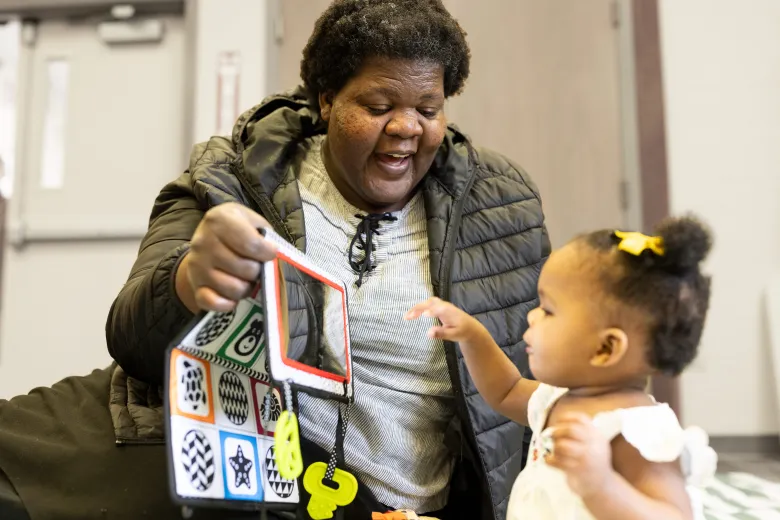
Early one spring evening, a group of caregivers, including parents and grandparents, brought their babes to the Betts Branch Library in Syracuse’s Valley neighborhood. The children, mostly older infants and toddlers, tossed balls, shook shakers and frolicked in play tunnels while the adults mingled and chatted with representatives from the Early Childhood Alliance Onondaga, which encompasses the local Help Me Grow affiliate. At some of these gatherings, called “Books, Balls, and Blocks” and funded through Help Me Grow, parents fill out a developmental screener at the event. But on this night, they left with a QR code to complete the screener later at home if they wanted. Beyond the screening, organizers say events like this one provide an opportunity to learn about child development, celebrate growth and raise any concerns.
Edythe Smith, one of the mothers, told organizers that she worried about whether her then-9-month-old was getting enough engagement during long days when she works from home. “I play with her whenever I can,” Smith said. “But is it enough?”
“If you’re playing with her, try not to second-guess yourself,” replied Bethany Creaser, the coalition’s executive director. “It’s easy to have mom guilt, especially when you are juggling different things.”
Smith said she has struggled to know what to ask her daughter’s pediatrician about developmental progress, so she appreciated the event putting the topic front and center. “The doctor seemed to only address development if there was a concern,” she said, adding that she didn’t know what questions to ask or how to gauge where her daughter should be.
Another mother, Caroline Webster, agreed that it’s easy for parents to feel confused amid sometimes conflicting messages from doctors, friends and social media about what’s “normal” child development — and what’s not. She worried at one point, for instance, that her now 3-year-old son didn’t clap until he was 14 months. “It’s hard to figure out what’s true,” she said, adding that it turned out her son was just slower than some others to clap.
Related: Black and Latino infants and toddlers often miss out on early therapies they need
Since 2019, the coalition has worked with doctor’s offices, childcares, libraries, public schools and the county government to boost screening rates. In 2022, the county executive sponsored a screening challenge, which included texting reminders to all families receiving WIC benefits. In its early years, the campaign struggled to crack 1,000 annual recorded screens across its partners. But in 2025, the number approached 5,000.

Just north of Syracuse, in more rural Oswego County, Help Me Grow brings “Books, Balls, and Blocks” to places like libraries and the local children’s museum — “anywhere family-friendly,” said Brandy Koproski, the executive director of the county effort’s umbrella group, Integrated Community Planning of Oswego County.
Since spring of 2024, Help Me Grow and its partners have screened more than 1,000 children — over 15 percent of the kids under the age of six in the county — which doesn’t include those families who filled out the questionnaire in two pediatric clinics that also collaborate with the effort.
Help Me Grow initiatives typically work in tandem with other early childhood services in a region, so a family that desperately needs diapers and formula, for instance, can get help with that first. In Oswego County, Help Me Grow is also connected to an in-house diaper bank.
“One of the barriers to screening is that we have such a high population that is homeless and can’t see past immediate need to developmental questions,” said Koproski. “We need to reduce those barriers.”
Boosting screening rates does not guarantee that every child with a disability or delay will get flagged or eventually helped. Pediatrician’s offices vary in terms of how well they read the results and communicate with parents about them. And even when there’s a demonstrated need for early intervention, waitlists can be long in some places, especially rural parts of New York. The state ranks low not just in screening rates, but also timely delivery of early intervention.
Julia Day, a parent and school psychologist in Saranac in northeastern New York, said she watched from her son’s earliest days as he fell behind on milestone after milestone: sitting up independently, babbling, walking, saying his first word. But although she reliably filled out screeners at the doctor’s office, her pediatrician never expressed concerns. “I don’t know what his score was on those or what they did with the information,” Day said.
On her own, Day sought out an evaluation for her son before his first birthday, and learned he qualified for both physical and speech therapy. But because of a shortage of in-person providers, it took months for early intervention to start. She briefly tried virtual therapy for speech from her phone, but the 1-year-old kept trying to grab the phone and suck on it. “It really didn’t work out,” she said.
Related: Six ideas to ease the early intervention staffing crisis
Other families have found screening to be more effective — even if their children didn’t ultimately need therapy.
A few weeks after the “Books, Balls, and Blocks” event at the Syracuse library, Edythe Smith received an email with the screening results. She learned that her daughter was hitting her milestones but could use a little more support with communication. The Help Me Grow team sent over books, cards and age-appropriate games for Smith to help nurture her daughter’s speech. “The irony is that I studied linguistic anthropology, and language and communication mean a great deal to me,” Smith said. “But when you are essentially a first-time parent, you don’t know what tools to use.”

Whenever possible, Smith now tries to narrate routine actions for her daughter, such as changing a diaper, putting on shoes and combing hair. In the last couple of months the extra effort seems to be paying off: Her daughter has shifted from babbling to saying several recognizable words: foot, ball, cat.
After completing the screening at the playgroup, Valerie Gregory knew almost immediately that there would be more follow-up. A woman from early intervention came to the house to do a full evaluation. “She was like, ‘He’s behind on this and this and that,’” Gregory recalled. When her son walked out of the kitchen during the session drinking from an open cup — unexpected for his age — the visitor looked surprised. “I take it that is the only thing he is ahead on,” Gregory remembered quipping. “She laughed so hard.”
Once the therapies started, a speech specialist got her child to communicate through hand gestures first, then used motivational strategies to coax the boy to start saying words. (“More” was an early one, enticed by his love of food.) If not for that early support, Gregory said, her son might have arrived at prekindergarten with few, if any, words.
Today, at the age of 10, he knows thousands of words and may be ready to graduate out of speech therapy next year. Without that timely screen, his mother says, “He would probably be a lot harder to understand.”
Contact Sarah Carr at carr@hechingerreport.org
This story about developmental screening was produced by The Hechinger Report, a nonprofit, independent news organization focused on inequality and innovation in education. Sign up for the Hechinger newsletter.
The post Most kids miss recommended screening for autism, speech delays appeared first on The Hechinger Report.
