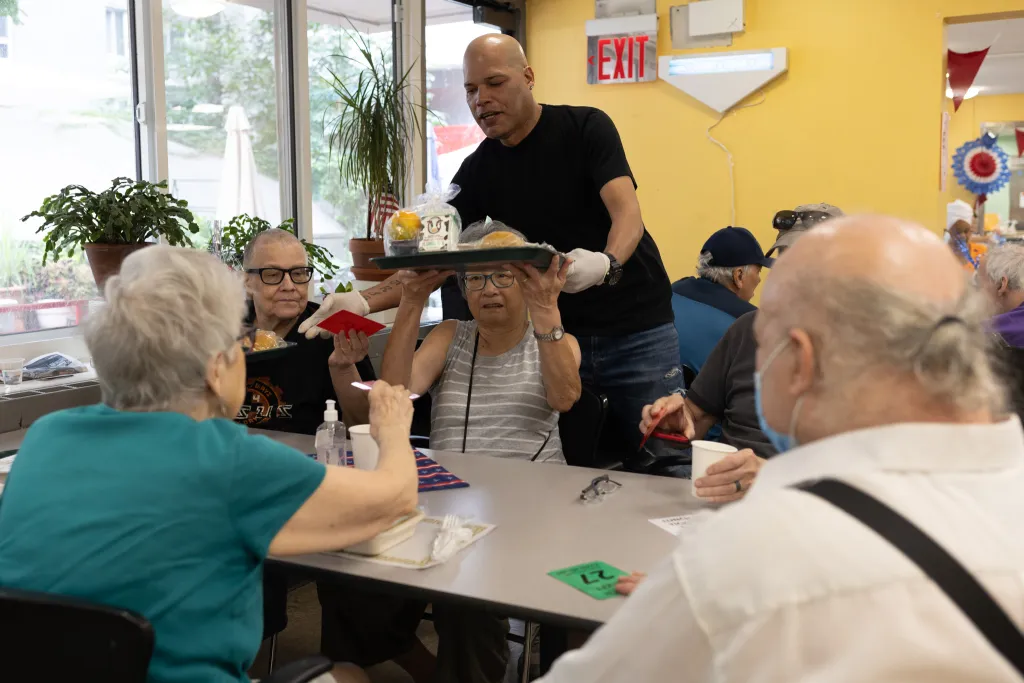
Every Tuesday, the Encore Aging Through Arts Center in Midtown bustles with activity and laughter as seniors sit at round tables, pen and paper in hand, playing bingo.
This is no accident. On Tuesdays, the center serves its weekly plant-based meal, which the city has required at all its senior centers since July 2023.
Worried about low attendance due the meatless offerings, Encore has sweetened its Tuesday pot with the popular game of chance.
It works well. Yakov Keiserman, 72, a self-professed bean-hater who does not usually eat the vegetable-based meals, is now a regular customer.
“If there is bingo, I’ll make sure I try to come,” he said. If there are beans for the main course, Keiserman passes them down the table to somebody else.

“We did pick Bingo Day on purpose because we weren’t sure how it would be received,” Jennifer Asquino, the director of the center, said. “But we know a lot of people come and would at least try it.”
Three years after the Eric Adams administration required senior centers to serve one plant-based meal a week, many venues across the city have built workarounds like Encore’s bingo gambit to combat low attendance.
An analysis by The City Reporter of a year of meal service records from the Department for the Aging, covering 309 centers, found attendance drops sharply at some centers on plant-based days.
Mandatory Meatless
The Department for the Aging began requiring the weekly plant-based lunch in July 2023. An internal memo obtained by The City Reporter at the time told centers they would need to provide at least one plant-based meal a week to New Yorkers over 60 who eat at centers or receive meal service at home. The memo allowed the plant-based entrée to replace the weekly vegetarian meal centers were already required to serve.
For the meals to be compliant, the main protein source must be a minimally processed plant-based protein, but the meal can still contain a small amount of dairy or eggs. Every lunch the agency funds also is served with a cold pack of milk, juice, bread, butter and fruit.
The City Reporter compared each center’s average lunch count on its plant-based day against its average count across the other four weekdays, according to data in the Department for the Aging’s report for fiscal year 2025.

At the Carter Burden Network’s Roosevelt Island Center, Wednesday, the plant-based day, is the lowest-attended lunch of the week. Wednesdays averaged 58 lunches served through fiscal year 2025, against 67 on Tuesdays and 68 on Fridays. Lisa Fernandez, who directs the center, said: “It’s definitely because of the vegan meal.”
This pattern repeats at many older adult centers across the city. At the Chinese Planning Council’s Chinatown Neighborhood Senior Center, Wednesday lunches fall by 26% when the green meal is on the menu, roughly 66 fewer meals a day at a center that otherwise feeds more than 250. (Seniors typically leave a $1 donation for each meal.)
At Central Harlem’s Beatrice Lewis center, Tuesday, the day where veggie-meals are served, averages just 53 lunches served, half of a normal day. At its sister location, Central Harlem St. Nicolas, where the chosen day is Monday, attendance is also half of the weekday average.
‘A Cultural Thing’
One of the steepest drops is at the Linden Boulevard location of the Allen Community Senior Citizens Center in Jamaica, Queens, which rotates its vegetable-based meal day every week.
“On an average, for a regular day, we’re seeing 90 people,” Angella King, the director, said. “And when we have our vegan days, we’re seeing maybe 40, 45.”
She attributes the low attendance to seniors taking their business elsewhere on plant-based days. Alpha Phi Alpha, Rochdale and Allen Community Rockaway Senior Center are all in the same area, and members will often drive or take the bus to go there, King said.
“When one program is serving the vegan meals, they just go to a program that’s serving a regular meal,” she said.
The sharp decrease could also be due to the demographic her center serves, King suggested. “The majority of our members are Black, Southern, or from the Caribbean,” King said. “It’s also a cultural thing.”
She has tried to offer a variety of menus on the plant-based days in an attempt to increase the numbers. “They just don’t go over well,” she said.
“Serving them like a bean stew or a falafel, it’s something that they would want to try,” she added. “But it’s not something that they want to have on a weekly basis.”
Kitchen Karma
A few centers, on the other hand, see no meaningful dip in attendance on veggie-based meal days. One common trait they share is that they have their own kitchens to cook the food fresh on site and adapt to the tastes of their members.
The Chinese Planning Council’s second Chinatown center, Open Door Senior Citizen Center, is one such example. Its plant-based Thursdays, during fiscal year 2025, served on average 248 lunch units, only a slight drop from Mondays at 253 units or Tuesdays at 257 units.
Po-ling Ng, who directs the center, said she runs a purchasing operation built around seasonal vegetables preferred by her members, who are almost entirely of Chinese origin.
For example, she knows that her members enjoy bitter melon, a squash-like vegetable common in Chinese cuisine, and tracks its price so she can procure it for the vegetable-meal days. “When it’s cheap, we try our best to give them what they like to eat,” she said.

Jennifer Asquino, at Encore, said it is important to have a kitchen that can adapt to members’ feedback and tastes. When seniors complained about too many beans, the kitchen cut back. When they asked for potatoes, they got potatoes.
“I think that for some people, they hear plant-based or veganism, and they immediately make certain assumptions that the food won’t be good,” she said. “Some of those concerns were addressed just by producing good food.”
The approach is paying off. Encore said it serves 143 meals on plant-based days, just slightly below the average of 156 on normal days.
Lisa Fernandez at Roosevelt Island Center said one of her limitations is that she does not have a kitchen on-site. Her meals arrive flash frozen from a sister site on East 74th Street. While the sister location that cooks can offer alternatives on the days vegan meals are served, such as a black bean veggie burger or a salad, “We don’t cook here,” Fernandez said. “The other locations that do cook on site…have bigger options than we do. We don’t have the option because we just have a catered meal.”
‘Schmaltz Up the Food’
Seniors interviewed by The City Reporter said the plant-based meals are simply too bland.
Louella Streitz, 71, a volunteer at the Roosevelt Island Senior Center, started running monthly cooking demonstrations after seeing some members leave their vegetables uneaten. She serves kale, broccoli rabe, blue oyster mushrooms from the farmers market, plated with color and served by hand to an eager clientele.

“The issue is how you serve it and how you cook it,” Streitz said. “It’s not just boiling it and dumping it in one corner of a platter.”
Cary Gibbs, 80, has come to Encore for about a decade and did a 30-day vegan challenge that he said he enjoyed enormously.
“Many seniors have issues with cholesterol, blood pressure, heart, certain things,” he said. “So having a good intermix of vegetables and veggie meals is a very healthy idea.”
However, it takes a little extra for him to enjoy the plant plate. “You have to schmaltz up the food,” he said, “It’s a little bland, so [I bring] my homemade horseradish and my hot sauce.”

Asked whether he was serious, he fished a bottle of hot sauce and a translucent jar of horseradish from his bag as proof.
“You think I’m kidding? Why would I lie?”
Holly Lundberg, 84, a vegetarian who was eating at the Roosevelt Island center for the first time, arrived at the same conclusion within one lunch.
“It doesn’t have enough salt,” she said. “I’ll bring my own salt next time.”
‘It’s Not a Choice’
Across two dozen interviews at older adult centers, The City Reporter found that the complaint is less that diners dislike plant-based meals and more that the seniors felt the city shouldn’t take away choice in their diets.
“I’ve been to other senior centers where they have a meal apart from the regular,” said Hermando Reyes, 76, a long-time customer at Encore. “Here, it’s just one choice for the day. If it happens to be vegetarian, good for the vegans, but it’s not a choice.”
He also pointed out that many seniors who come to Encore do not have the option of eating somewhere else. “Maybe they can’t afford a meal, so they eat whatever is there,” Reyes said.
Eileen Casey, 84, who spent her career in Broadway musicals and now dines at Encore, said she liked the food.
“They’re healthy, and you know you can’t have meat every day,” she said. It also, she added, keeps her weight down.
Asquino, the director of the Encore Midtown center, said a plant-based option should be available every day. “We would love to give them the options to eat the way that they want to eat,” she said.
Kevin Kiprovski, director of public policy at LiveOn NY, which represents roughly 110 nonprofit aging services providers across the city, said the requirement around food is a question of undue authority rather than nutritional advice.
“It’s an incredible amount of power to decide when people eat and what they eat,” he said. “They should be centered in the decisions about their own lives as much as they possibly can.”
Former Mayor Eric Adams credited a vegan diet with reversing his Type 2 diabetes and, in addition to imposing the requirement on the city’s senior centers, pushed the city hospital system and schools to serve more plant-based meals.

Whether the Mamdani administration will keep the requirement is unknown. When asked about the issue of low attendance rates on plant-based days, city Aging Commissioner Dr. Lisa Scott-McKenzie said in a statement that overall attendance has gone up since July 2023.
Senior centers served 5.5 million meals in fiscal year 2023, 6.1 million in fiscal year 2024 and 6.4 million in fiscal year 2025, according to city data. “During the same period, the number of average daily participants at older adult centers also increased from 24,545 in fiscal year 2023 to 27,456 in fiscal year 2025,” Scott-McKenzie said.
Keiserman, for his part, is not looking for nutritional guidance from the city.
“I like my sweet tea,” he said. “And I’m 72. And there’s nothing wrong with me.”
Our nonprofit newsroom relies on donations from readers to sustain our local reporting and keep it free for all New Yorkers. Donate to THE CITY today.
The post ‘BYO Hot Sauce’: Senior Centers Struggle With Mandatory Plant-Based Meals appeared first on The City Reporter.
