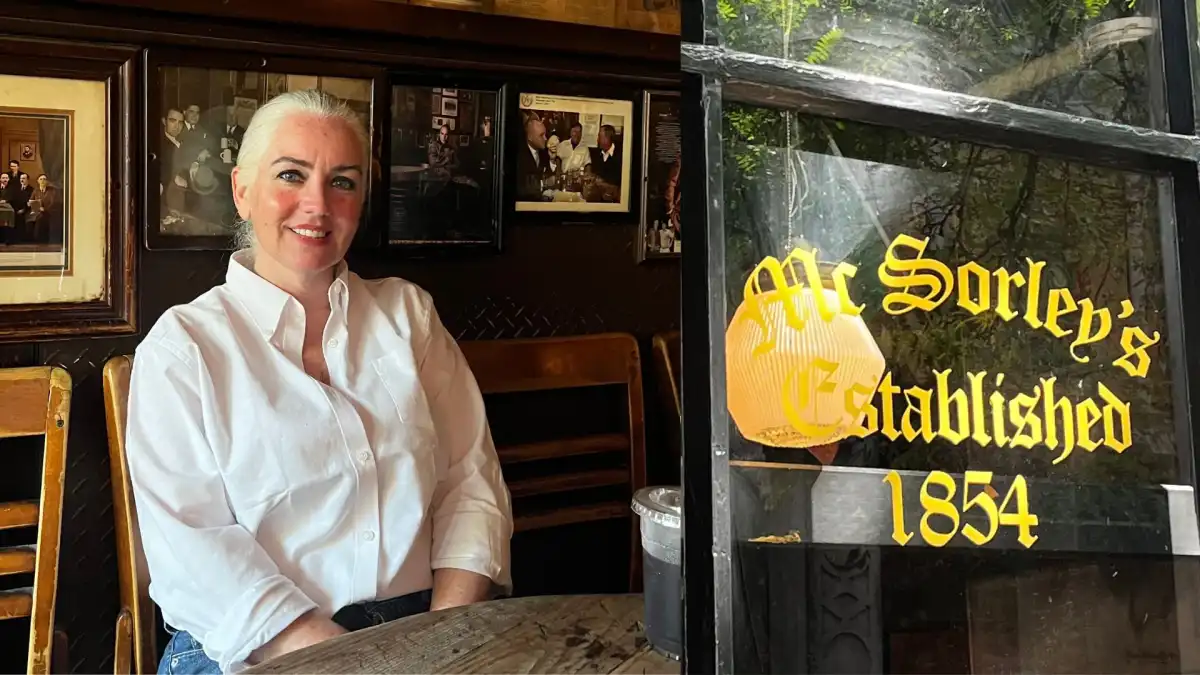
Teresa Maher de la Haba is the first woman ever to be the bartender at McSorley’s Old Ale House, a historic dive bar located in New York City’s East Village.
Women were, infamously, not allowed to enter McSorley’s until 1970, when the law made it compulsory for them to change. A year prior, two lawyers, Faith Seidenberg and Karen DeCrow, had been turned away from the establishment. They sued, arguing that a bar with a public license couldn’t just shut the door on half the public. The fight paid off a year later when Mayor John Lindsay signed a bill outlawing sex-based discrimination in public spaces, bars included, and the men-only era at McSorley’s was over.
I met Teresa on a Sunday morning inside the bar. When I walked in, she was lining up empty beer mugs on the counter, preparing for the doors to open at noon. We were to have coffee together, but we had not discussed where. Which is why she found me hovering awkwardly near a table, tracing lines with my feet on the sawdust-strewn floor.
“You can sit down. There’s a really cute bakery right around the corner. But it could be crowded. So I thought we could talk here. Would you like a coffee, latte, tea, pastry?”
I liked the idea of having coffee at a 172-year-old bar, which serves ale, and ale alone when it comes to alcoholic beverages. Well, there are two options: dark and light ale. I asked for whatever she wanted from the cafe. She requested her son Sebastian to get two black coffees and pastries, or whatever he felt like, “something simple!” He would head out once he was done clearing the leaves at the entrance. Sebastian is 21, a recent college graduate, and works part-time at McSorley’s.

“Simple” also seemed to describe her presence as she spoke about her life—matter-of-fact, pragmatic, cautiously candid.
Teresa would “probably be somewhere in fashion,” if she wasn’t tending the bar. She worked in clothing stores every weekend from age 16 to 24. She has been at McSorley’s for 32 years now–long enough to know that she wouldn’t trade it for anything. These days, she actually loves not having to think about fashion at all. “That’s the funny thing about this job. I wear a white shirt, my jeans, a garbage bag when I’m behind the bar, and waterproof boots. I pull my hair back. It’s been my shtick forever,” she laughed as she settled down.
The old amber light above us made her glow, her white shirt, white hair, and dark eyeliner standing out in the warmth of the room as she sat against a wall covered in history. Framed black-and-white pictures of presidents, soldiers, and famous patrons held time still. We were sitting at the third table in the barroom. I was facing a back room, which felt like a continuation of the bar – one long room, divided by a wide, doorless frame. Beyond it, the light softened, the walls looked heavier, and the air seemed thicker with history.
Teresa seemed to fit right in: a woman holding together a piece of New York City’s history that has refused to change.
Her father, Matthew Maher, known around the bar as Matty, took over McSorley’s from the previous owners in 1977. Matty first joined as a bartender and later became the manager. Teresa followed suit: She became the owner after Matty passed away six years ago, when he was 80, and she was 46.
She told me there’s nothing she would change about her childhood. Her parents moved to the US from Ireland. They met in New York City. By the time she was born, Matty was working as the night manager at McSorely’s, and they were living in the apartment above the bar. Soon, they moved to Maspeth, Queens, where she grew up, the second of five daughters. Teresa graduated with a Liberal Arts degree from Stony Brook University. “ I didn’t have a high GPA, if that’s what your next question is. I just graduated,” she laughed.

As we talked, I kept coming back to her legacy as “the first woman bartender at McSorley’s”. She seemed to realize that I had walked in expecting a conversation with a feminist icon who revolutionized the gendered identity of the place. She was comfortable, even adamant, admitting that she isn’t. When I continued to dwell on it, she shrugged – she is just her father’s daughter. “I am a hard worker, and I loved working for the family.”
Until she was in college, Teresa didn’t realize that her father owned a historic institution, or that McSorley’s was famous. “The way people talked about it, you would think McSorley’s took up all of 7th Street and was ten stories high.” All she saw in it was a second home. She would visit the bar with her sisters on weekends as a kid, and if it wasn’t too busy, Matty would set them up in the back room with a burger and a soda.
She was only one year old when the lawsuit happened. Did her mom ever bring up the woman’s issue? “She probably didn’t care that she couldn’t come in during the early days. She probably liked the fact. She did go in to do the books sometimes. She’d make her presence felt, but would never want to spend time at the bar. You know what I mean?”
Teresa says that a lot: “You know what I mean?” She doesn’t always wait for an answer, but this time, she could tell that I didn’t know what she meant. So she explained, “It was a different time.” When she was young, Teresa and her family would go to Ireland every summer. They would visit bars to meet extended family members. “And we always sat in the lounge area, not inside the bar. I am not saying we weren’t allowed, but it never dawned on me to ask my dad why I couldn’t go in with him. I just wasn’t defying in that way.”
And still, when Matty first offered her the job after college, she hesitated. She had grown up imagining McSorley’s as a man’s space–not in a way that bothered her, but just as a fact. “ I never thought I would actually work behind the bar. Maybe the floor. Maybe the kitchen, but never there,” she said, pointing at the bar counter. But she remembered Matty always nudging her and her sisters. “ One of you girls should learn the business.” Teresa gave in as an experiment and began by taking weekend shifts in the kitchen for a year.
Would he have pushed her towards the job if she had a brother? All she knows is that her father convinced her with one statement: “If anybody asks what you’re doing, just say you’re about your father’s business.” And that’s what she has been doing. “He always had my back,” she said.
When asked about women in his bar, Matty, in a 1987 documentary called ‘McSorley’s New York’, said, “I think McSorley’s arrived at a stage where women became a challenge. And I think it was a marvelous space to be able to observe what it was presented with. Because it wasn’t prepared for a women clientele in any aspect of the place, and I think, again, McSorley’s provided what it needed at that particular time. We are still here.” I saw him reflected in Teresa’s commitment to keeping the doors open and in the indifference with which she occupied a place once unimaginable for women.

Her first shift as bartender was on February 4th, 1994. “I was 24. Wait 25. Oh, 24. Well, I started a long time ago,” she laughed.
McSorley’s was immortalized in Joseph Mitchell’s 1940 profile in The New Yorker titled “The Old House at Home.” Teresa read it a long time ago, but does not remember much. She does remember his description of the walls adorned with pictures, newspaper clippings, quotes, and wishbones. Much of it still looks the same. Teresa seems as comfortable as all past owners with the tradition of keeping the place frozen in time. Her favorite thing on the wall, unsurprisingly, is a photo of her with her dad from 1999. “We are both holding 16 mugs of ale.”
The bar’s slogan, since 1854, is “Be Good or Be Gone.” If Teresa had to choose her own slogan, it would be “A Family Affair,” she told me after thinking about it for a good two minutes. The place has been defined by families. Hers is the third one to own it. Most of the staff is family– cousins, uncles, a brother-in-law, Teresa’s husband, her son–everyone works in shifts. She’s typically there from Wednesday to Saturday. “They have all been here for 30, 40, 50 years. One guy, Peppy, grew up across the street in that red building,” she pointed. “I love the history of the place. I love the connection I feel with my dad when I am here. Many of the old-timers have known me since I was little. That’s what made it easy working here.”
But there used to be customers who, after seeing a woman behind the bar, would ask, “Do you even understand the history of McSorley’s?” Teresa never took that to heart. She was about her father’s business, after all. There were days when she would be the only woman in the bar. “ But this is like my second home, so it didn’t faze me.”
Our conversation drifted back to her early days when Teresa met her husband at McSorley’s, just a year after she started working. Gregory De La Haba was an art student who used to hang out with other artists at McSorley’s. “One day, the old timers were joking,” she remembered, laughing with her eyes. “They said my portrait should be on the wall, just like there’s one of John McSorley,” she pointed at a small frame under an orange light of the man who started McSorley’s.
Matty took the joke seriously. He asked Gregory to work on a portrait of Teresa, and that’s how they met. She used the phrase “got involved,” blushing so deeply it showed through the blush she was already wearing. Her husband now works at the bar on Fridays and Saturdays.
“Who is Teresa when you are not at the bar?” I asked. She gave me her awkward shrug and a laugh before talking about the hats she has worn over the years. “I am a wife. And a mother. Being in the bar business and the art business for my husband, raising two boys, it’s a lot of work. I think I have an interesting life and I work for what I want.”

She enjoys the solitude of her home in Queens. Most of her leisure time is spent there, relaxing with her family, enjoying the food cooked by her family (“I am not a cook. I have three good cooks at home”), visiting her mom who lives in the same neighborhood as her, sometimes visiting an art show, and running errands. “Work is work,” she said. A mantra among the many tools of the business which, in hindsight, she absorbed from her father. “ Keep it in the now; do what you can; keep the doors open; wear a loose shirt and when you walk in, go to work,” he used to tell her.
Her biggest fear is that the building is old. “Even though it’s in good shape, we try to maintain the best we can. Keeping up a building in the city is expensive.” She is grateful that they own the business. Each owner had the opportunity to buy the building when they bought the business, and her dad did that. Her dream is that the place will continue for the next hundred years. “We have a joke among the staff–would we need a small table or a big table at the 200th anniversary? Who all will be around?” she laughed. “ I just wanna keep the McSorley name and this place. There’s only one McSorley’s, and it’s 15E 7th Street.”
During our conversation, Teresa remained protective about some details of her professional life. “There have been a couple of problems, but I’d rather not go into them because I think certain things are best kept; you know, everybody doesn’t need to know.”
Would the place stay in her family? “We’ll see,” she said. Her elder son, Matthew, is in the Navy. And though Sebastian loves working there, she doesn’t want to push him. “I just throw ideas at him,” she laughed. Matty always said, “McSorley’s finds what it needs,” and she believes that.
Sebastian was back again. “You’re ready?” he asked. Teresa looked up at the wall clock, which appeared as old as the place. “Oh, my God! It’s already five to twelve. My bad! I gotta go,” she walked behind the counter while Sebastian opened the door. By the time I came back from the restroom, the first three customers were already seated. Two more were at the bar asking Teresa about the ales.
She stopped me before I left to show me pictures on her phone. There was Sebastian when he was nine, behind the bar. “It was child labor,” he joked on his way to serve a table. There was that picture of her with Matty holding 16 mugs of ale. And there was the portrait of hers painted by Gregory. She was in her uniform–white shirt, black hair pulled back, no smile. Why wasn’t the portrait on one of the walls? “Well, some things should stay at home,” she smiled.
